

Shopify and Square are two of the biggest names in ecommerce and point-of-sale — but they come at selling from slightly different directions. In this post, I’m going to highlight the strengths and weaknesses of both platforms, and help you decide between them.
Quick Verdict
If you want to sell online AND in person, Shopify wins. Its store-building tools are considerably more powerful than Square’s, it gives you far more design options and integrations, and its features for international selling, dropshipping, marketing and SEO are all stronger than the Square equivalents. Its POS system is tightly integrated with its ecommerce setup, and broadly comparable to Square’s in terms of quality.
Square can make more sense when in-person selling is the bigger priority. It lets you start selling without a paid subscription, can technically be used in more locations, and gives you access to convenient “all-in-one” POS registers that don’t require iPads to work. It also provides restaurant-specific features that you won’t find in Shopify; these make it a more obvious choice for catering businesses.
Just bear in mind that Square’s paid POS plans are priced per location, so for very large retail operations, the Shopify Plus plan — which includes 20-200 POS Pro locations, depending on the payment processor used — can actually work out significantly cheaper than Square.
I’ll start my deep dive into both platforms with a look at the reasons to use Shopify, and then I’ll spell out the areas where Square might work better for you.
Reasons to use Shopify over Square
1. Its store-building features are considerably stronger
The biggest argument for choosing Shopify over Square is simple: it’s a much more powerful store builder.
Square certainly lets you build an online store, and its selling tools cover the basics fairly well. But Shopify gives you a much deeper set of features for managing, marketing and growing one.
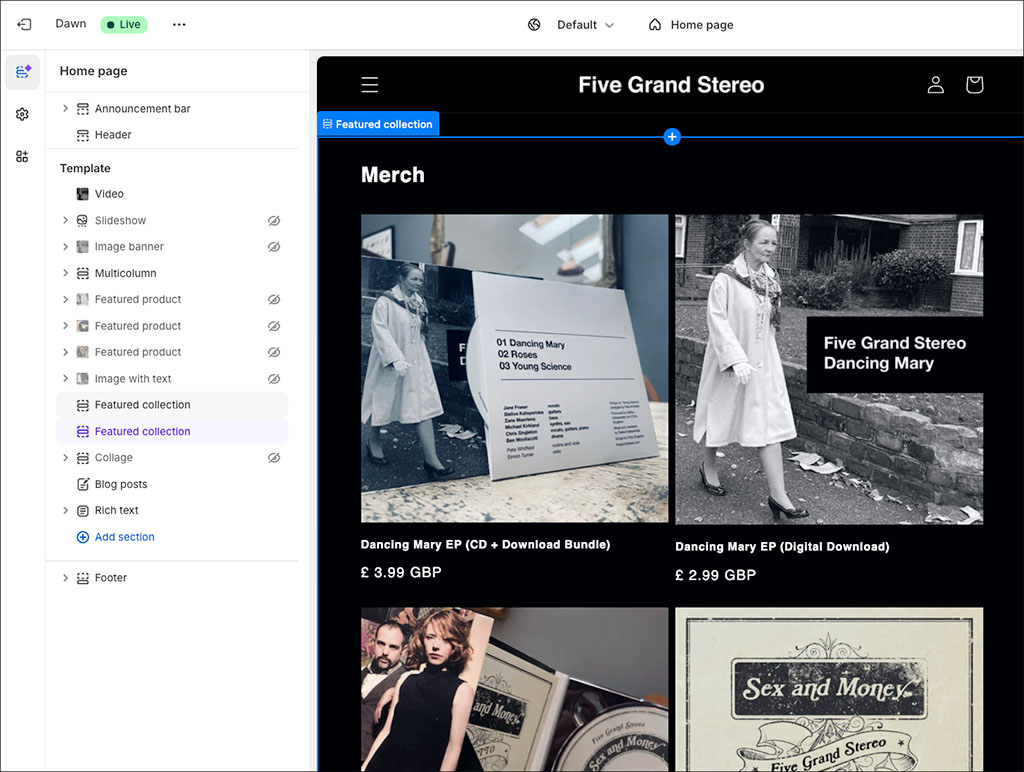
This becomes particularly noticeable when you start needing more sophisticated functionality — things like advanced shipping, international selling, dropshipping, digital-product delivery or extensive third-party integrations. Shopify outshines Square in all these areas — yet still has a POS system that’s comparable in most respects.

It also gives you access to more comprehensive shipping options, and more powerful email marketing and abandoned cart saver tools.
So, if your aim is to build a substantial online business rather than simply add an online store to an existing brick-and-mortar operation, Shopify is the more natural fit. You give up relatively little on the POS side, while gaining considerably more online selling functionality.
2. It gives you a much bigger choice of store designs
Shopify wins comfortably when it comes to both the quantity and quality of store templates.
At the time of writing, I counted over 1,200 themes in Shopify’s theme store, while I could only find 34 templates available for Square. Shopify’s themes are also generally more ecommerce-focused, with a wider range of layouts, product presentation options and visual effects available.
In practice, I’d say Square’s limited template selection matters less to businesses whose website is mainly there to support a physical operation. But if the website itself is a major sales channel, Shopify’s extra design flexibility becomes much more important.
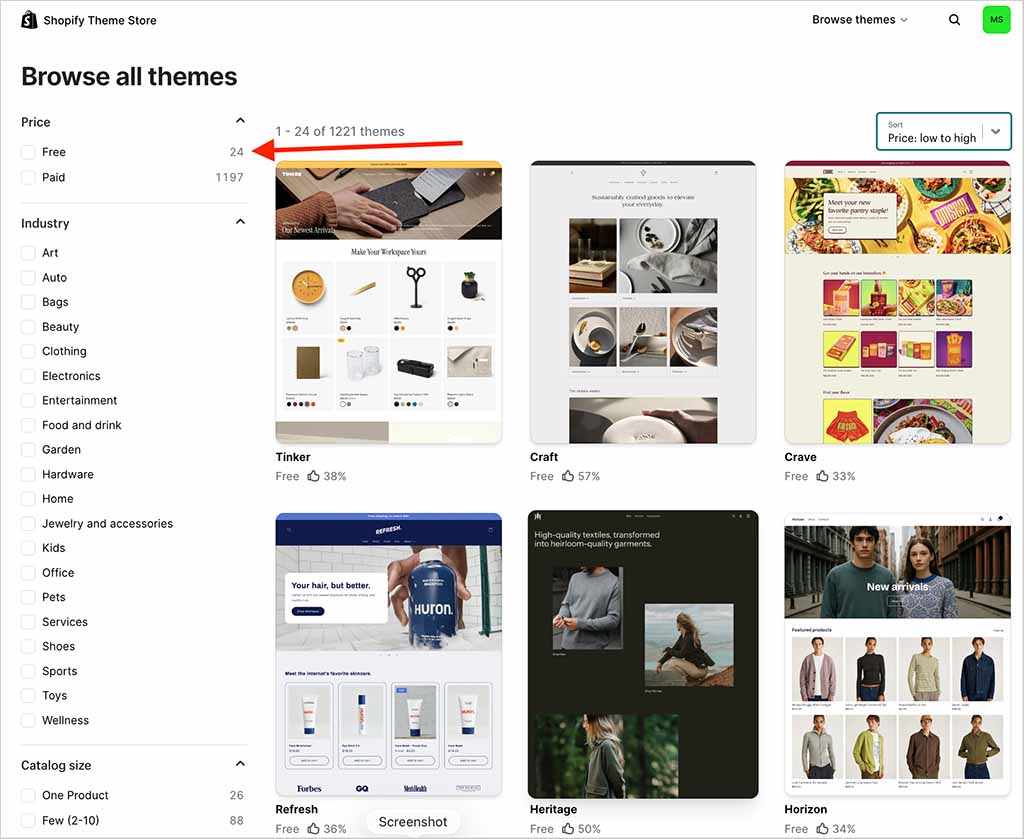
And speaking of flexibility, you also get much greater control over your site design with Shopify. Its editor provides more customizable sections and unlike Square, Shopify gives you extensive access to your theme’s code.
Square’s editor arguably has an advantage when it comes to ease of use — I found editing content directly on the page more straightforward in Square than in Shopify — but ultimately, Shopify gives you considerably more scope for creating a distinctive, highly customized online store.
3. It’s much better for international selling
If you intend to sell internationally, Shopify is a much better choice than Square.
While Square only lets visitors see product prices and check out in one currency, Shopify facilitates full multi-currency selling. This is thanks to its “Markets” feature, which lets you create different markets for different countries and regions — and automatically show product prices in local currencies.
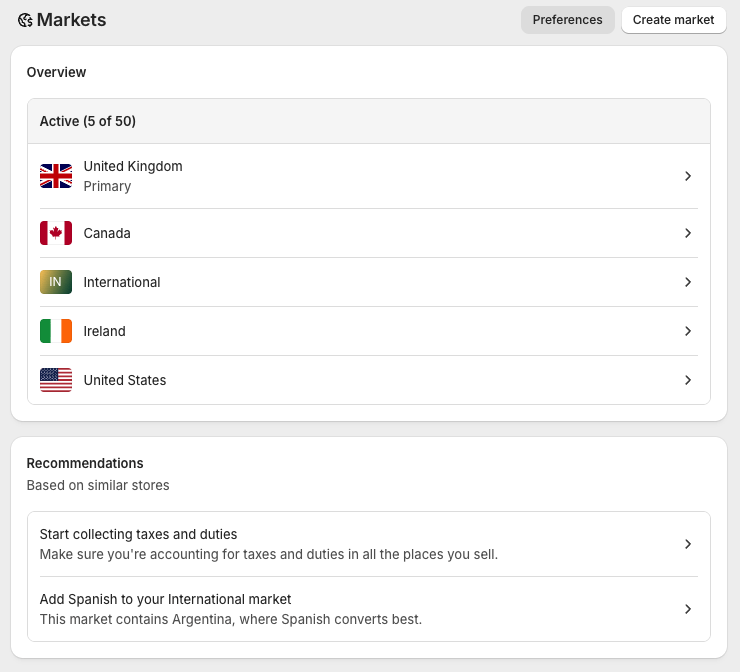
Shopify also provides much stronger multilingual functionality — it lets you translate a store into up to 20 languages on its regular plans (30 on Shopify Plus), without the need for any paid-for translation apps. With Square, you have to use the Weglot app to translate a store. This is good at creating automatic translations, but it can be expensive.
Shopify also wins when it comes to tax calculation: it provides automatic tax calculations in a wide range of territories (and caters well for the EU’s quite complex IOSS VAT rules), while Square’s automatic tax calculation features are restricted to merchants in the US and Canada.
So, if you’re targeting customers in multiple countries, Shopify is the better choice.
4. Its app ecosystem is vastly bigger
One of Shopify’s greatest strengths is its app store. There are 21,000+ apps available in it; by contrast, you’ll find just 500 apps in Square’s marketplace.
This means there’s usually an app available for Shopify if you need to add functionality that the platform doesn’t provide out of the box. A vast range of tools are available that let you add advanced product customization features, email marketing, accounting, dropshipping and subscriptions to a Shopify store.
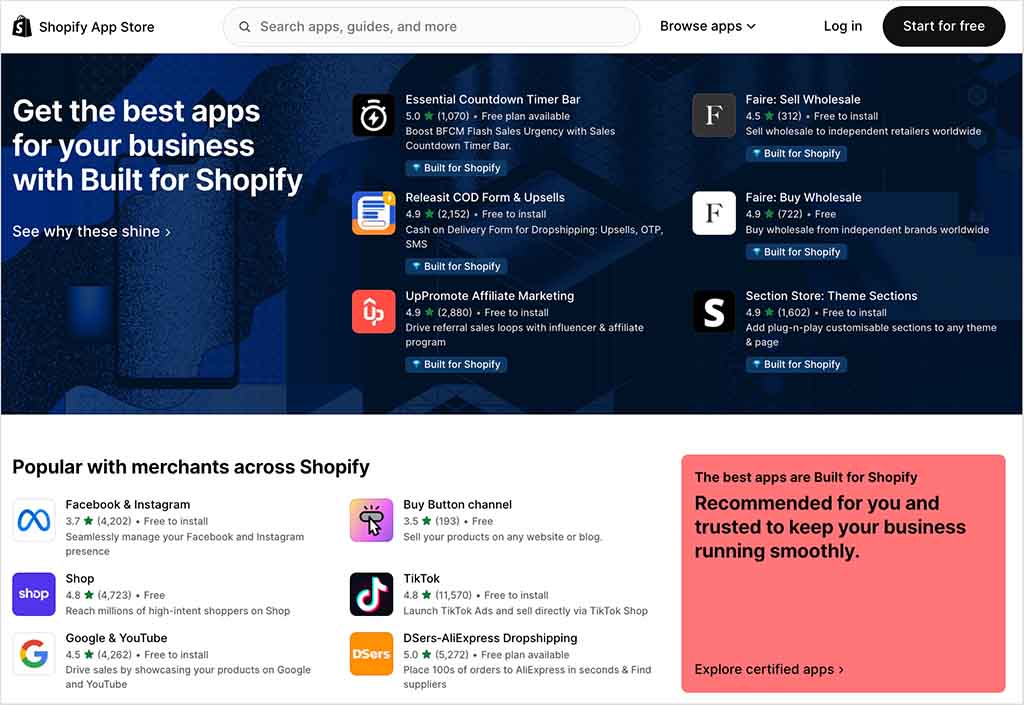
Square does provide a decent range of integrations, and its app selection is particularly strong for restaurant and food businesses. But ultimately, Shopify gives you far more options for adding interesting features to your store.
5. It’s a much better choice for dropshipping
Shopify is one of the strongest ecommerce platforms available for dropshipping.
At the time of writing, I found over 1,100 dropshipping-related apps in the Shopify app store, facilitating integrations with all the major players in the dropshipping industry. By contrast, Square works with just a few dropshipping suppliers.
To get a sense of how dropshipping with Shopify works, you can watch our video guide to dropshipping with the platform below.

To be fair, these include some well-known services, including Spocket, DSers and Printful. But Shopify gives you a much wider choice of suppliers and specialist dropshipping tools.
So if dropshipping is central to your business model, I’d choose Shopify over Square.
6. Selling digital products is easier with Shopify
Shopify is considerably better than Square for selling downloadable products like ebooks, music, artwork and digital courses.
Its free Digital Products app makes it very easy to sell digital goods and automatically deliver files after a purchase is made (file sizes of up to 5GB are supported, and apps are available that handle bigger files or more complex selling).
Our video guide below explains how selling digital products on Shopify works.

Square lets you list digital products on your store too, but it doesn’t automatically deliver purchased files. This means manually sending customers their downloads — something that can quickly become impractical if you start selling a high volume of digital products.
7. It’s better for SEO
Both platforms handle the ecommerce SEO basics well, letting you edit page titles, meta descriptions, headings, image alt text and URLs.
Shopify goes further, however. When you change a URL, it can automatically create and activate the appropriate redirect — something that requires more manual setup in Square. It also provides a web-performance dashboard that helps you monitor Core Web Vitals (Google targets for site speed and stability — sites that meet them can receive preferential treatment in search).
Add its stronger blogging functionality into the mix and Shopify is the better of the two platforms from an SEO and content-marketing perspective.
OK, so those are the key reasons I’d use Shopify over Square. Now let’s take a look at where Square wins.
Plan
Pricing per month (USD)
Basic
$39
Grow
$105
Advanced
$399
Shopify Plus
From $2,300/mo
Reasons to use Square over Shopify
1. It lets you sell in person for free
Square’s most obvious advantage is price. Unlike Shopify, it gives you access to both its POS system and online store builder for free.
(Credit card processing fees do apply, of course, but there are no monthly subscription fees to worry about.)
There are limitations to Square’s free online store, however — you can’t connect your own custom domain to it, and it features Square advertising. But it still gives you a quick way to start selling online without committing to a monthly software bill.
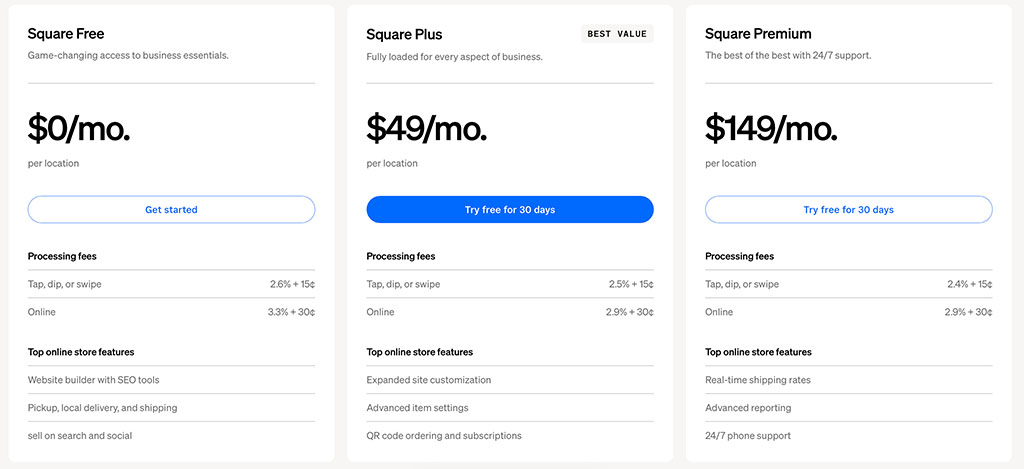
Square’s “free” offering is probably more attractive if most of your sales happen in person, however. It lets small shops, market sellers, cafés and service businesses start selling on their premises without worrying about upfront costs.
By contrast, Shopify requires a paid subscription once its trial period ends. Its main full-store plan, “Basic,” costs $39 per month.

2. It supports more business locations (but keep an eye on costs)
Square can be a better fit if you need to operate across a particularly large number of physical locations.
A single Square account lets you sell in up to 300 inventory locations. By contrast, Shopify’s Basic, Grow and Advanced plans support just 10. The enterprise version of Shopify, Shopify Plus, raises this limit considerably — to 200 inventory locations — but that’s still less than Square’s limit.
However, depending on the number of locations you need POS for, and the Square plan you’re using, you might find that despite its $2,300-per-month price tag, Shopify Plus can work out cheaper for you. This is because Square charges per location — and its paid POS plans cost $49 (Square Plus) or $149 (Square Premium) per month.
In other words, 200 Square Plus locations will cost you $9,800 per month, while Shopify Plus gives you access to pro POS functionality for the same number of locations at around a quarter of the price.
(Note, however that you must use Shopify’s own credit card processing service, Shopify Payments, to take advantage of this 200 location limit — if you don’t, your bundled POS Pro location limit drops down to 20, and additional locations are chargeable).
That said, you can use Square’s free POS offering at up to 300 locations too — the catch is that the free plan doesn’t give you access to many of the tools you’ll likely need if you’re running a multi-location retail operation (more sophisticated staff management and inventory reporting features, loyalty programs, etc.).
3. Its POS hardware is particularly well suited to physical businesses
Both Shopify and Square offer a good range of POS hardware, including card readers, terminals, barcode scanners and cash drawers.
But Square’s hardware offering is more “all-in-one” in nature. It lets you make use of a register that combines a touchscreen POS system and customer-facing display in a single setup.
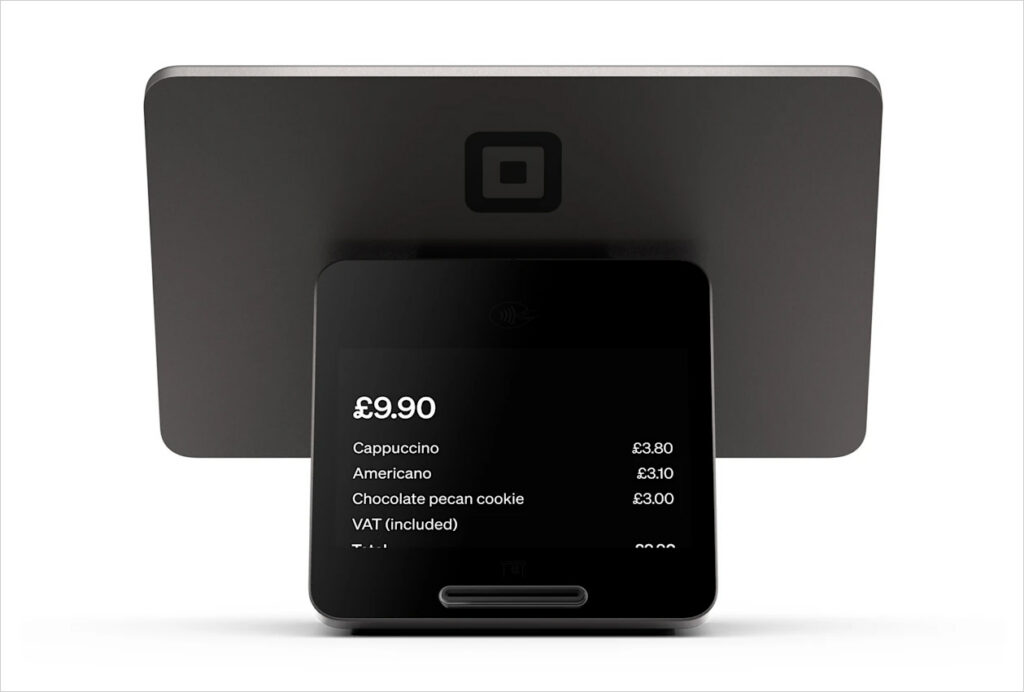
For a full counter-based register Shopify setup, you’ll typically need to combine its POS equipment with an iPad or Android tablet.
So, if you’re setting up a permanent checkout counter in a shop, café or restaurant, Square’s integrated hardware approach can make things a bit more plug and play.
(And, as I discovered after setting up a Shopify POS system, it will mean dealing with fewer cables.)
4. It’s an excellent option for restaurants
Square is particularly strong when it comes to restaurant and food-service businesses.
Its website builder includes a dedicated ‘Order Online’ setup designed for selling prepared food, with support for local delivery and in-store or curbside pickup provided too.
And its menu tools let you create menus by uploading an existing file or photo, or import them from platforms such as DoorDash. These menus can then be managed centrally and used across your POS system, online store, kiosks and delivery channels.
Square also provides restaurant-specific POS functionality, including table and floor-plan management, along with useful features such as order-ready and order-status text alerts.
So if you’re running a café, restaurant, takeaway or other food-related business, Square’s restaurant-focused ecosystem may make it a better fit for you than Shopify.
5. It’s a bit easier to use
Shopify and Square are both user-friendly, but after creating test sites with both platforms, I feel that Square has a bit of an edge over Shopify in the ease-of-use department.

Shopify’s interface is easy enough to get to grips with too, but it does have a slightly confusing workflow involving page editing: its drag-and-drop editor is primarily used for modifying page templates rather than page content. You have to edit page content in a slightly old-fashioned WYSIWYG text editor.
Square, by contrast, lets you edit page content directly and in a more straightforward way.
So, if simplicity is more important to you than having access to a large number of ecommerce features, Square is arguably the friendlier platform.
Square Pricing
Square website
- Free — $0 per month
- Plus — $49 per month
- Premium — $149 per month
Restaurant POS software
- Free — $0 per month
- Plus — $49 per month
- Premium — $149 per location per month
Retail POS software
- Free — $0 per month
- Plus — $49 per month
- Premium — $149 per location per month
Payroll software
- Pay contractors — $6 fee per person paid
- Pay employees — $35 per month plus $6 fee per person paid.
Key alternatives
Shopify and Square aren’t your only choices when it comes to ecommerce platforms and POS.
BigCommerce is perhaps the most obvious Shopify alternative. Its core ecommerce feature set is similar in nature, and it can integrate with several leading POS platforms. A key advantage of using it over Shopify boils down to its multi-storefront capabilities. To access multi-storefront selling capabilities with Shopify, you need to be on a $2,300 “Shopify Plus” plan, but BigCommerce lets you run multiple stores from a regular account.
Wix is a good option for small businesses that want an easy-to-use website builder that also provides decent ecommerce features and business tools (CRM, email marketing, appointment scheduling, etc.). It comes with a very large selection of templates and provides built-in POS functionality too.
Squarespace is a strong choice if presentation is particularly important. Its stylish templates make it an excellent option for portfolios, creative businesses and content-focused sites that need ecommerce functionality on the side.
User reviews
So far, you’ve heard my take on Shopify vs Square. But what do their customers think about these platforms? To find out I collated ratings from some popular software review sites (see table below).
| User review site | Shopify | Square |
| G2 | 4.4/5 (5,119 reviews) | 4.6/5 (1,208 reviews) |
| Capterra | 4.5/5 (6,700 reviews) | 4.7/5 (2,698 reviews) |
| TrustRadius* | 4.4/5 (700 reviews) | 3.8/5 (128 reviews) |
| Average score (out of 5) | 4.46 | 4.36 |
* Recalculated from an out-of-10 score.
As you can see, both platforms enjoy good ratings across the three review platforms covered, with Shopify edging it slightly (and based on a greater volume of reviews, too).
Final verdict
For businesses that want to combine online and in-person selling, Shopify wins.
It gives you far more control over store design, a vastly bigger app ecosystem, much better international selling features, stronger support for dropshipping, and more sophisticated marketing and shipping tools. And Shopify’s POS system is highly capable.
Square can make more sense when physical selling comes first. Its free entry point is a major advantage for smaller businesses, it lets you sell in more locations, its integrated POS hardware is particularly convenient for permanent retail locations, and its restaurant tools are considerably more specialized than Shopify’s.
However, Square’s location advantage comes with an important caveat: its premium POS plans are charged per location. This means that for very large multi-location businesses, Shopify Plus can actually work out cheaper — it gives you access to 200 Shopify POS Pro locations if you use its own Shopify Payments payment gateway to process card transactions.
Ultimately, if you’re mainly selling in person and want a low-cost, straightforward POS setup, Square is an excellent choice. This is particularly the case if you’re running a food or drink business.
But if you need a powerful online store alongside your physical retail operation — or you’re running a large, sophisticated multi-location business — Shopify is likely to be the better fit.
FAQs about Shopify vs Square
Is Shopify better than Square?
Shopify is better for businesses that mix online AND in-person selling. It gives you more sophisticated store-building features than Square, more templates and apps, stronger international selling tools and better options for dropshipping, marketing and SEO. It does so while still providing store owners with a very robust POS system. Square can work better for businesses that focus heavily on in-person sales because you can use it for free, it lets you sell in more locations, and it provides easier-to-manage “all-in-one” POS hardware.
Which is cheaper, Shopify or Square?
Square is cheaper to get started with because it provides a free online store plan and lets eligible businesses use its core POS software without a monthly subscription. Using Shopify always involves a paid subscription (once your free trial ends). However, if you’re selling in multiple locations, using Shopify can be more cost-effective, as its Shopify Plus plan lets you use its professional POS tools in up to 200 locations (Square charges a minimum of $49 per location for the premium version of its POS).
Is Square better than Shopify for restaurants?
Square can be a better choice for restaurants, cafés and takeaways. It provides restaurant-specific POS tools, food-delivery integrations, menu-import features, and the ability to create a simple one-page online ordering site.
Which is better for international selling, Shopify or Square?
Shopify is considerably better for international ecommerce. Its Shopify Markets functionality supports localized currencies and markets, while its multilingual and automatic tax features are much more sophisticated than Square’s.
Can I sell digital products with Shopify and Square?
Yes, but Shopify is the much better option here — unlike Square, it automatically delivers downloadable files to customers (via its Digital Products app). Square lets you list digital products on your store, but you’ll need to handle file delivery manually.

Chris Singleton is the Founder and Director of Ecommercetrix.
Since graduating from Trinity College Dublin in 1999, Chris has advised many businesses on how to grow their operations via a strong online presence, and now he shares his experience and expertise through his articles on the Ecommercetrix website.
Chris started his career as a data analyst for Irish marketing company Precision Marketing Information; since then he has worked on digital projects for a wide range of well-known organizations including Cancer Research UK, Hackney Council, Data Ireland, and Prescription PR. He then went on to found the popular business apps review site Style Factory, followed by Ecommercetrix.
He is also the author of a book on SEO for beginners, Super Simple SEO.