

Written by Chris Singleton based on research by Matt Walsh.
Riva review — quick verdict
Riva takes a different approach to AI visibility tracking than many competing tools. Rather than just monitoring brand mentions and citations, it analyzes how well AI systems can access and understand your website — and recommends changes that could improve its visibility.
Its main strengths are its detailed business analysis, actionable improvement recommendations and customizable visibility tests. It’s also reasonably priced and offers useful reporting features.
The main drawbacks are its ChatGPT-only coverage, relatively small query sets and occasionally overprescriptive recommendations. Its readiness scores aren’t a proven formula for improving AI visibility, either.
Our overall rating: 4/5
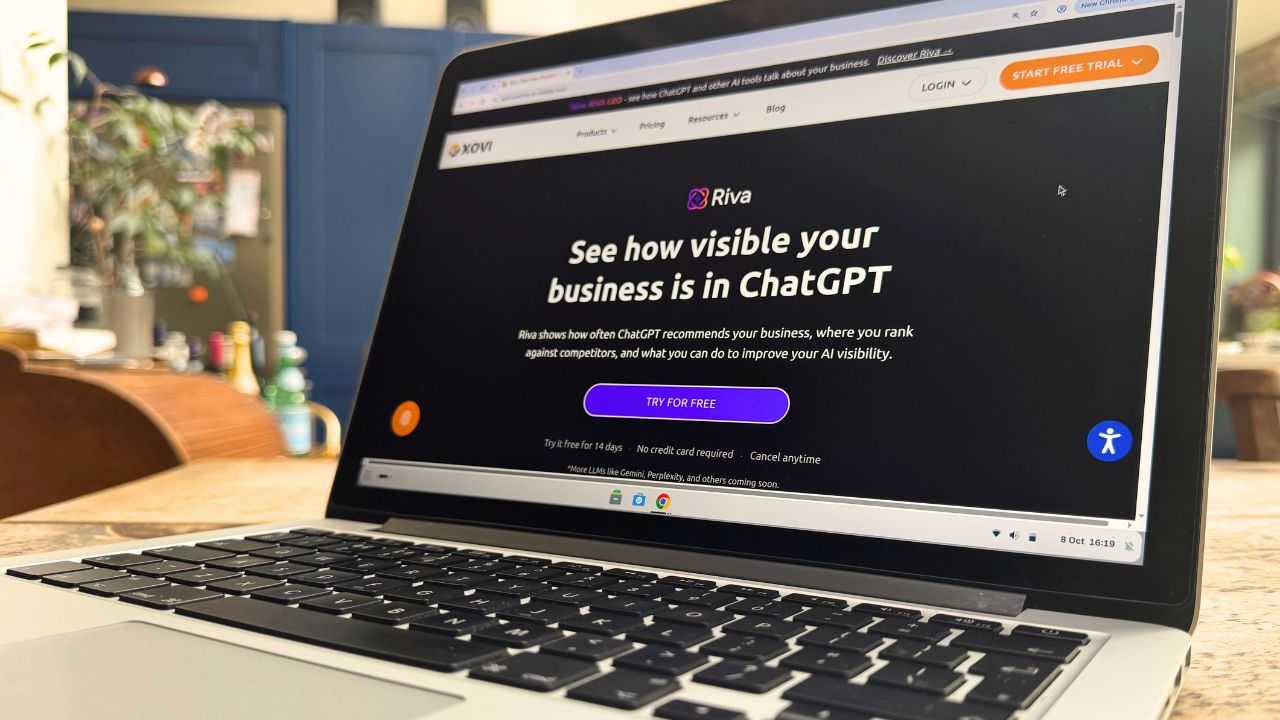
Riva is an AI visibility tool from XOVI (an SEO platform from WebPros). It helps businesses understand how well they appear in ChatGPT — and what they can do to improve their visibility.
But unlike many competing AI visibility platforms, which focus primarily on tracking brand mentions, citations and competitors, Riva takes a more diagnostic approach, looking at:
- whether AI systems can access your website or ecommerce store
- how clearly they can understand your business
- what changes you might make to improve your chances of being recommended in AI-generated answers.
But is it worth using?
To find out, we tested Riva on three very different websites: a content-led business site, an independent music site with ecommerce functionality, and a large international consumer brand website.
Riva’s approach can be summarized in three stages:
Access → Understanding → Visibility
First, it checks whether AI systems can access your website. Next, it examines how clearly your site communicates information about your business, audience, products and services. Finally, it tests whether your business appears when users ask ChatGPT relevant questions.
This approach makes Riva rather different from competitors such as Semrush, Ahrefs, Moz and Profound.
Those platforms generally emphasize broad AI visibility monitoring across multiple systems. Riva focuses more closely on diagnosing potential problems and suggesting improvements.
There is, however, an important limitation: Riva currently tracks visibility in ChatGPT only.
Support for additional AI platforms is planned, but hasn’t been launched yet.
How does Riva work?
Setting up Riva is straightforward. You enter your domain, and the platform starts analyzing your website.
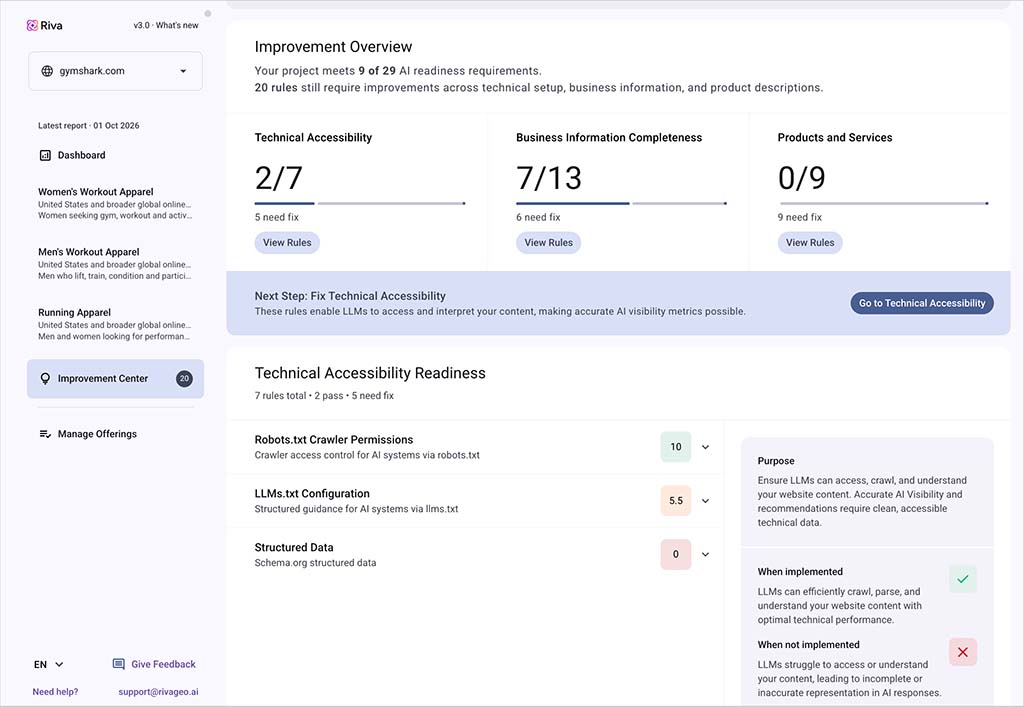
It begins with a technical accessibility assessment, checking areas such as robots.txt, AI crawler permissions, structured data and llms.txt configuration.
Next comes its “Business Information Completeness” analysis, which evaluates how clearly your website communicates your company name, address, target audience and geographic market.
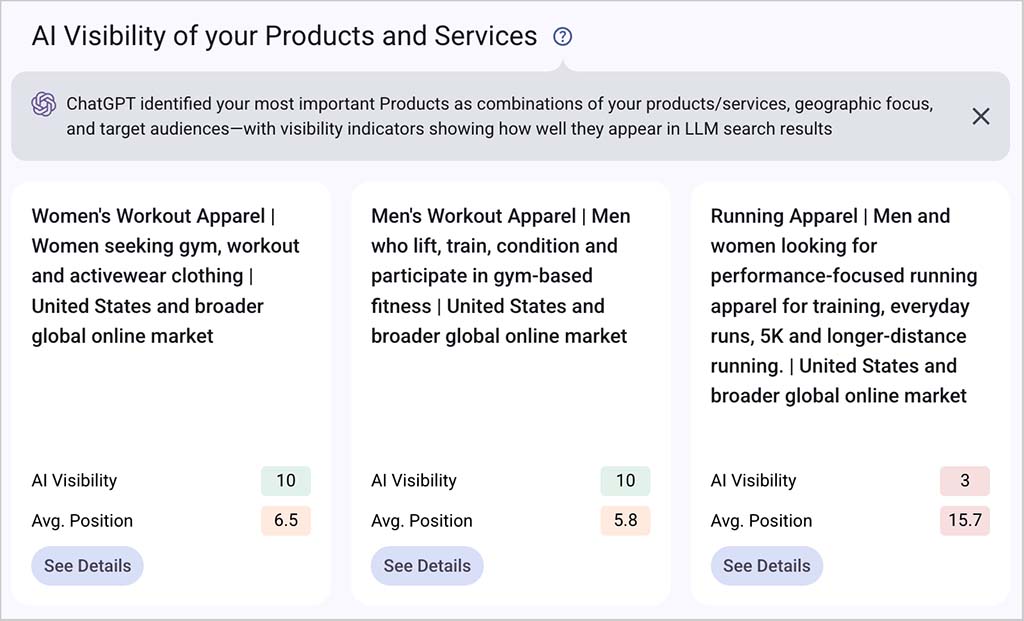
Riva then identifies up to three main products or services, which it calls “offerings.” For each offering, it automatically generates 10 questions that potential customers might ask ChatGPT.
These questions are used to calculate three key metrics:
- AI Visibility: an overall visibility score out of 10.
- Query Success: the number of test queries in which your business appeared.
- Average Position: where your business appeared in ChatGPT’s answers when mentioned.
Riva also identifies other brands and entities appearing in these responses.
Finally, it combines its findings in an Improvement Center, which highlights potential problems and recommends changes to your website.
The analysis runs automatically approximately every two weeks, allowing you to monitor changes over time.
Now, let’s look at what I particularly liked about Riva; I’ll then follow this up with a look at its downsides.
The pros of using Riva
1. It takes a useful diagnostic approach to AI visibility
Riva’s biggest strength is that it doesn’t just tell you whether your business appears in ChatGPT. It tries to explain why.
Most AI visibility tools are good at answering questions like:
- How often does my brand appear in AI-generated answers?
- Which competitors are being recommended instead?
- Which prompts trigger mentions of my business?
Riva tackles the next question: what could I change on my website to improve the situation?
For example, it might identify unclear audience messaging, inconsistent business information, accessibility issues or product claims that lack supporting evidence. It then connects these findings to specific recommendations.
This makes Riva particularly useful for businesses that want to take action rather than simply monitor another set of marketing metrics.
During testing, I came to think of the platform as less of a conventional AI visibility tracker and more as an AI visibility auditing and improvement tool.
2. Its business information analysis is impressively detailed
One of Riva’s strongest features is its “Information Completeness” analysis.
At first glance, this looks fairly simple: you get scores relating to your company name, business address, target audience and geographic focus. But underneath these scores you’ll find a surprisingly detailed examination of your website.
For example, Riva’s company-name analysis considers whether your business name is consistent across pages and whether AI systems can distinguish your brand from similarly named organizations.
Its audience analysis looks at how specifically and consistently you describe your customers, while its geographic checks examine the markets you actually serve.
During my testing (see screenshot below), Riva correctly distinguished between the public-facing brand name and legal company name of the content business site I was analyzing. It also recognized the difference between where that company maintained offices and where it delivered services.
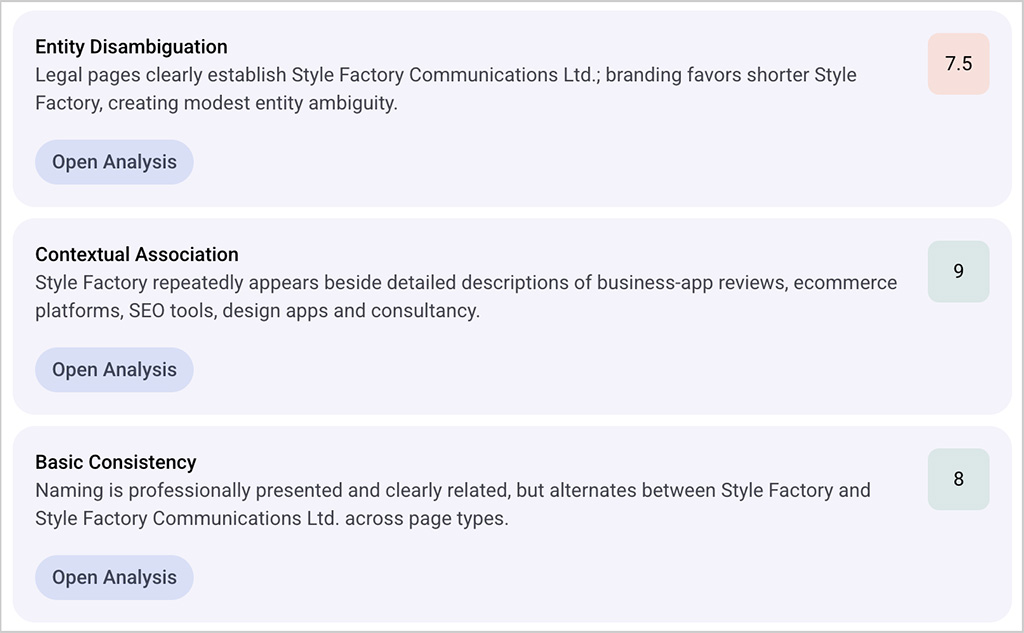
On the independent music website I tested, it correctly identified a UK/London business identity while recognizing that its ecommerce products were available internationally.
I also appreciated how Riva explained its findings. Individual checks showed the URLs analyzed, statements found on the site, inferred information, missing details and confidence levels.
This approach makes Riva’s assessments much easier to understand and challenge than a generic AI visibility score.
3. Its improvement recommendations are highly actionable
Riva’s Improvement Center was probably my favorite feature. Instead of just highlighting problems that might be holding your site’s AI visibility back, it frequently shows you the affected page, explains what needs improving and suggests how to fix it.
Sometimes it even provides revised copy.
One particularly good example came from my content-led test site. Riva identified passages making strong qualitative claims without enough nearby evidence to support them.
But rather than simply suggesting that I “add statistics” to the page, it found relevant numbers already present elsewhere in my content — including template counts, app numbers and review data (see my screenshot below).
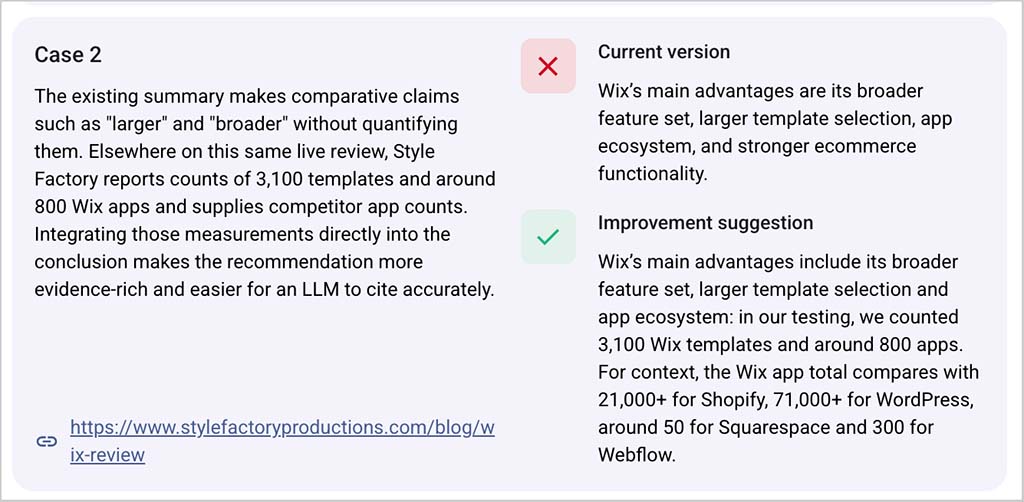
It then recommended connecting these figures more closely to the claims they supported.
On the independent music store, Riva questioned descriptions such as “highly limited,” suggesting that highlighting actual pressing quantities or stock figures would provide more convincing evidence of these claims.
(Importantly, when supporting figures weren’t available, it didn’t invent them.)
And when analyzing the large consumer brand, it suggested strengthening claims about product comfort, support and performance using genuine testing results and verified customer evidence.
These are useful editorial recommendations regardless of whether they ultimately improve ChatGPT visibility.
Not every suggestion was equally convincing, however — something I’ll return to shortly.
4. You can customize visibility tests
Another thing I like about Riva is the way it lets you edit the products, services and queries it uses to assess your visibility. This is important because automatically generated AI queries don’t always accurately reflect what a business sells or what its potential customers might ask.
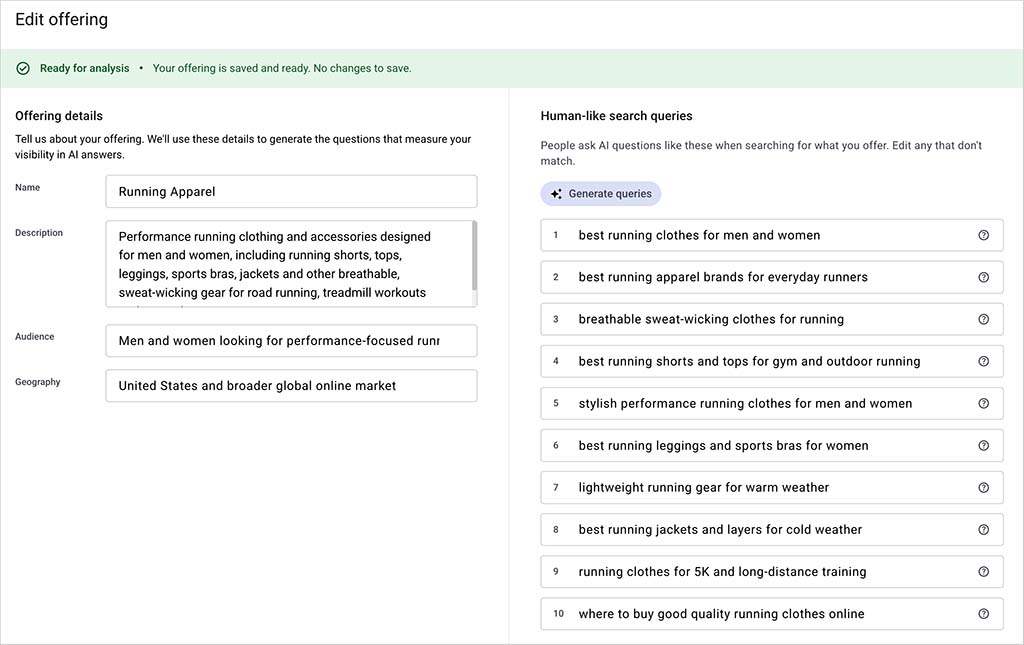
I discovered this when testing Riva on a large sportswear brand. Riva correctly identified running apparel as an important offering, but initially defined the category largely around male runners.
I changed the offering to cover both men and women, then rewrote all 10 associated queries to include general running apparel, leggings, sports bras, weather-specific clothing and long-distance training.
And interestingly, the results became worse.
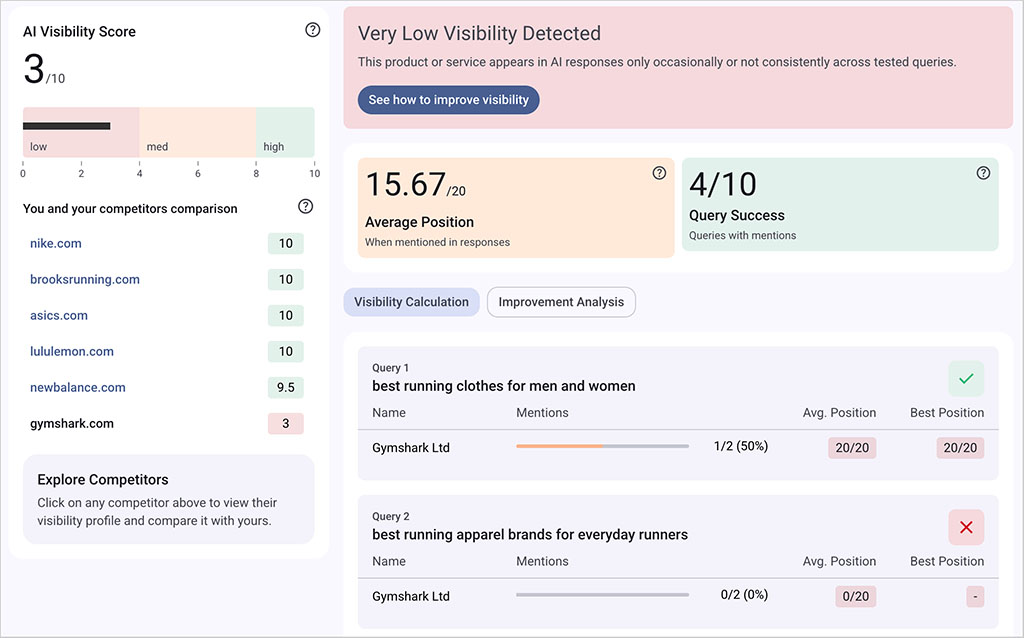
The overall AI Visibility score dropped from 4/10 to 3/10, Query Success fell from 6/10 to 4/10, and Average Position declined from 13.25 to 15.67.
But this wasn’t necessarily bad news: the revised queries provided a more realistic picture of the brand’s visibility, revealing that it performed better for specific product searches than for broader questions about running clothing.
This illustrates why controlling your test queries matters. A visibility score based on commercially irrelevant questions isn’t particularly useful, however impressive that score might be.
5. Its methodology is unusually transparent
AI visibility optimization — often called generative engine optimization, or GEO — is still a developing field. And there are plenty of vendors presenting speculative optimization techniques as established facts.
Riva is more transparent here — its individual assessment rules frequently include explanations, evidence, confidence levels and references to academic research.
I particularly liked that it sometimes acknowledges the limitations of this research.
For example, one research-based recommendation I encountered (pictured below) highlighted the benefits of including statistics in content, while also offering clear caveats about the value of doing so.
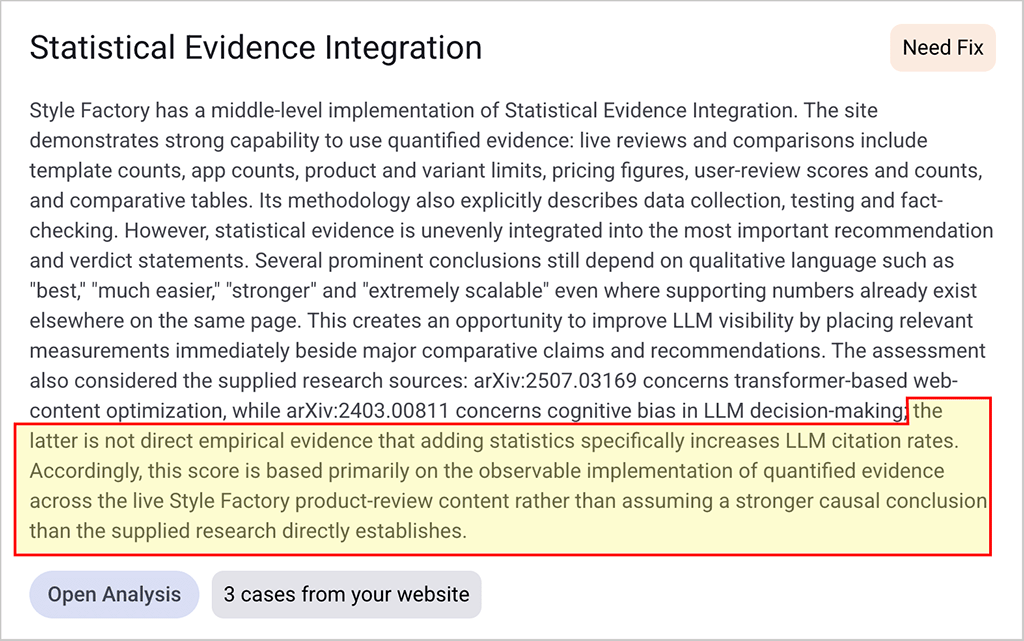
This is important: just because a technique makes sense, or is associated with better outcomes in research, doesn’t mean that implementing it will automatically make ChatGPT recommend your business.
Riva doesn’t always get this balance of information and caveats 100% right — but its willingness to explain the reasoning behind its recommendations is commendable.
6. It offers good value for money
Riva costs $49 per month to track one domain, with each additional tracked domain costing $29 per month. For that, you get technical accessibility analysis, business-information assessments, three tracked offerings, 30 editable visibility queries, competitor discovery, improvement recommendations and biweekly monitoring.
You also get access to unlimited user accounts — particularly useful for agencies and marketing teams.
And significantly, you get generous API access — 500,000 credits are provided on its cheapest plan. This lets you use Riva in your own systems, apps, and dashboards; competing tools often force you to buy an expensive enterprise-grade plan to get API access.
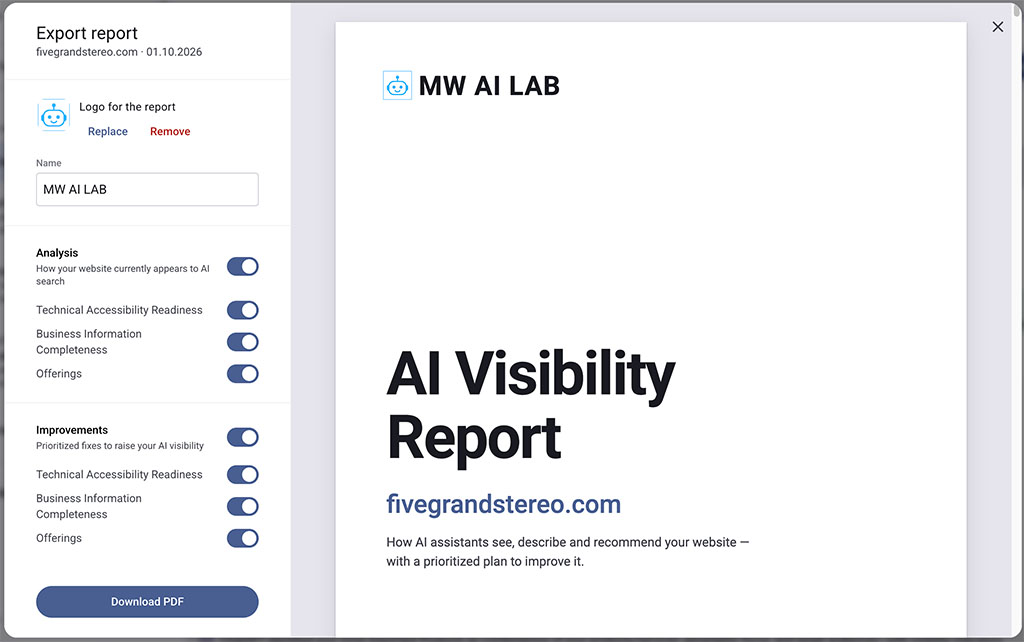
Riva’s reporting functionality is another strength. During testing, I generated reports containing around 50 pages of technical findings, business analysis, visibility results and improvement suggestions. I was able to customize these PDF reports with my own logo and report title.
This creates a useful agency workflow: audit a website, review the recommendations, implement selected improvements and rerun the analysis to see what changed.
Riva also offers a 14-day free trial, with no credit card required.
Riva pricing plan
Monthly pricing (USD)*
Pro
$99
Business
$149
Enterprise
$499
Should ecommerce merchants invest in Riva?
For me, Riva makes most sense for merchants who already have an established store and want to specifically investigate why their products aren’t being recommended in ChatGPT. For successful merchants, Riva can be an interesting addition their ecommerce tech stack.
For smaller stores, however, I’d be cautious about making AI visibility optimization a major spending priority. Improving product pages, building brand recognition and attracting qualified traffic through established channels may deliver more immediate returns.
But as your store matures, tools like Riva can definitely start to come in handy.
The cons of using Riva
Despite Riva’s advantages, I encountered several limitations during testing. Let’s go through these now.
1. It only tracks ChatGPT
Riva’s biggest weakness is its narrow platform coverage. Although it examines technical factors associated with AI accessibility in general, its actual visibility testing currently focuses solely on ChatGPT.
That’s an important limitation because AI visibility varies considerably between platforms. A business might perform well in ChatGPT — but receive little exposure in Gemini, Perplexity or Google’s AI Overviews.
Competing tools such as Semrush, Moz and Profound provide broader cross-platform visibility monitoring.
So if you need to understand your brand’s performance across the wider AI-search landscape, Riva won’t currently give you the complete picture.
2. Its visibility scores use small query sets
Riva tests a maximum of three offerings per domain, using 10 queries for each. That means its visibility scores are based on just 30 questions at most.
This makes results easy to monitor, but it’s a very small sample of the countless questions people might ask ChatGPT.
I encountered a particularly revealing illustration of this problem during testing. Riva assigned one website a visibility score of 0/10 across its monitored offerings.
However, Semrush identified 79 AI citations across 34 pages on the same domain, including 23 citations specifically from ChatGPT.
Now, neither tool was necessarily wrong. Riva was measuring whether the business appeared for a particular set of product-related questions. Semrush was identifying other circumstances in which its content was being cited.
But the difference demonstrates why Riva’s scores need careful interpretation.
A visibility score of 0/10 doesn’t mean your business never appears in ChatGPT. Equally, a score of 10/10 doesn’t mean it dominates the platform.
So, it’s better to treat Riva’s results as a focused benchmark than a comprehensive measure of AI visibility.
3. Its competitors aren’t always genuine commercial rivals
Riva automatically identifies competitors based on the brands and entities that appear alongside your business in ChatGPT answers.
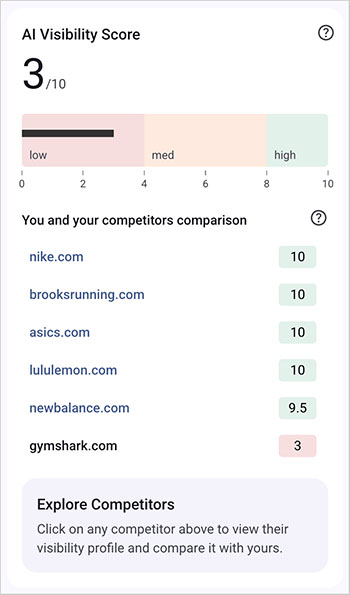
Now, for conventional ecommerce businesses, this can work well. When I ran a running apparel brand through Riva, it identified familiar competitors such as Nike, Adidas, Lululemon, Brooks, ASICS and New Balance.
But things were less convincing with the other types of business websites I was testing with the tool.
For my content-led website, Riva classified companies such as Shopify, Wix, WooCommerce and Adobe as competitors — even though they were businesses the site primarily wrote about.
And for the independent music website, it identified platforms like Spotify and Bandcamp as competitors — rather than competing bands.
These findings weren’t entirely useless. They showed which organizations occupied similar space in AI-generated answers. But appearing in the same AI answers isn’t necessarily the same thing as competing commercially.
4. Some recommendations are too prescriptive
Although Riva’s improvement advice is generally excellent, some of its recommendations need to be taken with a grain of salt.
For example, it frequently suggested turning declarative statements into question-and-answer formats. This can work well for FAQs, but applying it everywhere risks making website content repetitive and unnatural.
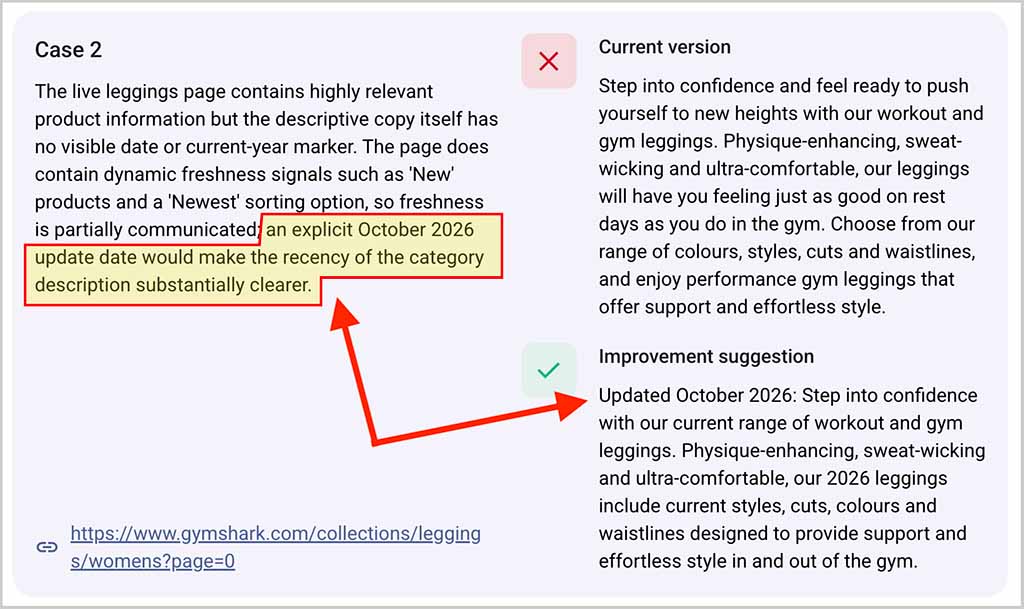
It also regularly recommended adding visible update dates to pages. That’s sensible for software reviews and articles that receive substantial updates, but less useful for continuously maintained ecommerce collection pages.
Some recommendations were also poorly suited to particular business types. For example, Riva suggested adding detailed audience demographic information, office hours and directions to the independent band’s website.
I wasn’t convinced that any of these changes would improve the site.
The lesson here is simple: use Riva’s recommendations as expert input, not instructions that must be followed.
5. Its readiness checks aren’t a proven formula for AI visibility
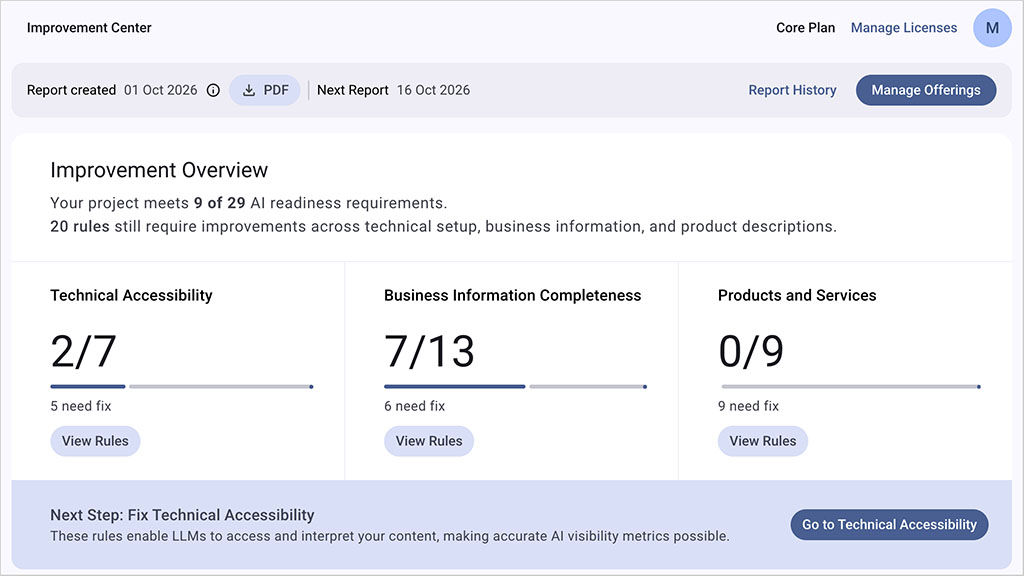
Riva evaluates websites against 29 rules: seven relating to technical accessibility, 13 to business information and nine to products and services. These provide a useful framework for identifying possible weaknesses.
But passing more checks doesn’t necessarily mean your business will become more visible in ChatGPT.
My testing demonstrated this quite clearly.
One large consumer brand passed just 9 of Riva’s 29 readiness checks. Despite this, it achieved 10/10 visibility for two major product categories.
So, a website can fail most of Riva’s checks and still perform extremely well in ChatGPT.
I also encountered a technical discrepancy where Riva couldn’t retrieve a site’s robots.txt file (and marked the relevant check as “Not Ready”). Another AI visibility auditing tool I ran the same site through found that it wasn’t blocking any crawlers at all.
These examples reinforce the importance of independently checking significant findings.
Ultimately, Riva’s readiness framework should be treated as a structured diagnostic system, not a 29-step formula for appearing in ChatGPT.
Riva review — verdict
Riva is an interesting addition to the growing market for AI visibility tools, largely because it approaches the subject differently from its competitors.
Given that it currently only supports ChatGPT, it isn’t the platform I’d choose for monitoring AI visibility across multiple AI systems. Tools like Semrush, Moz, Ahrefs, and Profound are better suited to that broader task.
But Riva performs very well as an AI visibility diagnostic and improvement tool. Its detailed business-information analysis, practical content recommendations, customizable visibility queries and transparent methodology make it genuinely useful. And I particularly like the way it connects potential visibility problems to specific changes you can make on your website.
The pricing is attractive too, especially for agencies and consultants that need to analyze multiple client sites and produce detailed reports.
The main downsides to bear in mind are its ChatGPT-only coverage, small query samples and the need to apply editorial judgment to its recommendations.
Its readiness scores should also be treated as guidance rather than proof that particular changes will increase AI visibility.
But used with those limitations in mind, Riva is a very capable tool.
It won’t tell you everything about how your business appears across AI search, but it does a particularly good job of helping you understand what might be holding your ecommerce website back — and what you could do about it.
You can try Riva for yourself using its 14-day free trial.
Pros and cons summary
☑️ Detailed analysis of how AI systems access and understand your website
❌ Currently tracks ChatGPT only
☑️ Highly actionable, page-specific improvement recommendations
❌ Visibility scores are based on small query sets
☑️ Transparent methodology backed by academic research
❌ Automatically identified competitors aren’t always genuine commercial rivals
☑️ Affordable pricing, unlimited users and generous API access
❌ Some optimization recommendations can be overly prescriptive
☑️ Detailed, customizable PDF reports for agencies and consultants
❌ AI readiness scores don’t necessarily correlate with actual ChatGPT visibility
Riva review — FAQs
What is Riva?
Riva is an AI visibility and optimization tool developed by XOVI. It analyzes how well AI systems can access and understand your website, tracks whether your business appears in relevant ChatGPT answers, and recommends changes that could improve your visibility.
How much does Riva cost?
Riva costs $49 per month for one tracked domain, with each additional domain costing $29 per month. It also includes unlimited user accounts, reporting tools and API access.
Does Riva offer a free trial?
Yes. Riva offers a 14-day free trial, with no credit card required. This lets you test its website analysis, AI visibility tracking and improvement recommendations before committing to a paid subscription.
Which AI platforms does Riva support?
Riva currently tracks visibility in ChatGPT only. Support for additional AI platforms, including Gemini and Perplexity, is planned, but hasn’t been launched yet. If you need cross-platform AI visibility monitoring, alternatives such as Semrush, Moz and Profound are worth considering.
Can Riva improve my ecommerce store’s visibility in ChatGPT?
Riva can help identify potential obstacles to your store appearing in ChatGPT answers, including unclear product information, unsupported claims and technical accessibility issues. It then suggests ways to address them. However, implementing its recommendations doesn’t guarantee increased ChatGPT visibility.
How many products or services can I track with Riva?
Riva lets you track up to three products or services, which it calls “offerings,” per domain. Each offering is assessed using 10 customizable ChatGPT queries, giving you a maximum of 30 tracked queries. Riva reruns its analysis approximately every two weeks.

Chris Singleton is the Founder and Director of Ecommercetrix.
Since graduating from Trinity College Dublin in 1999, Chris has advised many businesses on how to grow their operations via a strong online presence, and now he shares his experience and expertise through his articles on the Ecommercetrix website.
Chris started his career as a data analyst for Irish marketing company Precision Marketing Information; since then he has worked on digital projects for a wide range of well-known organizations including Cancer Research UK, Hackney Council, Data Ireland, and Prescription PR. He then went on to found the popular business apps review site Style Factory, followed by Ecommercetrix.
He is also the author of a book on SEO for beginners, Super Simple SEO.