

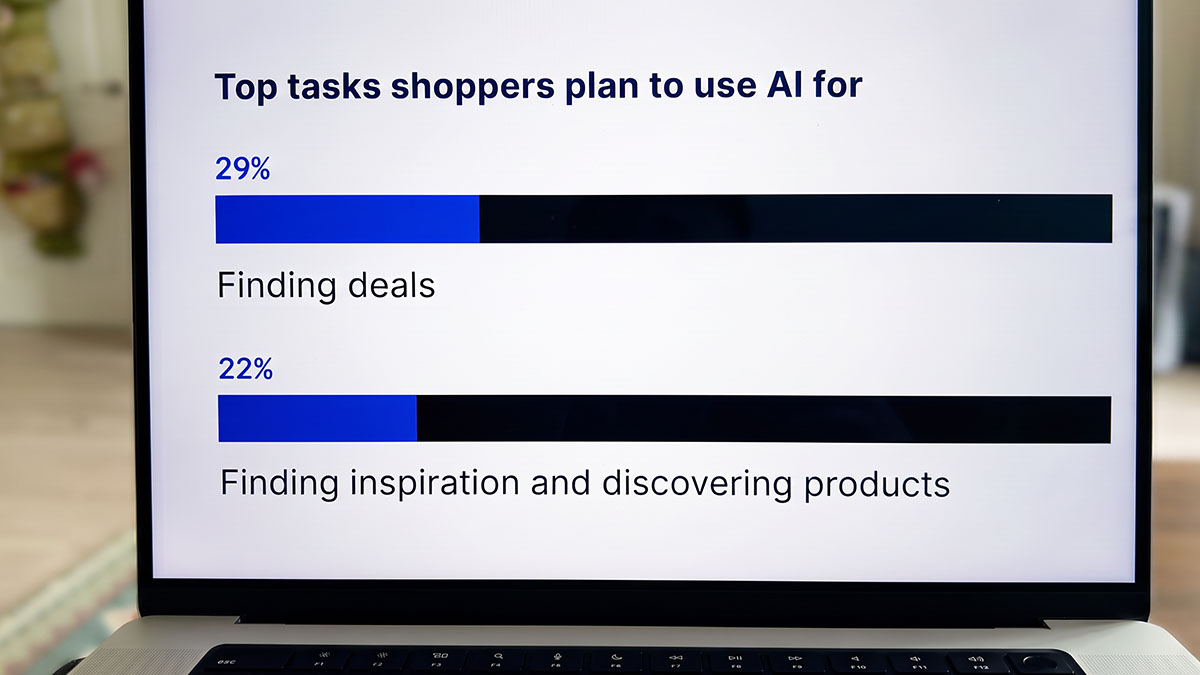
Nearly two-thirds of consumers plan to use artificial intelligence to help with their holiday shopping this year, according to a new global report from Shopify. However, while shoppers are increasingly comfortable using AI to find and compare products, far fewer are willing to let it complete purchases on their behalf.
The findings come from Shopify’s 2026 Global Holiday Retail Report, which is based on surveys of 18,000 consumers and 7,500 business leaders across nine countries, including the US, UK, Canada and Australia.
(The research was conducted by Sapio Research and reflects survey responses rather than actual shopping activity recorded on Shopify’s platform.)
Shoppers embrace AI recommendations, but remain cautious about AI purchases
According to the report, 65% of consumers expect to use AI for at least one shopping-related task during the holiday season. Finding deals (29%) and discovering new products or shopping inspiration (22%) are among the most popular intended uses.
But the research also reveals a significant gap between shoppers’ willingness to accept AI assistance and their readiness to hand over purchasing decisions.
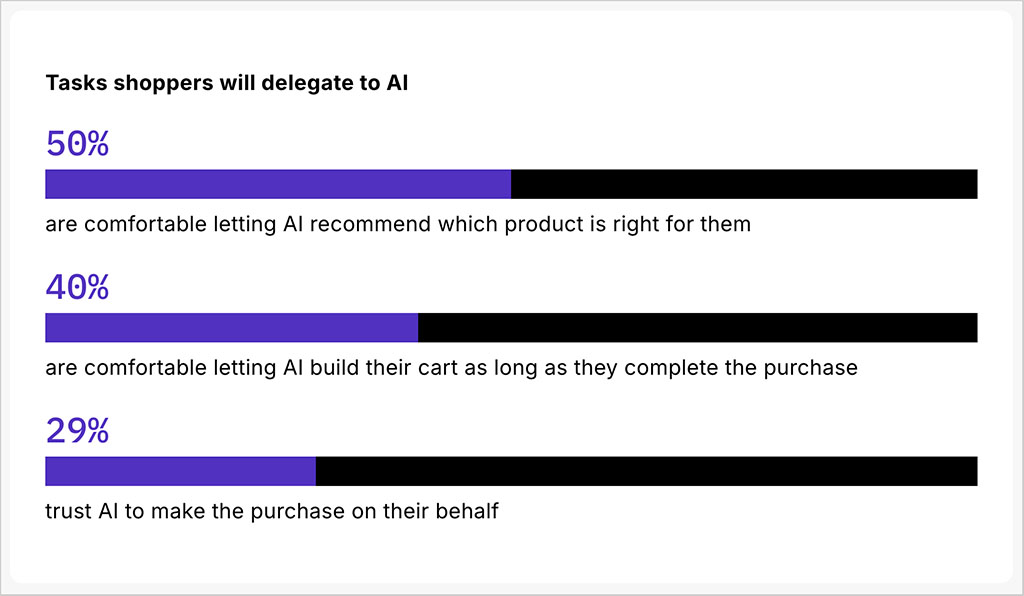
Half of respondents say they’re comfortable letting AI recommend products, while 40% would allow an AI assistant to build a shopping cart provided they complete the purchase themselves. But just 29% trust AI to make purchases on their behalf.

The findings suggest that while AI is becoming a more established product-discovery tool, consumer confidence in fully automated shopping remains limited.
Related resources
Key findings from Shopify’s holiday shopping report
Beyond AI adoption, Shopify’s research highlights several trends shaping consumer behavior and business expectations ahead of the holiday season:
- 65% of shoppers expect to use AI for at least one holiday shopping task.
- 50% are comfortable with AI product recommendations, but only 29% trust AI to complete purchases.
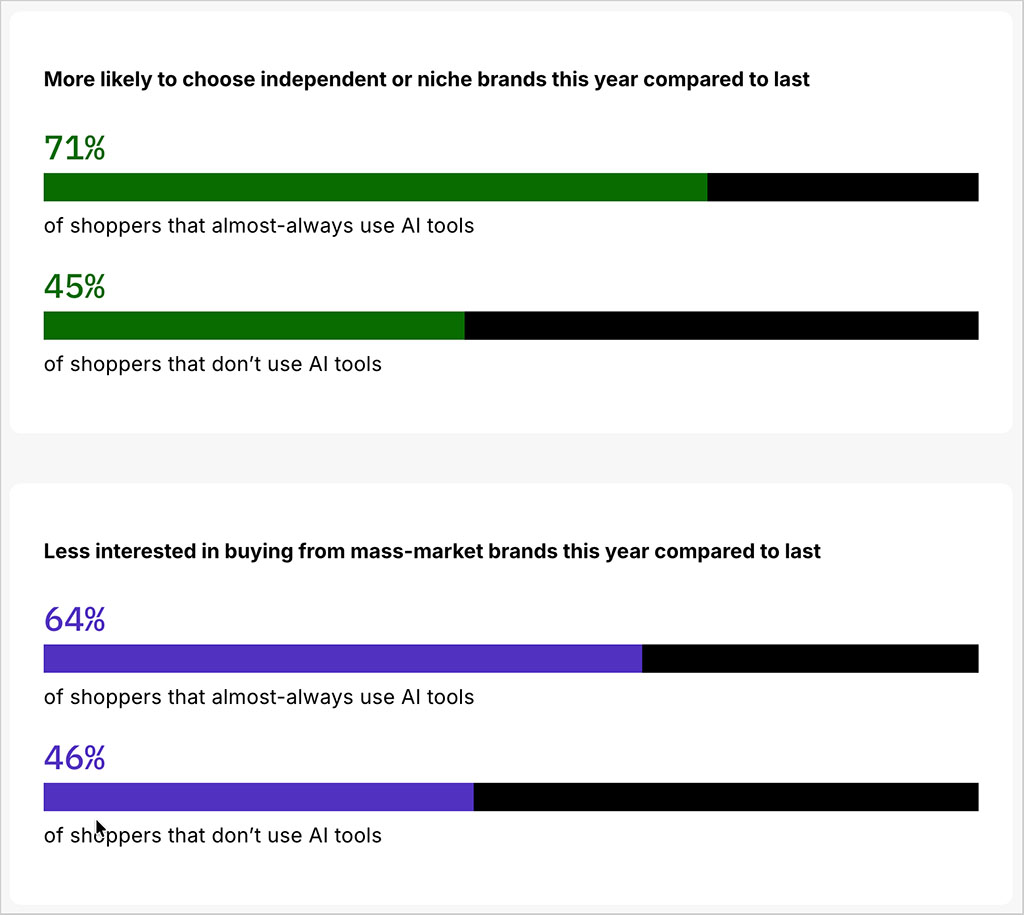
- 71% of shoppers who almost always use AI say they’re more likely to choose independent or niche brands than last year, compared with 45% of shoppers who don’t use AI.
- 54% of consumers say recent economic conditions have negatively affected their shopping plans.
- 76% of businesses expect higher holiday sales, compared with 72% in Shopify’s 2025 survey.
- 24% of shoppers deliberately leave products in online shopping carts to give themselves more time to decide whether to buy.
The report also suggests that consumers are increasingly focused on getting value from their purchases, rather than simply finding the lowest price.
AI shopping habits vary by country and age
Shopify’s country-specific findings reveal broadly similar attitudes toward AI shopping across major ecommerce markets.
In the UK, 64% of consumers expect to use AI for at least one holiday shopping task, compared with 63% in Canada, 62% in Australia and 60% in the US.
However, willingness to let AI complete purchases remains considerably lower. The US records the highest level of trust among these four markets, at 31%, followed by Australia (29%), the UK (28%) and Canada (26%).
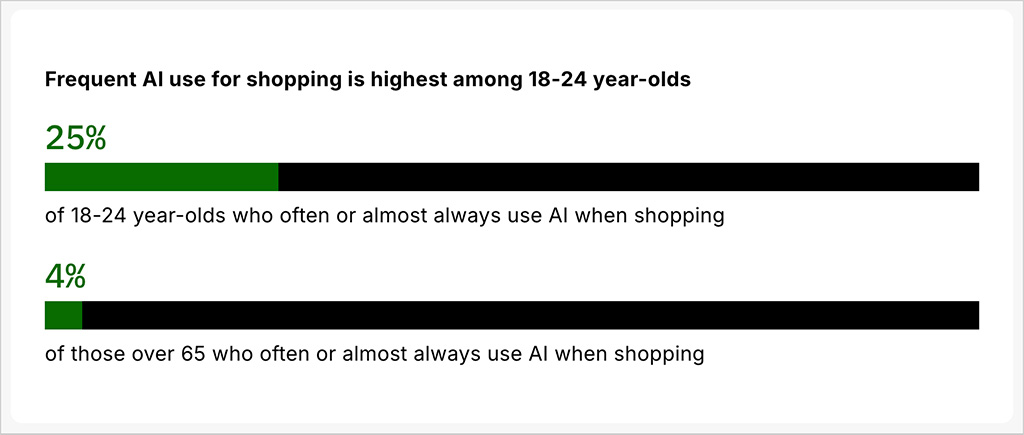
The research also finds that AI shopping is particularly popular among younger and higher-income consumers. Globally, 25% of 18–24-year-olds say they often or almost always use AI when shopping, compared with just 4% of consumers over 65.
Consumers are researching more and spending carefully
Alongside growing interest in AI, Shopify identifies a broader shift toward more deliberate purchasing decisions.
Some 80% of surveyed consumers say they feel more in control when they take time to research products before buying, while 84% feel satisfied when they find something that meets their specific needs.
Price remains important, but quality also plays a major role. Half of shoppers define good value as receiving better quality than expected for the price, while 35% say they choose the best product for their needs even when it isn’t the cheapest option.
Economic concerns are nevertheless affecting spending plans. Average planned spending over Black Friday weekend has slipped from $192 in 2025 to $186 in 2026 across the surveyed markets.
Despite this caution, business confidence remains relatively strong, with more than three-quarters of surveyed businesses anticipating higher holiday sales.
Why this matters to ecommerce merchants
Shopify’s findings suggest that AI is becoming an increasingly important part of how consumers discover and evaluate products, even if most shoppers aren’t yet ready to delegate the final purchase.
For ecommerce merchants, this makes accurate product descriptions, up-to-date pricing, reliable inventory information and clear delivery details increasingly important. These help AI shopping tools understand and recommend products, while also giving customers the information they need to buy confidently.
The research also offers encouragement to smaller and specialist retailers. Frequent AI users report greater interest in independent and niche brands, suggesting that AI-assisted discovery could help these businesses reach shoppers beyond their usual audiences.
But the wider message is that AI visibility alone won’t guarantee sales. With consumers researching more carefully and weighing value against quality, merchants will still need to give shoppers convincing reasons to choose their products — whether those products are discovered through AI, search engines or traditional online stores.
Get ecommerce news you can use
Sign up below and we’ll send you email digests of all the latest news and developments in the world of ecommerce, tips on how to grow an online business, and special offers.

Matt Walsh is the Head of Content at Ecommercetrix. He also creates video content for the site and its associated YouTube channel.
Having gained a degree in Literature and Philosophy from Trinity College Dublin and an MA in International Relations from Dublin City University, Matt worked in the marketing world for a decade before taking up an education role — teaching languages, literature and creative writing in London.
Matt is an Adobe Certified Associate in Photoshop and Illustrator, and also holds a certificate in digital marketing from DMI (Digital Marketing Institute), along with a postgraduate certificate in Design Thinking, Innovation, Entrepreneurship and Creative Thinking from Trinity College Dublin.