

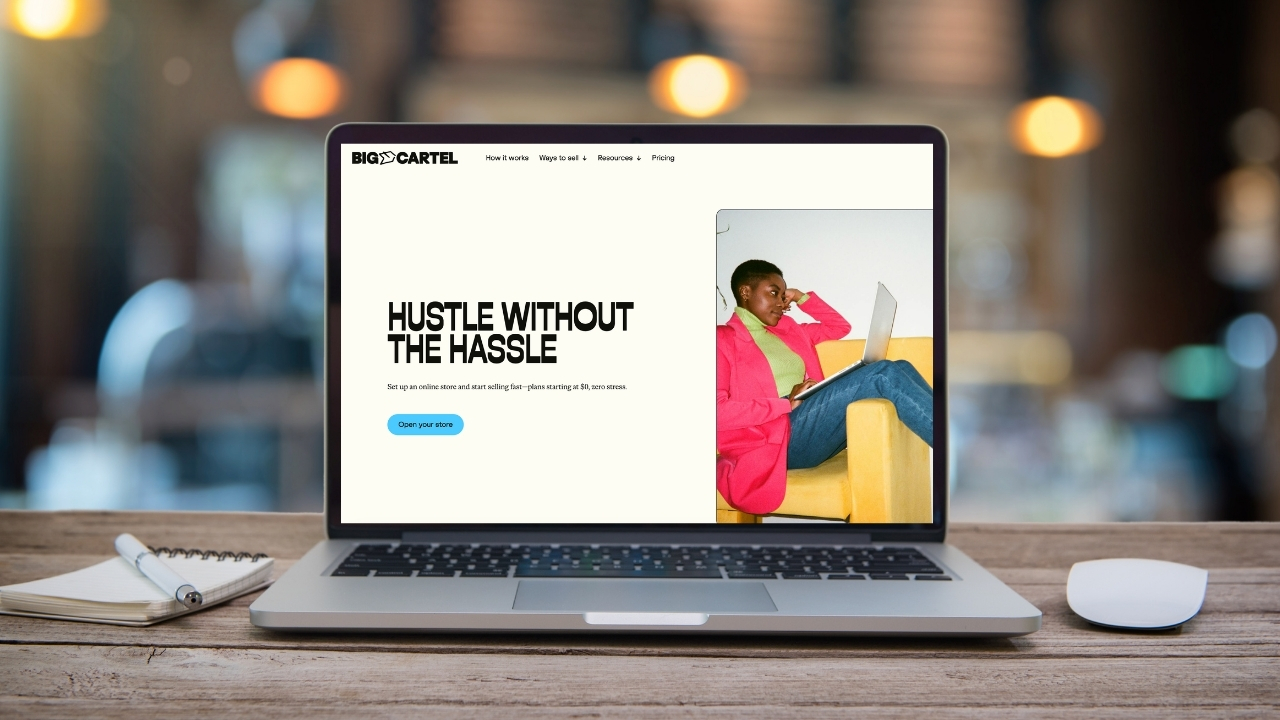
In this Big Cartel review, I outline all the key pros and cons of this cheap and cheerful platform, and discuss whether you can really build a professional online store with it.
Quick verdict on Big Cartel
Big Cartel’s biggest attractions are price and ease of use. It lets you sell up to five products completely free, while its paid plans cost just $15 and $30 per month. Its interface is clean, adding products is straightforward, and you don’t have to worry about a learning curve.
The downside is that Big Cartel is considerably less powerful than competing platforms like Shopify, Wix, and Squarespace. It limits you to selling 500 products, and its SEO, shipping, and international selling features are all fairly basic.
So, Big Cartel makes the most sense if you have a small catalog, a limited budget, and straightforward selling requirements. If you’re building a larger or more ambitious ecommerce business, I’d look elsewhere, most probably in the direction of Shopify or Squarespace.
Key alternatives
Overall score: 3 / 5
Pros of using Big Cartel
1. It’s very cheap
The strongest argument for using Big Cartel is its pricing. Its entry-level Gold plan is completely free, and you can keep using it indefinitely.
Now, this plan comes with some fairly significant restrictions. It only lets you sell five products and make use of one image per product. And it doesn’t facilitate inventory tracking or Google Analytics installation.
But if all you want to do is sell a few products quickly, this may be perfectly adequate.
Tip
The free Gold plan is slightly buried on the Big Cartel pricing page — but if you look underneath the paid pricing plans, you’ll find a text link to it.
The paid plans are cheap too. Platinum costs $15 per month and lets you sell up to 50 products, while Diamond costs $30 per month and raises this limit to 500. You can also save 20% by paying annually.
So if keeping ecommerce costs to an absolute minimum is your priority, Big Cartel is hard to argue with.
Plan
Monthly pricing (USD)*
Gold
Free, 5 product limit
Platinum
$15, 50 product limit
Diamond
$30, 500 product limit
2. It’s extremely easy to use
Big Cartel is one of the most user-friendly ecommerce platforms I’ve tested. Its dashboard is clean and uncluttered, and gives you straightforward access to products, orders, discounts, marketing tools, and store settings.
Adding products is particularly simple. You click “Add a product,” fill in a few fields, upload your images, and you’re more or less done. Unlike some competing ecommerce platforms, you’re not confronted with a huge number of configuration options every time you want to perform a basic task.
(The only thing I don’t like about Big Cartel’s interface is the slightly goofy fonts it makes use of.)
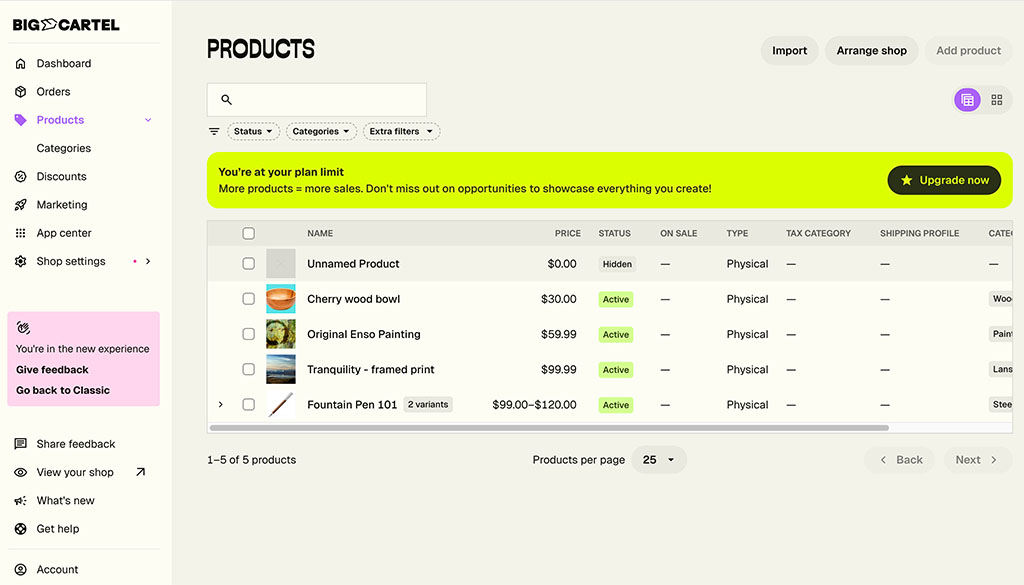
Of course, the reason Big Cartel is so easy to use is partly because there’s less you can actually do with it.
But if you’re a complete ecommerce beginner — or simply want a no-fuss way to sell a few products — its simplicity is definitely a plus.
3. Its templates are attractive — and free
Big Cartel only gives you 12 templates, which is a very small selection compared with the theme offerings of competing ecommerce platforms.
The good news is that the templates themselves are nicely designed, fully responsive, and completely free (see my screenshot below for a few examples).
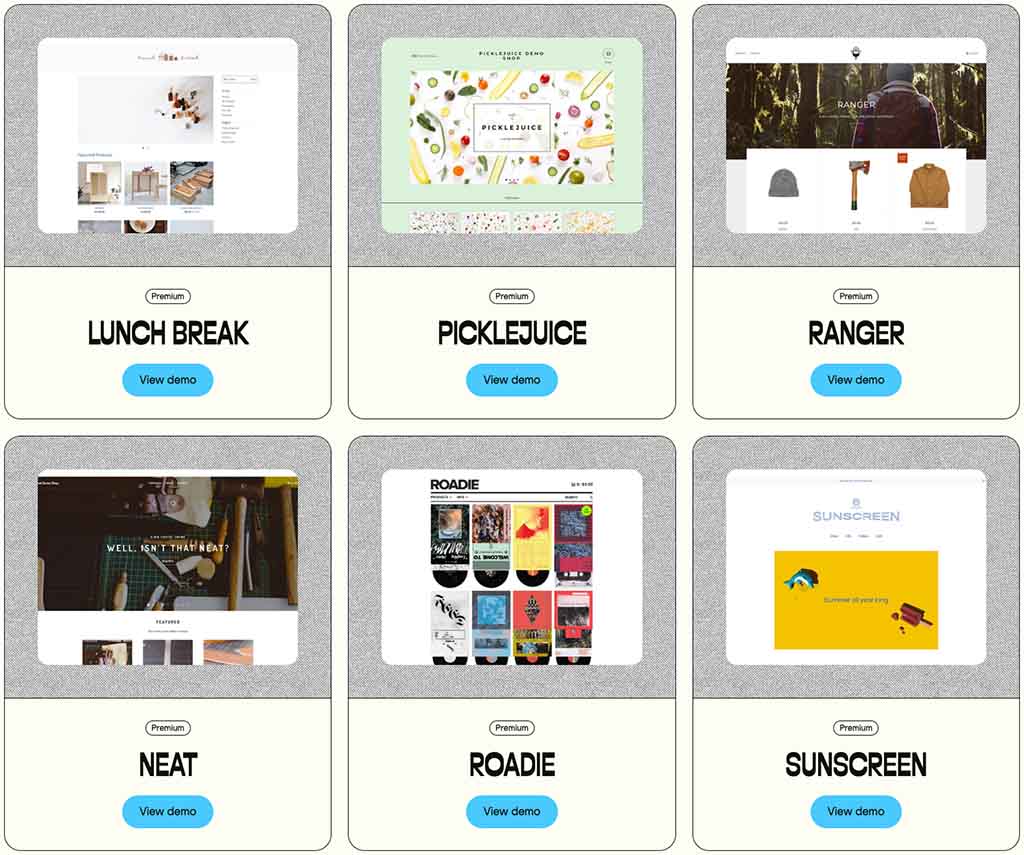
As you might expect from a platform with a long history of targeting artists and musicians, quite a few of Big Cartel’s designs have a creative or slightly quirky feel to them.
This makes them work well for things like artwork, band merchandise, clothing, handmade products, and other creative goods.
There are some more general-purpose designs available too, and if you’re comfortable working with code, paid Big Cartel plans let you edit your template’s HTML and CSS.
So while I’d definitely like to see more templates provided, the quality of what’s available is generally good.
4. It doesn’t charge transaction fees
Big Cartel lets you process transactions through Stripe and PayPal.
(If you use Stripe, you can offer payment methods including Apple Pay, Google Pay, and Afterpay.)
And significantly, Big Cartel doesn’t add any transaction fees of its own.
You’ll still pay the usual card-processing fees charged by Stripe or PayPal, but Big Cartel doesn’t take an additional percentage of your sales. Other platforms — including BigCommerce and Shopify — can take an additional cut of sales if you process them through a third-party payment gateway.
5. It offers useful features to creative sellers
Although Big Cartel’s feature set is quite limited overall, it does include some useful tools for its core audience.
One thing I particularly like is its built-in support for selling digital products. Big Cartel’s paid plans let you sell ebooks, music, artwork, printables, patterns, and other downloadable files without connecting a separate app or relying on a third-party service. The Platinum plan gives you 25GB of storage for digital products, while Diamond provides 250GB.
Big Cartel also gives you access to a subscriptions feature that lets you collect recurring payments, including Patreon-style contributions.
And if print-on-demand is your thing, Big Cartel integrates easily with services like Printful, The Art of Where, and Creative Hub.
So the platform actually covers several bases that small businesses will find useful.
Cons of using Big Cartel
1. You can only sell 500 products
The first big limitation to be aware of is Big Cartel’s product cap.
The free plan lets you sell five products, Platinum lets you sell 50, and the Diamond plan lets you sell 500.
For a painter selling 20 prints, or a band selling a small range of merchandise, this probably won’t matter at all. But if your product catalog grows significantly, you’re eventually going to hit a hard ceiling.
In short, Big Cartel isn’t particularly suitable for scaling a store; there are many other ecommerce solutions that are. Competing platforms like Shopify, BigCommerce, and Squarespace — to name just a few — let you sell an unlimited number of products.
2. Its SEO tools need improvement
Big Cartel does get some SEO basics right.
Its sites are mobile-friendly, use clean URLs, generate sitemaps automatically, and let you edit image alt text.
But when creating pages in Big Cartel, I came across some pretty significant shortcomings:
- You don’t have full control over all page URLs.
- Redirects are handled in an odd way.
- Changing a product URL can result in the old address redirecting to your homepage rather than the new product page.
I also think the lack of a built-in blogging tool is a real weakness. If you’re trying to grow an ecommerce business through content and organic search, blogging can be extremely important.
Ultimately, if you plan to make SEO a key part of your selling strategy, I’d be inclined to use another platform.

3. International selling is limited
Big Cartel lets you choose a selling currency from one of 135 currencies — but when trying to create a test store for an international audience, I found that only one of these can be enabled at a time.
This means you can’t automatically show US customers product prices in dollars, UK shoppers prices in pounds, and European visitors prices in euros. Similarly, visitors can’t check out in their own local currency.
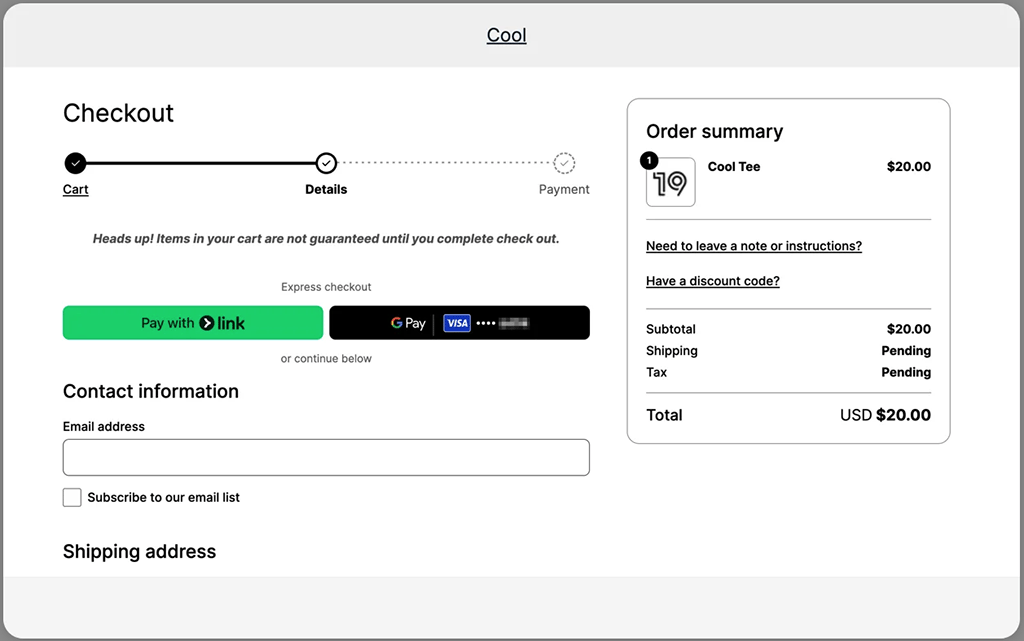
Big Cartel’s tax calculation functionality will also cause headaches for merchants who want to scale internationally. Big Cartel supports automatic US sales tax calculations, but international sellers have to do more manual configuration themselves. Additionally, there’s no built-in support for the EU’s IOSS system.
So if you’re planning to sell heavily into multiple countries, Big Cartel probably isn’t the best fit.
4. Shipping functionality is surprisingly basic
Big Cartel lets you offer free shipping, flat-rate shipping, and in-store pickup to your customers.
But I was really surprised to discover that if you’re based outside the US, it doesn’t let you calculate shipping based on product weight.
If everything you sell is roughly the same size and weight, this may not cause you too many problems. But if you’re shipping a varied range of physical goods, this limitation could quickly become frustrating.
5. A limited number of apps and integrations are available
Big Cartel gives you around 25 apps that add marketing, fulfillment, shipping, and payments functionality to your store. Admittedly, they include integrations with key business services like Mailchimp, Omnisend, Google and ShipStation, but when you consider that rivals like Wix and Shopify offer thousands of apps in their app stores, Big Cartel’s selection looks extremely limited.
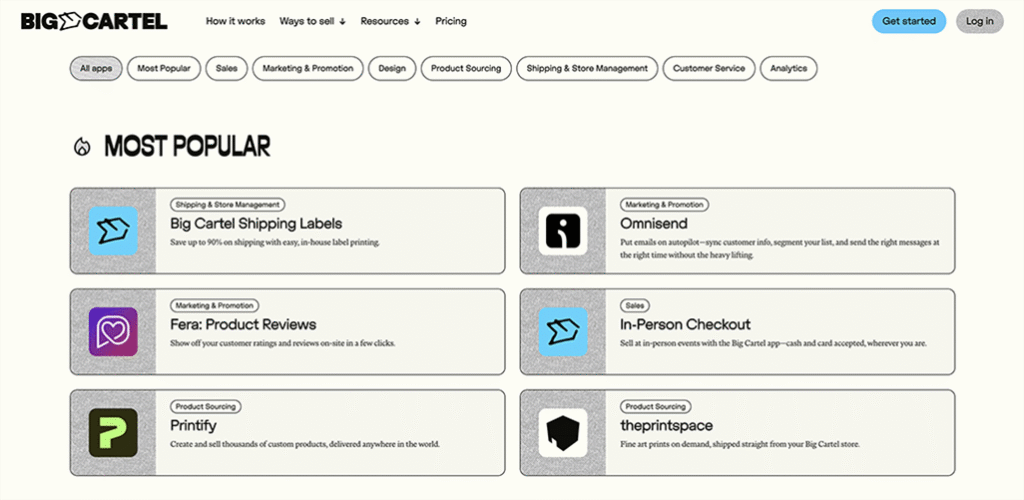
To be fair, you can connect Big Cartel to many more services via Zapier, but doing so can involve additional fees and configuration.
There’s no built-in email marketing tool either, so if you want to send newsletters, you’ll need to connect a separate service like Mailchimp, GetResponse, or AWeber.
And although Big Cartel can be used for in-person selling through Stripe, its POS setup is pretty basic. You don’t get the sophisticated retail hardware and multi-location features available from platforms such as Shopify.

None of this will necessarily bother a very small seller.
But as your business becomes more complex, you may find yourself repeatedly bumping into the platform’s limitations.
📖 Related POS resources
6. There are some security and compliance shortcomings
There are a few other issues worth flagging.
First, Big Cartel doesn’t appear to offer two-factor authentication, which puts it behind platforms like Shopify, BigCommerce, and Squarespace from an account-security point of view.
And if you need to comply with GDPR, Big Cartel doesn’t provide a built-in cookie consent system that handles all the relevant requirements. You’ll need to add a third-party solution like CookieBot or CookieYes to ensure compliance.
These aren’t necessarily dealbreakers, but they’re another indication that Big Cartel is better suited to relatively simple ecommerce projects than more sophisticated ones.
User reviews
So far you’ve heard my take on Big Cartel. But what do its users think of the platform? To find out, I collated data from popular software reviews websites — see my table below.
| Review Platform | User Rating |
|---|---|
| TrustRadius | 5.0 (note: based on just 5 reviews). |
| G2 | 4.2 |
| Capterra | 4.2 |
| Trustpilot | 4.7 |
| Overall Average | 4.5 |
As you can see, user reaction to Big Cartel was fairly positive across the various review sites, with an average rating of 4.5 out of 5 amongst users who reviewed the platform.
(For the record, I’m rating Big Cartel 3 out of 5 in this review — mainly because its ecommerce features are not powerful enough to facilicate scaling a business significantly).
Verdict
Overall, I think Big Cartel is a good example of a platform where its biggest strength and biggest weakness are essentially the same thing: simplicity.
It’s inexpensive, extremely easy to use, and quick to get started with. Its free plan is genuinely useful, its templates are attractive, and the platform is particularly well suited to artists, musicians, makers, and other creative sellers with small product catalogs.
But the more ambitious your ecommerce requirements become, the harder Big Cartel is to recommend.
The 500-product limit leaves little room for larger catalogs; its SEO setup has some significant weaknesses; international selling is limited; shipping functionality is too basic; and its app ecosystem is small compared with those of the leading ecommerce platforms.
So I’d use Big Cartel if I had a small number of products to sell, wanted to keep costs as low as possible, and didn’t expect my store to become particularly complicated.
If I were building an ecommerce business that I wanted to grow significantly, however, I’d go with something more powerful.
Shopify would be my preferred general-purpose alternative, and if I were a creative seller that wanted much stronger website-building functionality alongside simple ecommerce tools, I’d consider Squarespace.
Pros and cons summary
☑️ It’s cheap
❌ Its product limits are ungenerous.
☑️ It’s easy to use
❌ It doesn’t let store visitors check out in their own currency
☑️ It provides a decent set of selling tools
❌ Its SEO features needimprovement.
☑️ It lets you sell digital products effectively out of the box
❌ A limited number of apps and integrations are available for the platform
☑️ It doesn’t charge transaction fees
❌ There’s no blogging feature.
☑️ Lets you add selling features to any website easily
❌ A very small number of apps and integrations are available for the platform.
FAQs about Big Cartel
Is Big Cartel really free?
Yes. Big Cartel’s Gold plan is free to use indefinitely and lets you sell up to five products. However, it has some significant limitations, including one image per product and no inventory tracking or Google Analytics support.
How much does Big Cartel cost?
Big Cartel offers a free plan, and its Platinum and Diamond plans cost $15 and $30 per month respectively. Paying annually reduces the cost of the paid plans by 20%.
How many products can you sell on Big Cartel?
You can sell five products on Big Cartel’s free plan, 50 on its Platinum plan, and 500 on its Diamond plan. There is no Big Cartel plan that lets you sell an unlimited number of products.
Is Big Cartel good for beginners?
Yes. Big Cartel is one of the easiest ecommerce platforms to use, thanks to its clean dashboard and straightforward product-management tools. This makes it particularly suitable for beginners and merchants with simple selling requirements.
Is Big Cartel good for artists and musicians?
Yes. Big Cartel is particularly well suited to artists, musicians, makers, and other creative sellers. Its templates have a strong creative focus, and paid plans support digital downloads, subscriptions, and integrations with print-on-demand services.
Can you sell digital products on Big Cartel?
Yes. Big Cartel’s paid plans let you sell digital products including ebooks, music, artwork, printables, and patterns without installing a separate app. The Platinum plan provides 25GB of digital-product storage, while Diamond provides 250GB.
Does Big Cartel charge transaction fees?
No. Big Cartel doesn’t charge its own transaction fees. You will still need to pay the standard payment-processing fees charged by Stripe or PayPal, however.
Is Big Cartel good for SEO?
Big Cartel covers some basic SEO requirements: it supports mobile-friendly sites, clean URLs, automatic sitemaps, and editable image alt text. However, its limited control over URLs and redirects and its lack of a built-in blogging tool make it a weaker choice if SEO is central to your ecommerce strategy.
Can you sell internationally with Big Cartel?
Yes, but its international selling features are fairly limited. You can choose from 135 currencies, but only one currency can be enabled at a time, and Big Cartel lacks some of the more advanced international tax and localization features offered by competing platforms.
Is Big Cartel GDPR compliant?
Big Cartel can be used by merchants who need to comply with GDPR, but it doesn’t provide a built-in cookie consent system that handles all the relevant requirements. If you add third-party scripts to your site, you’ll usually need to add a separate cookie consent solution to your site.
What are the best alternatives to Big Cartel?
Shopify is a better choice if you need more powerful ecommerce and growth features. Squarespace is a particularly strong alternative for creative sellers who want more sophisticated website-building tools alongside ecommerce functionality.

Chris Singleton is the Founder and Director of Ecommercetrix.
Since graduating from Trinity College Dublin in 1999, Chris has advised many businesses on how to grow their operations via a strong online presence, and now he shares his experience and expertise through his articles on the Ecommercetrix website.
Chris started his career as a data analyst for Irish marketing company Precision Marketing Information; since then he has worked on digital projects for a wide range of well-known organizations including Cancer Research UK, Hackney Council, Data Ireland, and Prescription PR. He then went on to found the popular business apps review site Style Factory, followed by Ecommercetrix.
He is also the author of a book on SEO for beginners, Super Simple SEO.