

If you run an ecommerce business and you’re serious about growing organic traffic, you’ve almost certainly come across Ahrefs and Semrush.
They’re two of the biggest names in SEO. Two of the most powerful marketing toolsets on the market. And two of the most expensive.
But which one is right for you? Let’s find out.
My quick verdict on Ahrefs vs Semrush
Ahrefs and Semrush are both excellent SEO platforms, but they suit different types of ecommerce businesses.
Choose Ahrefs if you manage multiple stores, need generous reporting limits, want strong backlink analysis tools, or care about tracking brand visibility across a wide range of AI and content platforms.
Choose Semrush if you need an all-in-one marketing toolkit. It’s the better option for merchants who need SEO, paid search research, social media tools, local listing features, outreach tools, daily rank tracking, and AI prompt research in one place.

Reasons to use Ahrefs over Semrush
1. Ahrefs lets you track more domains
Ahrefs lets you track an unlimited number of domains, so long as you can verify ownership of them. If you operate multiple ecommerce stores, international storefronts, microsites, or client projects, this is a big advantage.
Semrush applies strict caps on the number of domains you can track, regardless of plan — so a clear win for Ahrefs here.
2. Ahrefs provides more generous reporting limits
If you’re on one of Ahrefs’ upper-tier plans, you can access an unlimited number of reports. By contrast, Semrush applies reporting limits across all plans.
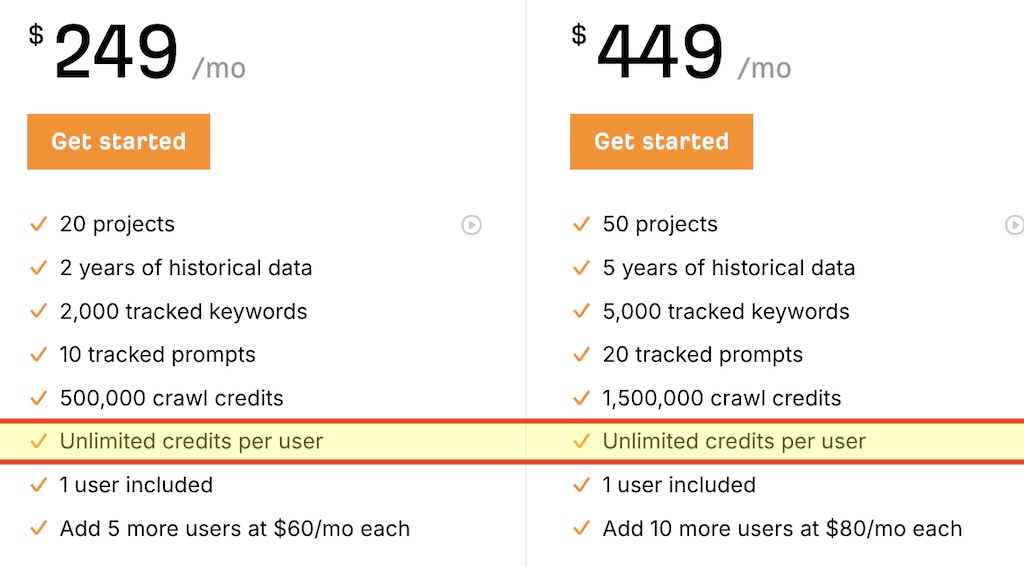
Ahrefs also allows you to crawl considerably more pages per month during technical SEO audits — for example, 500,000 pages per month on its “Standard” plan versus 300,000 on the similarly priced Semrush “Pro Plus” plan.
For large ecommerce sites with thousands of product pages, that additional crawling can make a real difference.
3. Ahrefs tracks brand visibility across more AI and content platforms
Ahrefs’ Brand Radar feature tracks performance across ChatGPT, Gemini, Copilot, Perplexity, and Grok.
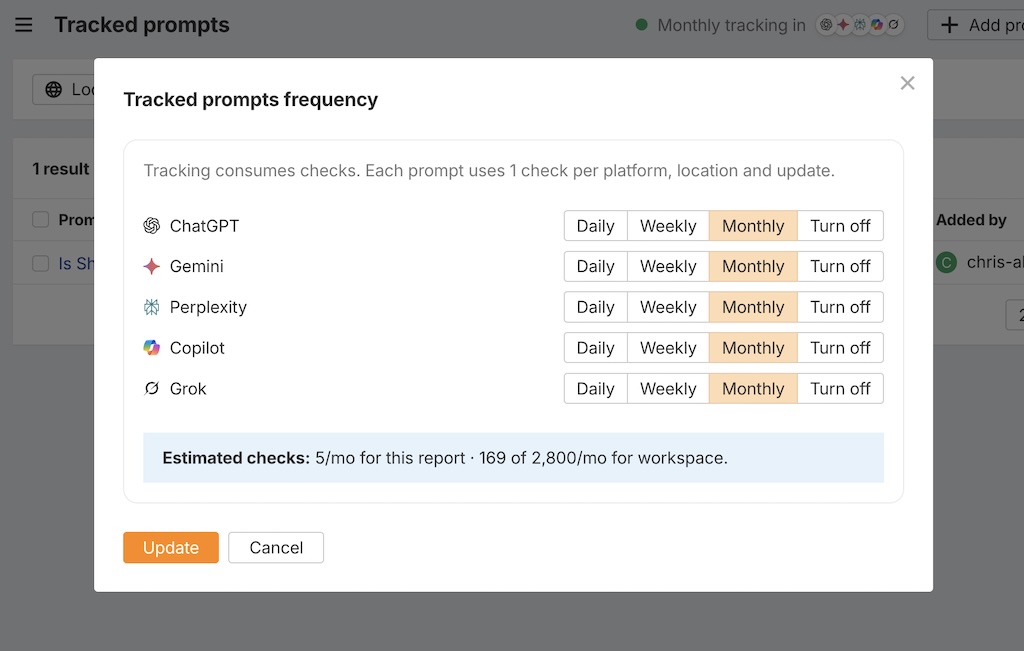
Semrush, by contrast, focuses on ChatGPT, Perplexity, and Google AI tools only.
Additionally, Ahrefs’ Brand Radar tool lets you track brand visibility across YouTube, TikTok, and Reddit — all important spaces for conversations about ecommerce. But Semrush’s equivalent feature currently focuses exclusively on AI tools.

4. The Ahrefs link intersect and keyword gap tools are more generous
A link intersect tool helps you identify websites that are linking to your competitors, but not to you. You can then use this data to reach out to the owners of these sites, and request a backlink.
Ahrefs’ link intersect tool is more flexible than the Semrush equivalent, because it lets you compare a URL’s link profile against up to ten others. Semrush, by contrast, limits you to just four comparisons at a time.
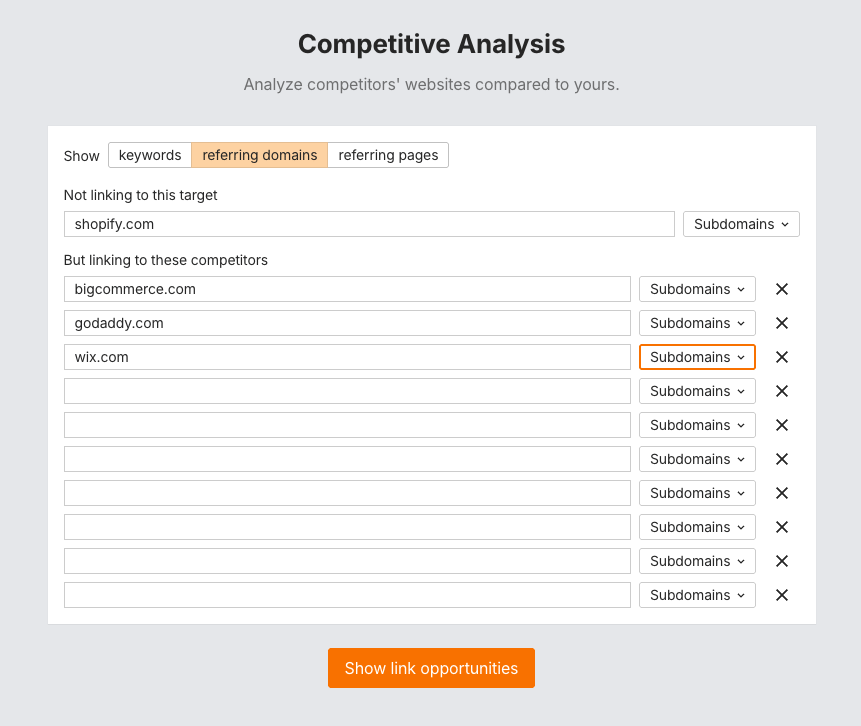
The same applies to keyword gap tools (these show you which keywords your competitors are ranking for that you aren’t). Ahrefs allows you to benchmark your site against up to ten competing domains, while Semrush restricts you to four comparisons.
5. Ahrefs gives you global data when surfacing keyword suggestions
When using Semrush’s Keyword Magic tool, the search volumes for the keyword suggestions provided are on a per-country basis. But Ahrefs lets you view global search volumes for keyword suggestions (see my screenshot below for an example of this).
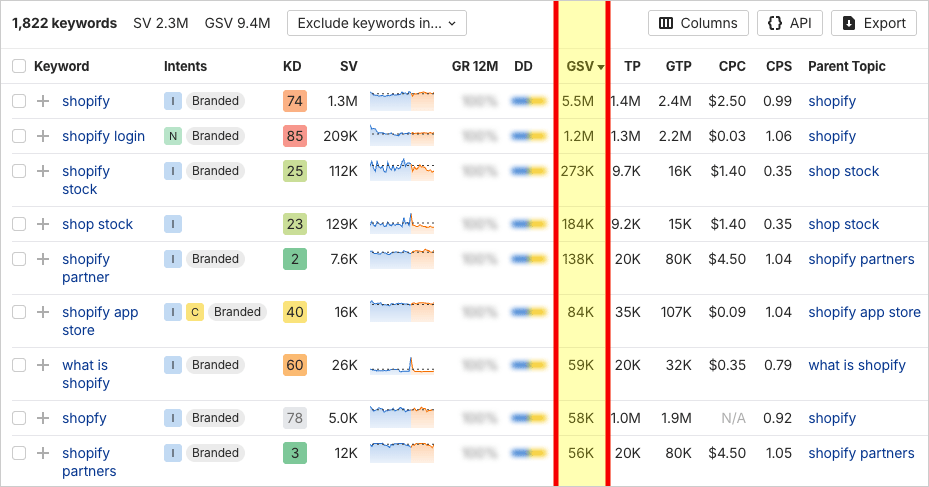
If you sell internationally, or target English-language keywords across multiple markets, that global data can provide a much more complete picture of demand.

6. Ahrefs makes broken link building easier
Broken link building involves finding broken backlinks pointing to competitor content, recreating similar content, and earning those links yourself.
In Ahrefs, you can enter a competitor’s domain into Site Explorer and instantly access a broken backlinks report for that site. Semrush supports broken link research too, but the process involved is a fiddlier, more manual one.
Ahrefs pricing
Ahrefs plan
Monthly pricing (USD)*
Lite
$129
Standard
$249
Advanced
$449
Enterprise
$1499
Reasons to use Semrush over Ahrefs
1. Semrush gives you a full marketing toolkit
The biggest difference between Semrush and Ahrefs arguably involves scope.
Ahrefs is exceptionally strong when it comes to improving your content’s visibility in search engines and increasingly, AI platforms.
Semrush, however, goes beyond this in several ways.
Alongside its SEO and AI visibility tools, Semrush offers a dedicated advertising research toolkit that gives you detailed Google Ads data — including paid keywords, ad copy history, landing page insights, and competitor positioning.
It also lets you make use of local listings management tools, brand monitoring features, and social media scheduling and tracking functionality.
And then there’s the Semrush App Center, which expands the platform even further with additional marketing integrations and add-ons.
Now, it has to be said that accessing much of this functionality involves add-on fees. But nonetheless, when you put all this together, Semrush starts to look less like a content visibility tool and more like a centralized digital marketing hub — one that lets you manage organic search, AI visibility, paid search, local listings, and social media in a single environment.
2. Semrush offers stronger AI prompt research features
As AI chat becomes part of how customers research products, prompts are increasingly becoming the new keywords.
Semrush allows you to enter a topic and see real prompts being used in ChatGPT Search and Google AI Mode to find content about that topic.
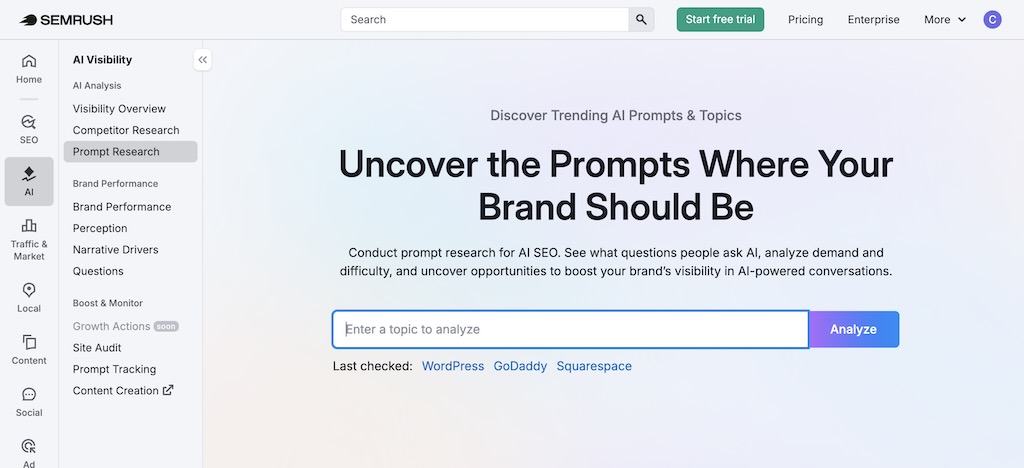
For ecommerce brands creating product comparisons and buying guides, this can generate valuable content ideas.
While Ahrefs does let you track your brand’s performance for prompts, it doesn’t currently offer the same ‘general’ prompt discovery feature.
3. Semrush’s site auditing features cover AI
Both Ahrefs and Semrush provide comprehensive Site Audit tools that flag technical SEO issues like broken links, duplicate content, security problems, and missing alt text.
However, Semrush has extended its audit feature to include an AI Search Health score, along with recommendations aimed at improving AI-driven visibility. Ahrefs’ Site Audit tool, by contrast, remains primarily focused on traditional technical SEO factors.
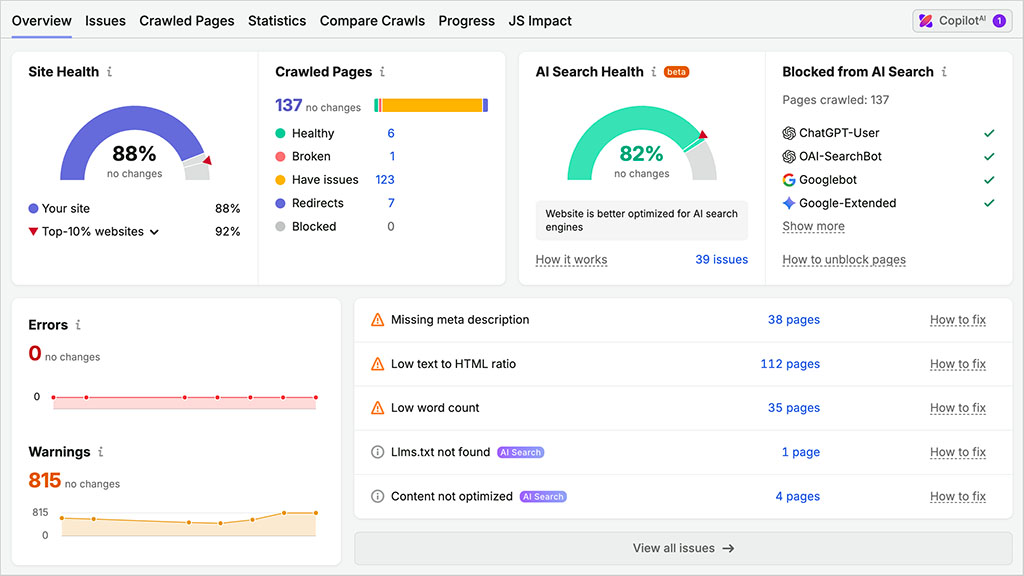
4. Semrush provides personalized keyword difficulty scores
SEO tools typically give you a “keyword difficulty” score that lets you know how hard it’s going to be to rank for a keyword you’re researching.
But most platforms, Ahrefs included, provide a generic score that doesn’t take your own domain strength or topical authority into account — two factors that significantly affect your ability to rank.
Semrush, by contrast, lets you enter your domain and generates a personalized keyword difficulty score based on these factors.
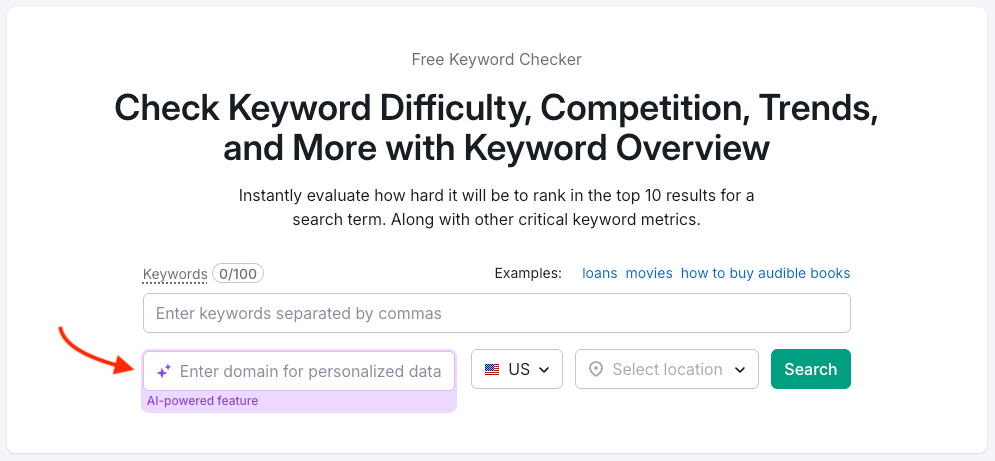
This lets you zoom in on keywords that you realistically have a chance of ranking for.
5. Semrush comes with built-in outreach tools
Effective ecommerce SEO often involves outreach — contacting site owners to secure links to your store. Getting more of these backlinks typically improves your search rankings.
Semrush streamlines this process with a dedicated link-building tool: enter a URL and it suggests relevant sites to approach for links. In many cases, contact details for these sites are also provided. You can then use Semrush’s built-in outreach system to send pitch emails directly from the platform, and keep tabs, CRM-style, on your campaign’s progress.
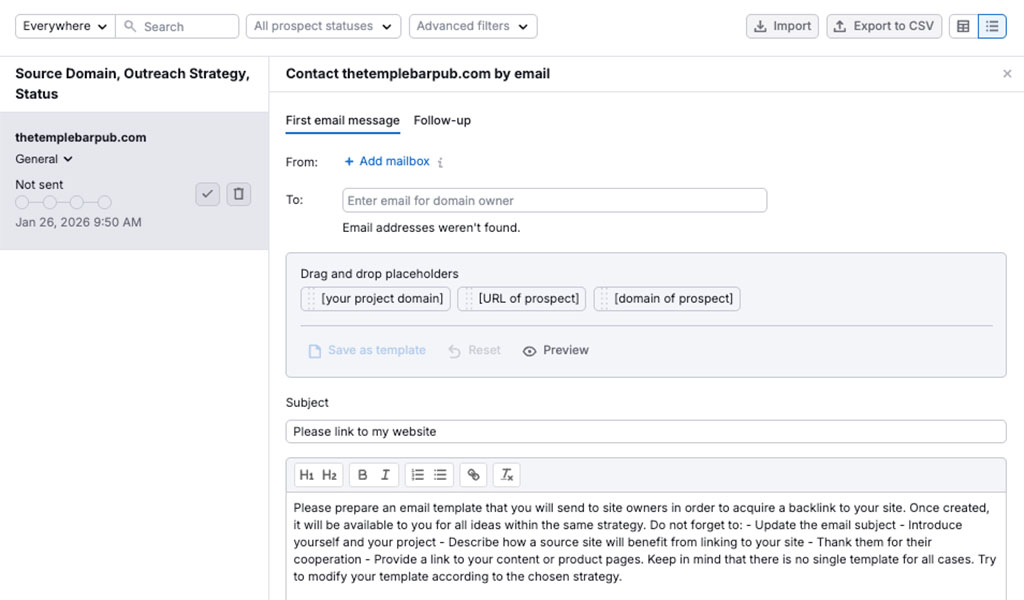
Ahrefs is good at surfacing link-building opportunities, but it doesn’t surface contact details, or offer a comparable integrated outreach tool.
6. Semrush provides daily rank tracking by default
Rank tracking shows how your target keywords perform over time and alerts you to visibility drops.
While Semrush provides daily rank updates on all plans, Ahrefs limits you to weekly reports by default. To access daily tracking in Ahrefs, you’ll need to pay an additional $200 per month for a ‘Project Boost Max’ add-on. This will prove prohibitively expensive for many site owners.
7. Semrush gives you access to a proper free trial
Although Ahrefs does provide some free tools and resources, it doesn’t give you access to a proper free trial. Trying the platform out always involves paying for it.
By contrast, Semrush gives you access to all its key features and data as part of a fully-functional free trial.
Semrush pricing
Semrush plan
Monthly pricing (USD)*
Starter
$199
Pro+
$299
Advanced
$549
Enterprise
Negotiable

User ratings for Ahrefs and Semrush
So far you’ve heard my views on Ahrefs vs Semrush. But what do real-world users make of both platforms? To find this out, I compiled user ratings data from popular review sites:
| Site | Ahrefs Rating (out of 5) | Semrush Rating (out of 5) |
| Capterra | 4.7 | 4.6 |
| G2 | 4.5 | 4.4 |
| Trustpilot | 2.1 | 1.7 |
| TrustRadius* | 4.3 | 4.3 |
| Average | 3.9 | 3.8 |
*Recalculated from an out-of-ten score.
As you can see, the user reaction to both platforms is pretty similar!
Ahrefs vs Semrush: the verdict
Ultimately, both Ahrefs and Semrush are extremely powerful platforms. Which one is right for you basically boils down to your use case.
Ahrefs is probably best suited to ecommerce merchants that need to manage multiple sites or stores — this is thanks to the way it lets you work with an unlimited number of domains. Other key advantages that Ahrefs boasts over Semrush include its more generous link intersect and keyword gap tools, its unlimited reporting on higher-tier plans, and the fact that its brand visibility tool tracks more AI platforms than Semrush.
Semrush is a better choice for merchants that want an all-in-one marketing tool — a platform that is not just about SEO but a solution that can be used to handle paid search, social media, local listings, outreach, and more. Other notable edges that Semrush has over Ahrefs include its daily rank tracking, its personalized keyword difficulty scores, and its superior AI prompt research features.
If you’d like to try either tool out, you’ll find links to both platforms’ free offerings below:
Finally, do feel free to drop any questions about Ahrefs or Semrush in the comments. We read them all and will do our best to help.
Related resources
You may also find our Ahrefs vs Profound comparison and our guide to the best SEO / AI visibility tools of interest.


Chris Singleton is the Founder and Director of Ecommercetrix.
Since graduating from Trinity College Dublin in 1999, Chris has advised many businesses on how to grow their operations via a strong online presence, and now he shares his experience and expertise through his articles on the Ecommercetrix website.
Chris started his career as a data analyst for Irish marketing company Precision Marketing Information; since then he has worked on digital projects for a wide range of well-known organizations including Cancer Research UK, Hackney Council, Data Ireland, and Prescription PR. He then went on to found the popular business apps review site Style Factory, followed by Ecommercetrix.
He is also the author of a book on SEO for beginners, Super Simple SEO.