

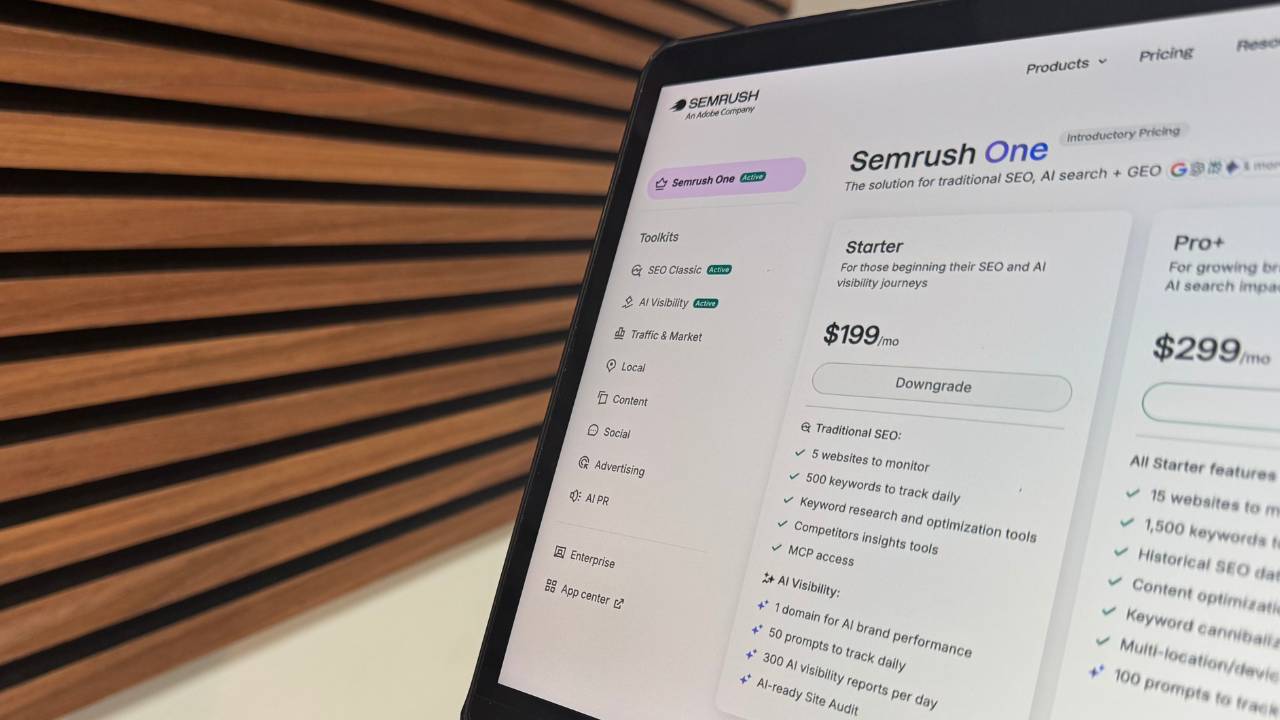
In this guide, I break down Semrush pricing, explain the key differences between its plans, and help you determine which option makes the most sense for your ecommerce business’s SEO and AI visibility tracking needs.
Our quick take on Semrush pricing for ecommerce merchants
- Choose the Starter plan if you’re running a small ecommerce business, and need access to SEO and AI visibility tracking tools at a resonable price point.
- Choose the Pro+ plan if you’re managing multiple online stores, publishing content regularly, or need higher reporting limits and content optimization features.
- Choose the Advanced plan if you need API access, large-scale reporting capabilities, and advanced SEO or AI workflows.
- Choose an SEO Classic plan if you’re focused solely on traditional SEO and want to keep costs down.

Introduction
If you’re not familiar with Semrush, it’s one of the most comprehensive online visibility platforms on the market. Ecommerce merchants use it to identify valuable keywords, analyze competitors, track search rankings, audit websites for technical SEO issues, and optimize content for greater search visibility.
More recently, Semrush has begun helping merchants track their visibility beyond traditional search engines. Its AI visibility tools let you monitor how your brand appears in platforms such as ChatGPT, Gemini, and Google’s AI-powered search experiences — an increasingly important consideration as more consumers use AI tools to research products, compare brands, and discover new retailers.
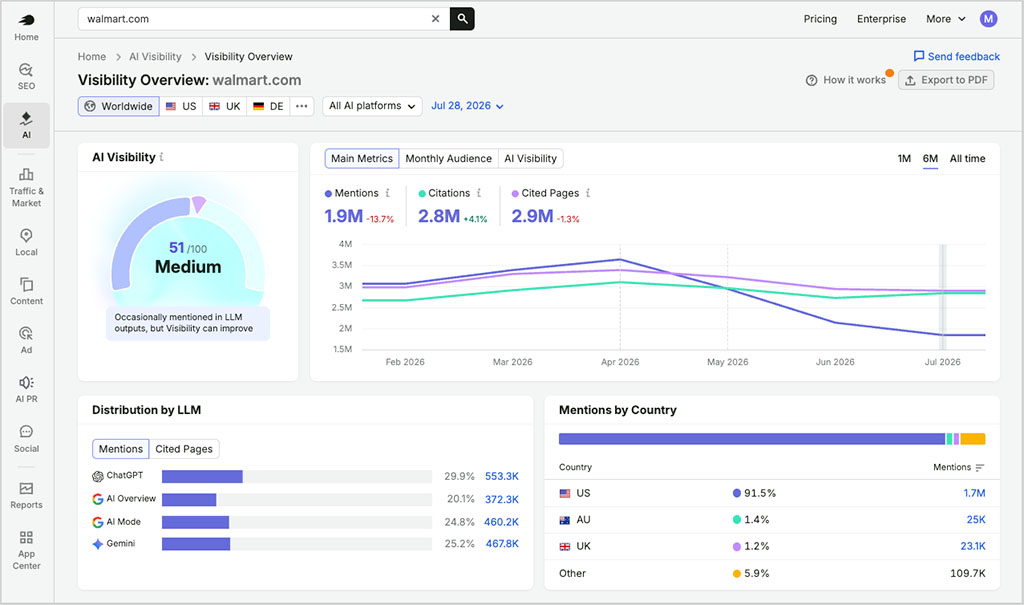
The main Semrush plans are now sold under the ‘Semrush One’ banner. These combine Semrush’s traditional SEO tools with its newer AI visibility tracking features.
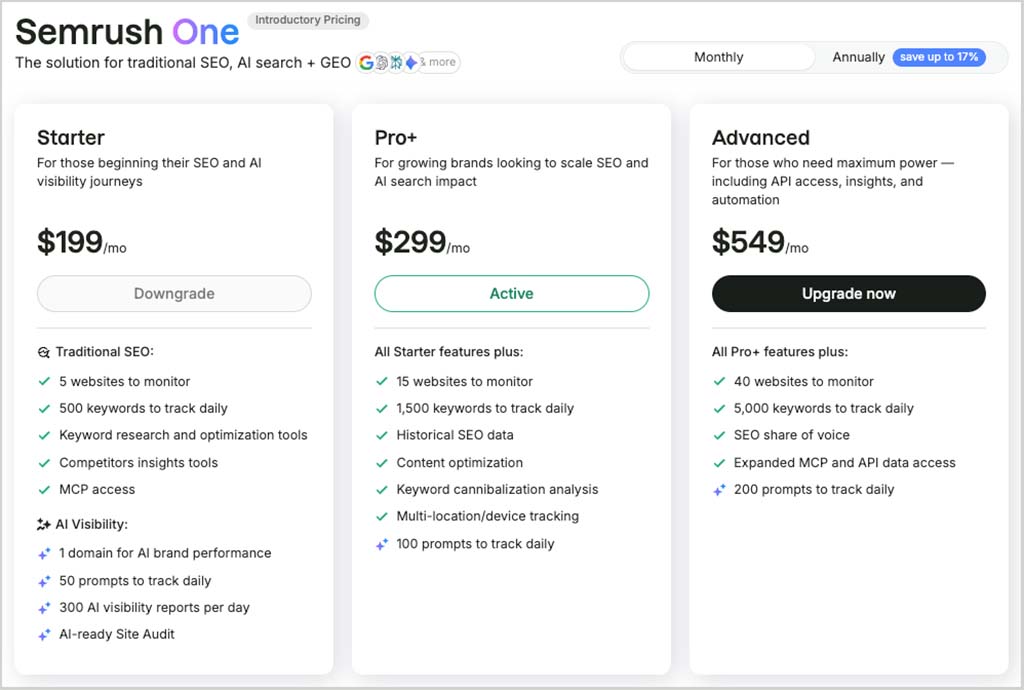
There are three main Semrush One plans available:
- Starter — $199 per month
- Pro+ — $299 per month
- Advanced — $549 per month.
Let’s look at each plan in turn, starting with Semrush Starter.
Semrush Starter — $199 per month
At a cost of $199 per month, the Starter plan is the entry-level Semrush One plan — and for many small ecommerce businesses, it’s the most sensible option.
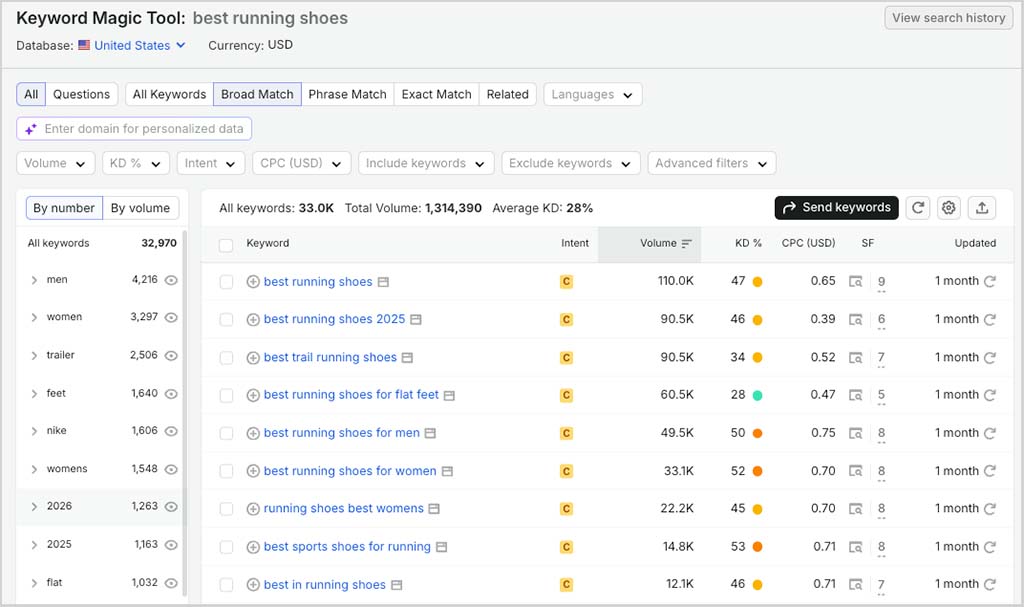
It gives you access to Semrush’s core SEO tools, including keyword research features, domain analysis, site auditing, rank tracking, and on-page SEO recommendations.
So, for example, you can use it to find product keywords, check how your category pages are performing, audit your online store for SEO problems, and keep an eye on competitor sites.
Importantly, Starter also includes AI visibility tracking.
This lets you monitor how your ecommerce brand appears in AI search experiences like ChatGPT, Google AI Overviews, Google AI Mode and Gemini.
That matters because shoppers are increasingly using AI tools to research products, compare brands and get buying advice; knowing whether your store is showing up in these environments is becoming ever more important.
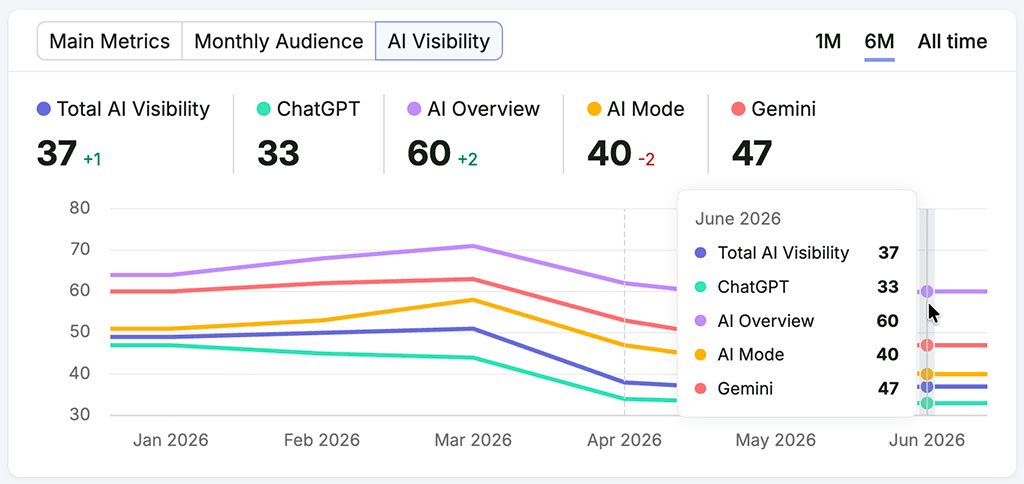
In terms of limits, Starter lets you manage up to five websites, track 500 keywords, monitor 50 AI prompts, and crawl up to 100,000 pages per month.
For a solo merchant working on one or two stores, that should usually be enough.
However, if you’re managing lots of stores, tracking thousands of product keywords, or monitoring a large number of AI prompts, you may outgrow Starter fairly quickly.
But for most ecommerce businesses starting out with SEO and AI visibility tracking, the Starter plan is the obvious place to begin.
You’ll find a link to a special, double-length trial of this plan below.
Semrush Pro+ — $299 per month
The Pro+ plan costs $299 per month, and gives you some useful features that aren’t included on Starter.
The biggest addition is access to Semrush’s content optimization tools. These help you research topics, create SEO content briefs and optimize articles.
This can be useful if content marketing is part of your strategy — for example, if you’re publishing buying guides, comparison posts, product roundups, or blog content designed to bring more organic traffic to your online store.
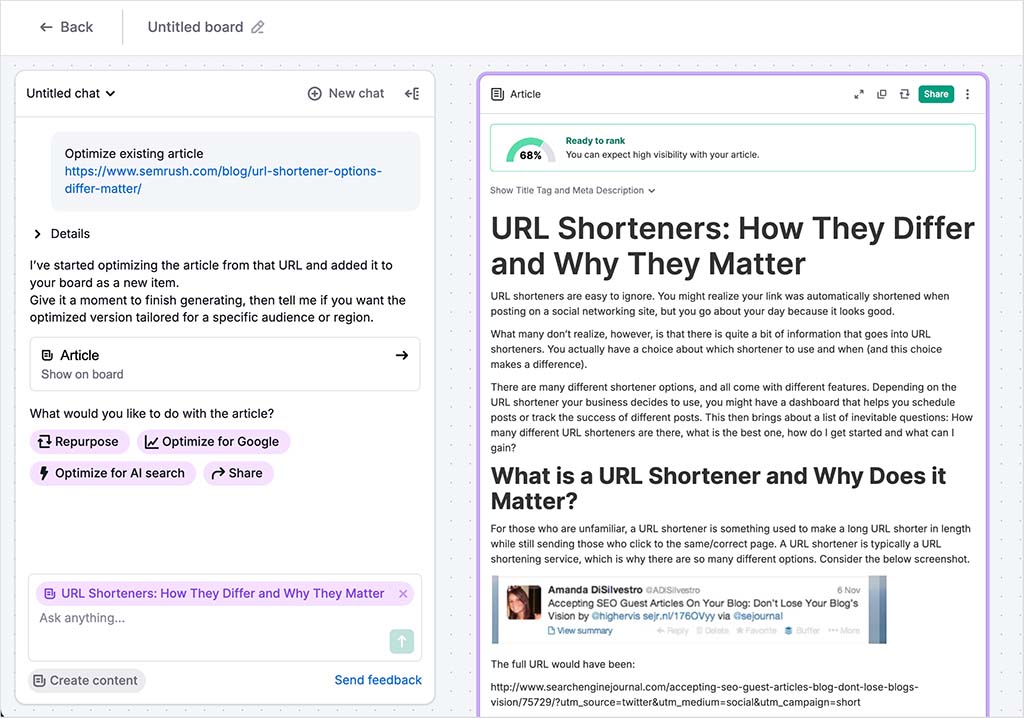
Pro+ also gives you access to historical SEO data. This is useful if you want to see how your store — or a competitor’s site — has performed in search over time.
But for many users, the main reason to choose Pro+ over Starter will be the higher usage limits. On Pro+, you can manage 15 websites, track 1,500 keywords, monitor 100 AI prompts, and crawl up to 300,000 pages per month.
This makes it a much better option than Starter if you’re managing several ecommerce sites, working with a large product catalog, or creating a lot of SEO content.
Overall, Pro+ is probably the sweet spot in the Semrush One lineup for growing ecommerce businesses.

Semrush Advanced — $549 per month
The Advanced plan costs $549 per month, so it’s a big step up, financially speaking, from Pro+.
But you do get a lot more functionality for your cash.
First, the reporting limits are much more generous than the cheaper plans. The Advanced plan lets you track up to 40 websites, monitor 5,000 keywords, work with 200 AI prompts, and crawl up to one million pages per month.
It also unlocks several of Semrush’s more advanced features.
The first is significantly increased access to Semrush’s API. This lets developers pull Semrush data into other systems — for example, custom dashboards, internal reporting tools, or other marketing apps.
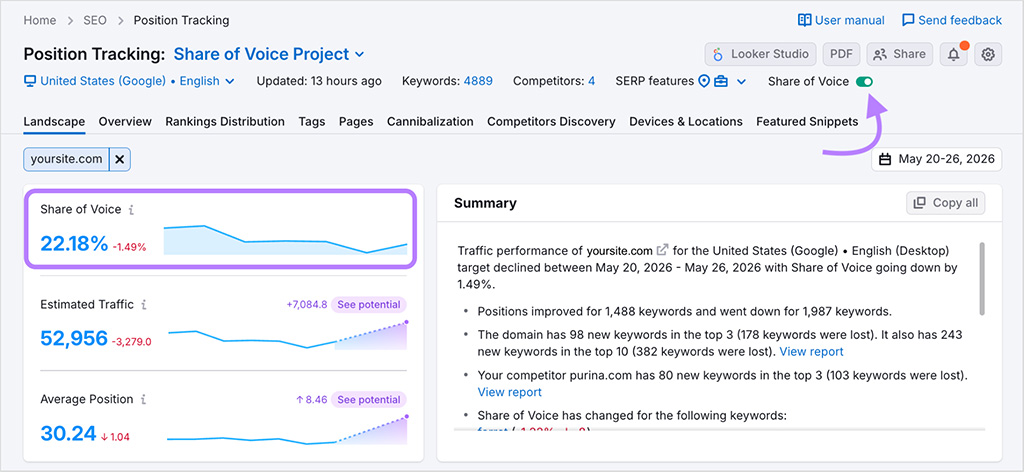
Then there’s Share of Voice data. This helps you understand how visible your site is across a group of tracked keywords, compared to your competitors.
For ecommerce brands operating stores in competitive product niches, this can be very useful, because it gives you a clearer picture of how much search visibility you’re really getting across your most important commercial terms.
And finally, Advanced gives you expanded Semrush MCP access.
MCP stands for Model Context Protocol. In simple terms, it’s a feature that AI tools like ChatGPT and Claude can use to work with Semrush data more effectively — it gives these systems direct access to Semrush’s database, which can then be queried within those tools using simple prompts. This lets users access SEO, traffic, and competitive intelligence data in an easy, more conversational way.
Ultimately, the Advanced plan is best suited to larger ecommerce businesses and technically-minded teams that need high limits, API access, and more sophisticated SEO or AI workflows. It’s overkill for new merchants and small ecommerce businesses, though.
Semrush pricing: extra costs to consider
Now, when choosing a Semrush plan, there are a couple of extra costs to watch out for.
First, Semrush plans only include one user account by default. If you want to add extra users, you’ll need to pay for them.
Additional users cost $45 per month on Starter, $80 per month on Pro+, and $100 per month on Advanced.
Second, by default, Semrush One plans only let you monitor AI visibility for one domain. Monitoring additional domains costs $99 per month per domain. This is worth remembering if you run more than one store.

SEO Classic Plans
It’s also worth mentioning that Semrush offers a cheaper set of SEO-only plans in the form of its SEO Classic subscriptions.
These plans give you access to Semrush’s traditional SEO features — including keyword research, backlink analysis, rank tracking, site auditing and on-page SEO tools — but they don’t include the platform’s newer AI visibility tracking features.
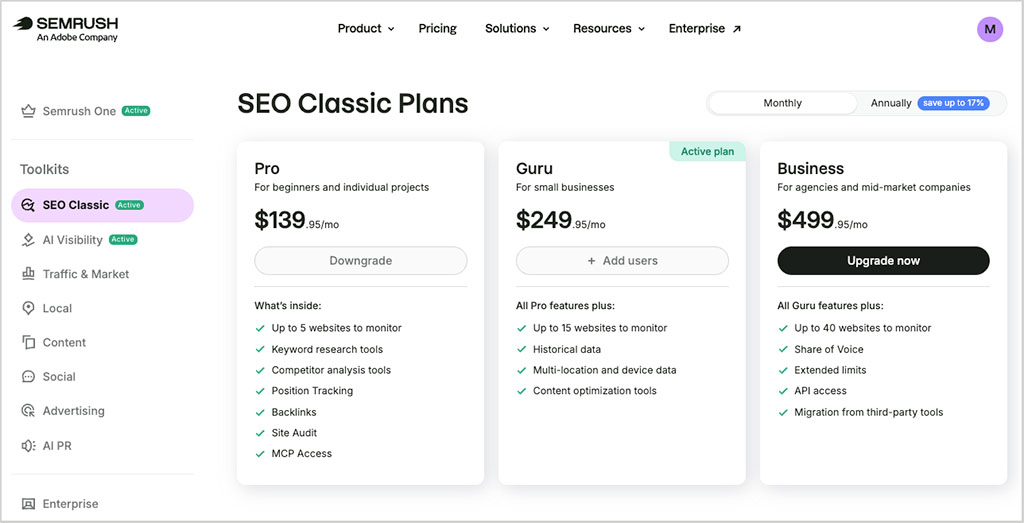
There are three main SEO Classic plans available.
The entry-level Pro plan costs $139.95 per month and is the most affordable way to access Semrush’s core SEO toolkit. It’s a good option for freelancers, bloggers, consultants, and small businesses that need powerful SEO tools but don’t currently require AI visibility tracking.
Next is Guru, which costs $249.95 per month. This plan is better suited to growing businesses and ecommerce merchants managing multiple websites, thanks to its higher limits and access to historical data. It’s also a good choice for merchants who want to drive a lot of organic traffic through content creation, thanks to its inclusion of a comprehensive set of content marketing tools.
Finally, there’s Business, which costs $499.95 per month. Aimed at agencies, larger organizations and advanced users, it comes with generous reporting limits and API access, making it a strong choice for those working on large-scale SEO campaigns and ecommerce merchants that need to integrate Semrush data into their own reporting systems.
The SEO Classic plans can represent better value than Semrush One if your focus is solely on traditional SEO. However, for many businesses, Semrush One may be the more future-proof option. Search is changing rapidly, and understanding how your brand appears in AI-powered search experiences is becoming increasingly important.
So, which Semrush plan should you choose?
For most small ecommerce businesses and solopreneurs, Semrush Starter is the best place to begin. It provides access to both Semrush’s SEO toolkit and its AI visibility tracking features, while keeping costs relatively manageable.
If you’re managing multiple websites, publishing content regularly, or need access to content optimization tools, Semrush Pro+ is likely the better option. Its higher limits and additional content marketing features make it a strong fit for growing ecommerce businesses.
Larger ecommerce brands, agencies and technically-minded teams should consider Semrush Advanced. The plan’s higher reporting limits, API access, and advanced features make it better suited to larger-scale SEO and AI visibility projects.
If you’re only interested in traditional SEO and don’t currently need AI visibility tracking, one of the SEO Classic plans may represent better value. These plans provide access to Semrush’s core SEO tools at a lower price point than the equivalent Semrush One subscriptions.
Semrush Pricing FAQ
Which Semrush plan is best for small ecommerce businesses?
For most small ecommerce businesses and solopreneurs, Semrush Starter is the best place to begin. It includes Semrush’s core SEO tools along with AI visibility tracking, and lets you manage up to five websites, track 500 keywords and monitor 50 AI prompts.
What’s the difference between Semrush One and SEO Classic?
Semrush One plans combine traditional SEO tools with AI visibility tracking features. SEO Classic plans focus solely on traditional SEO and do not include AI visibility monitoring for platforms such as ChatGPT, Gemini, or Google’s AI-powered search experiences.
Which Semrush plan includes content optimization tools?
Semrush Pro+ includes content optimization tools that help you research topics, create SEO content briefs and optimize articles. These features can be particularly useful for ecommerce businesses that publish buying guides, comparison posts and other content designed to attract organic traffic.
Which Semrush plan includes API access?
API access is available on Semrush Advanced and the SEO Classic Business plan. This functionality allows developers and technical teams to pull Semrush data into custom dashboards, reporting systems and other applications.
Are there any additional costs to consider with Semrush?
Yes. All Semrush plans include just one user account by default, with additional users charged separately. Semrush One plans also only include AI visibility tracking for one domain; monitoring additional domains costs $99 per month per domain.

Matt Walsh is the Head of Content at Ecommercetrix. He also creates video content for the site and its associated YouTube channel.
Having gained a degree in Literature and Philosophy from Trinity College Dublin and an MA in International Relations from Dublin City University, Matt worked in the marketing world for a decade before taking up an education role — teaching languages, literature and creative writing in London.
Matt is an Adobe Certified Associate in Photoshop and Illustrator, and also holds a certificate in digital marketing from DMI (Digital Marketing Institute), along with a postgraduate certificate in Design Thinking, Innovation, Entrepreneurship and Creative Thinking from Trinity College Dublin.