


In ecommerce, search is no longer just about ranking highly in Google for product keywords. These days, you also need to know how your store and products are showing up in AI systems like ChatGPT, Gemini, Perplexity, and Google AI Overviews.
So in this post, I’m going to look at five leading SEO and AI visibility tools for ecommerce businesses: Semrush, Ahrefs, SE Ranking, Moz, and Ubersuggest. Read on to find out which one is the best fit for your store.

My quick verdict on the best SEO/AI tools for ecommerce merchants
| Tool | Quick verdict |
|---|---|
| Semrush | The strongest all-round SEO and AI visibility tool here for most ecommerce businesses. It combines keyword research, site auditing, competitor analysis, PPC data and AI visibility tracking in one very joined-up platform. Try Semrush >> |
| Ahrefs | The best choice if you want access to the largest AI visibility dataset, very deep SEO data, and the option to work with an unlimited number of verified domains. However, its pricing may be harder for smaller merchants to justify. Try Ahrefs >> |
| SE Ranking | A strong option for ecommerce merchants who want a broad feature set and generous tracking limits at a lower price point than many top-tier alternatives. Its datasets are smaller, however, than those of Semrush and Ahrefs. Try SE Ranking >> |
| Moz | Worth considering if solid SEO tools, brand authority metrics, link data and affordable API access are priorities. Its pricing is a bit more competitive than that of its rivals, but its keyword research database is smaller than them too. Try Moz >> |
| Ubersuggest | The best budget option for smaller stores that need basic SEO and AI visibility features without a large monthly spend. Not as powerful as its rivals, but cheaper than them. Try Ubersuggest >> |
Let’s go through each tool in depth now.
Semrush
Semrush has long been considered one of the strongest SEO platforms on the market. But it’s now one of the most complete tools for tracking visibility in AI search too.
On the SEO side, it does everything you’d expect, and very well too. It lets you research product and category keywords, perform an SEO audit on your store, analyze backlinks, check competitor performance, and track rankings.
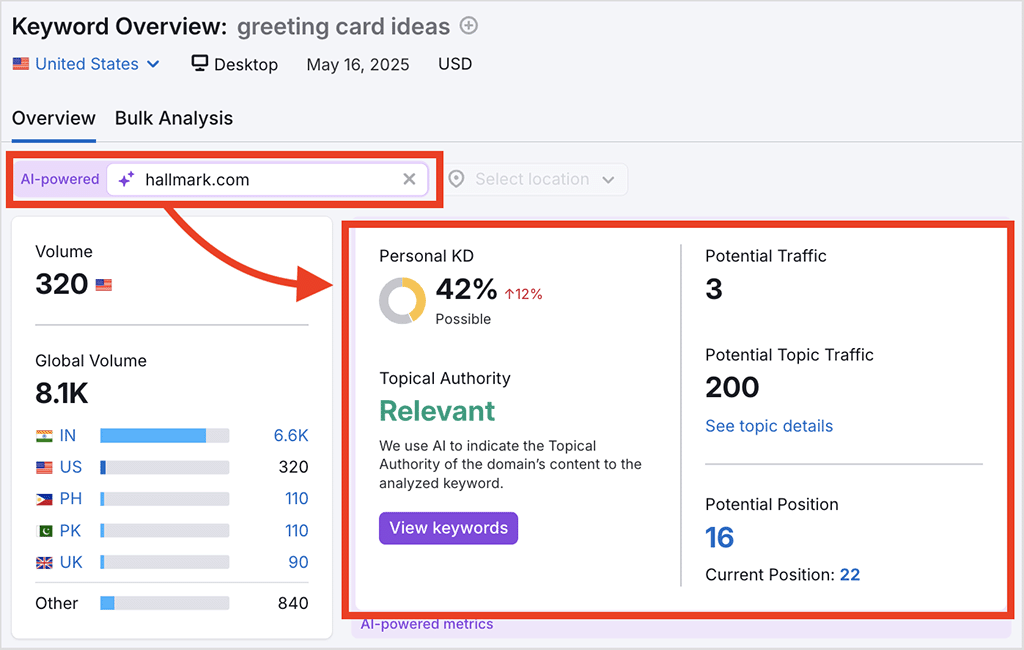
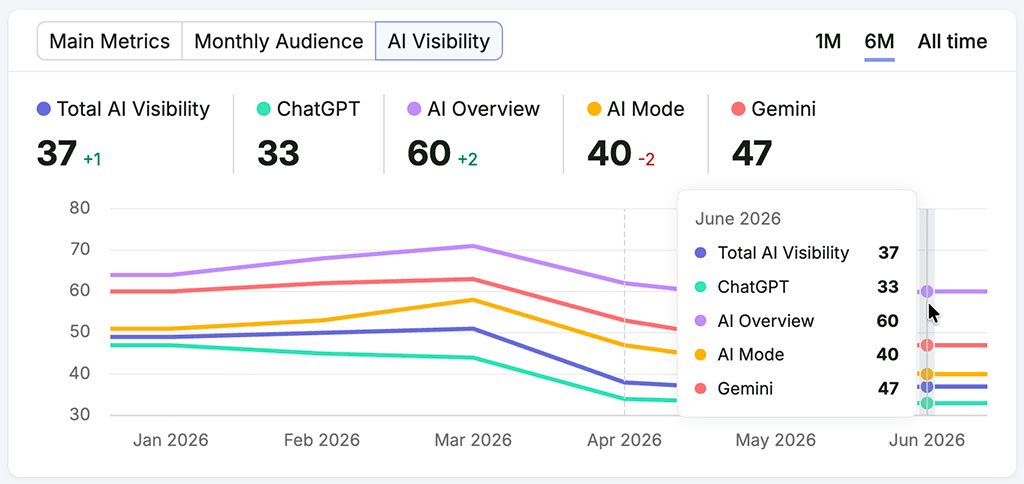
On the AI visibility side, Semrush’s feature set includes prompt tracking, citation analysis, share-of-voice reporting, competitor benchmarking, and sentiment analysis. That last feature is important: it doesn’t just tell you whether your store is being mentioned — it tells you how it’s being described.
Semrush also supports the “Model Context Protocol,” a feature that lets AI systems connect directly to Semrush data. This means you can use natural language prompts in AI tools to query live Semrush information, simplifying tasks like keyword research and competitor analysis in the process.

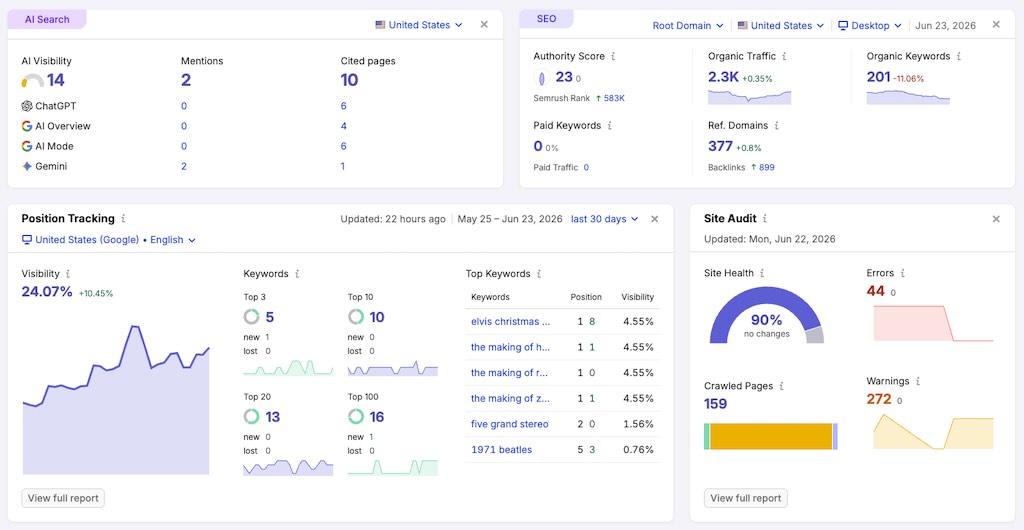
But what I *particularly* like about Semrush is how joined-up everything feels. AI health scores, cited pages, and brand mentions are displayed clearly alongside organic traffic data, keyword rankings, backlinks, and site authority metrics. And the availability of features like advertising research data and content marketing tools further adds to the sense of Semrush being an ‘all-in-one’ marketing platform rather than a specialist SEO tool.
The downside of all this functionality, however, is Semrush’s pricing. Its plans that include both SEO and AI visibility features start at a not-insignificant $199 per month.

So Semrush isn’t the cheapest option. But for ecommerce businesses that want SEO, AI visibility tracking, PPC research, content tools, and competitor analysis in one place, it’s probably the strongest choice.
Ahrefs
Ahrefs is another platform that’s traditionally been seen as a market-leading SEO tool, and it’s especially strong when it comes to the amount of data it gives you.
Its keyword database contains more than 28.7 billion keywords from 217 locations; its backlink index contains over 35 trillion live links; and its crawler tracks nearly 20 billion pages.
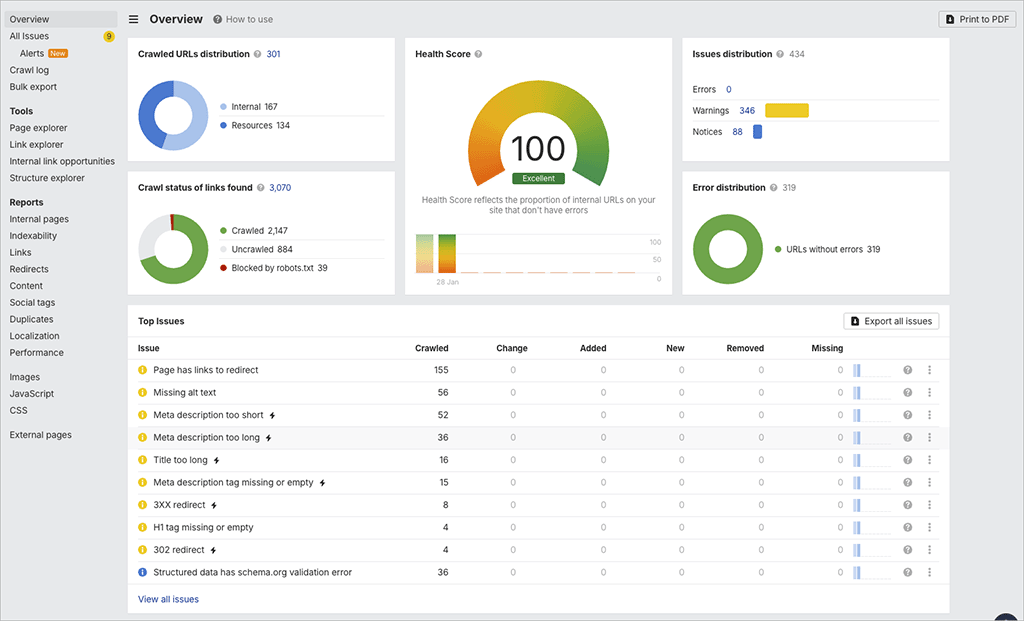
For ecommerce merchants, this makes Ahrefs particularly useful for competitor research. It lets you see which keywords rival stores rank for, spot which product or category pages attract backlinks, and identify content ideas that are already working in your ecommerce niche.

Ahrefs also beats its rivals when it comes to the number of websites you can monitor — so long as you can verify ownership of them, you can use Ahrefs to track the SEO performance of an unlimited number of domains. The option to do this can be really useful if you work with multiple online stores.
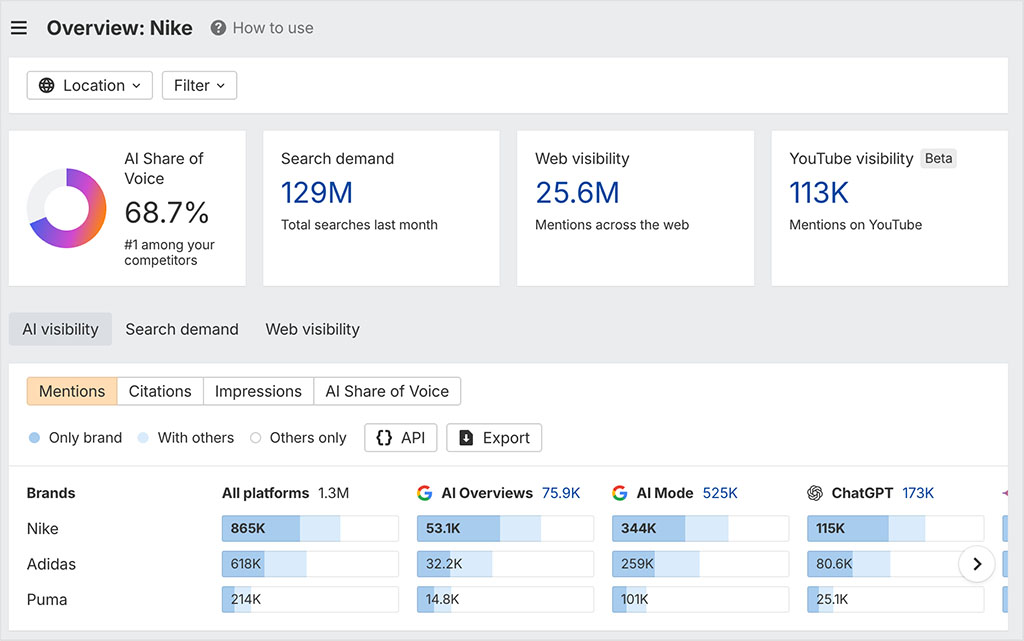
Ahrefs has also moved seriously into AI visibility tracking too, via its Brand Radar feature. This gives you access to a database of 387 million monthly prompts across seven AI search environments: ChatGPT, Gemini, Perplexity, Copilot, Grok, Google AI Overviews and Google AI Mode.
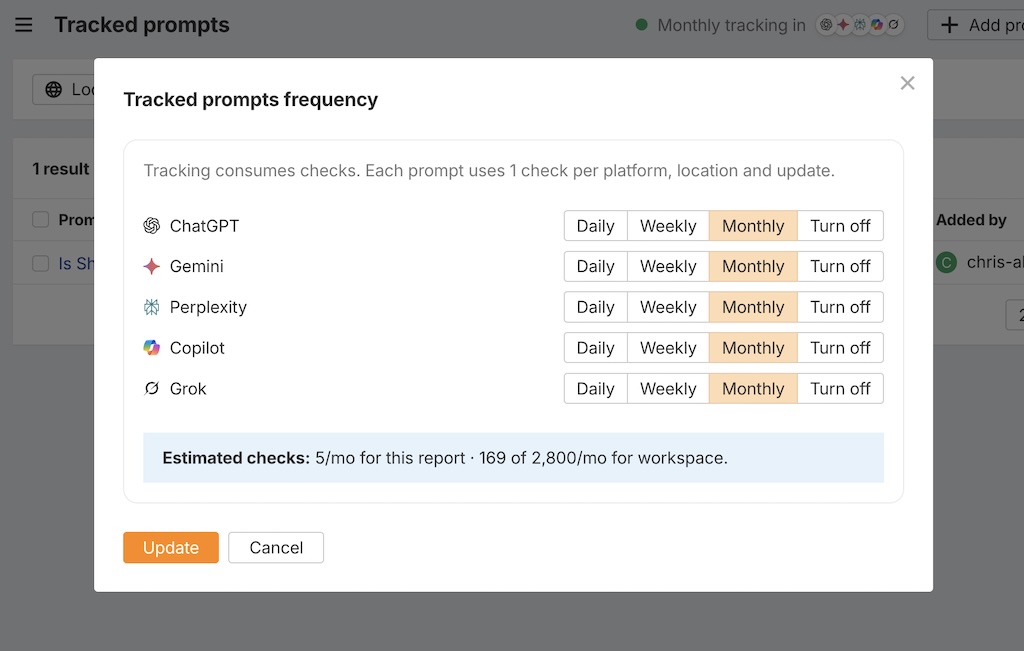
That means Ahrefs gives you the largest AI visibility dataset and the broadest AI platform coverage of the tools I’m covering here.
With Brand Radar, you can monitor brand mentions, citations, and share of voice across AI-generated answers. You can also compare your store against up to 20 competing ones, and see which of your competitors are being cited most often by AI systems.
Significantly, Brand Radar also tracks brand mentions across YouTube, TikTok, and Reddit. This matters because these platforms increasingly influence both search results and AI-generated answers — especially in product-led niches.
However, Ahrefs doesn’t currently provide AI brand sentiment analysis in the same way that some competing tools do. It lets you see where your brand appears — but doesn’t tell you *how* it’s being talked about.
Now, pricing is arguably Ahrefs’ key drawback. Its entry-level “Lite” plan costs $129 per month, but many of the key features that ecommerce merchants need are locked behind its $249-per-month “Standard” plan. And significantly, its AI visibility tracking tool, Brand Radar, is sold separately — meaning that you’re looking at an add-on fee of at least $199 per month to access any AI data.

Overall, Ahrefs is an excellent choice for ecommerce businesses that run multiple websites, and want access to huge SEO and AI visibility datasets. But many merchants, particularly those running small stores, may find its pricing harder to justify.
If you’d like to try Ahrefs out, you can access some of its free tools here.
SE Ranking
SE Ranking started as an SEO platform, but it’s now become a strong online visibility tool too.
When it comes to SEO, SE Ranking gives you generous allowances for rank tracking, site audits, backlink analysis, keyword research and competitor monitoring. Its rank tracker is particularly strong, and its interface is easier to get to grips with than some of the more advanced tools in this list.
SE Ranking provides comprehensive AI visibility tracking features through its AI Results Tracker and SE Visible products. These let you monitor how your brand and content appear across ChatGPT, Gemini, Perplexity, Google AI Overviews, and Google AI Mode.
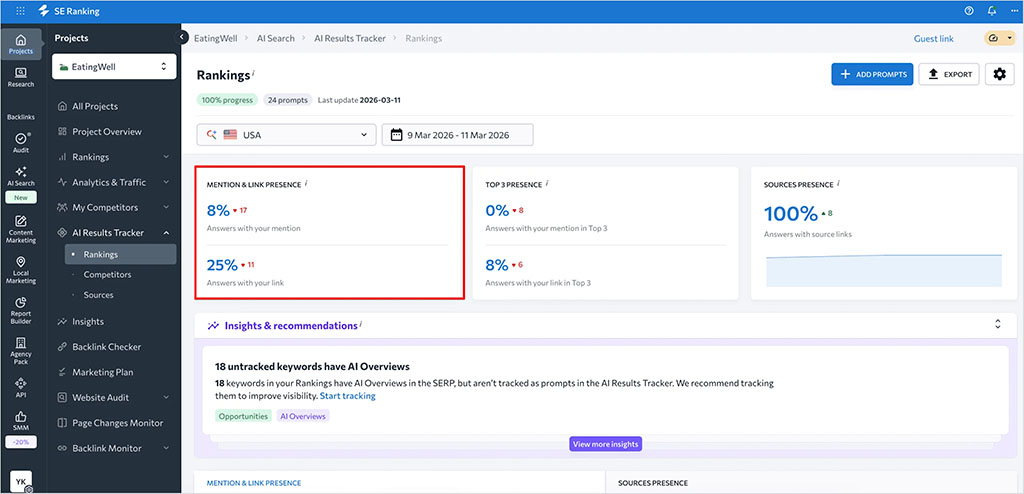
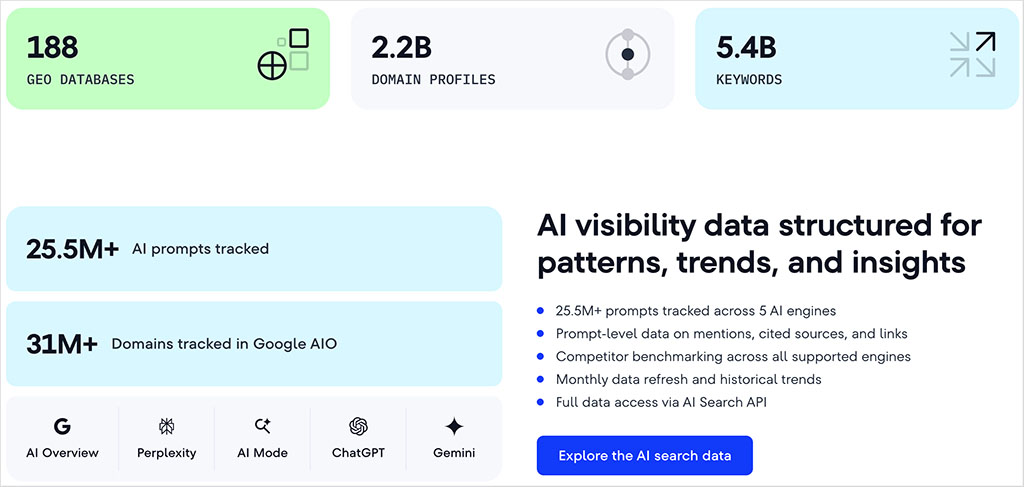
SE Ranking’s main drawback is database size. Its databases currently contain 25.5 million AI prompts, 5.4 billion keywords, and 2.7 trillion backlinks. That’s a lot of data, but still considerably less than you get from Semrush or Ahrefs.
And SE Ranking isn’t as cheap as it used to be — its plans now start at $129 per month, which is in line with how much higher-end tools like Ahrefs and Semrush charge. That said, you get more generous tracking and reporting limits for the money.
Ultimately, for ecommerce merchants who want a capable SEO and AI visibility platform without paying top-tier Semrush or Ahrefs prices, SE Ranking is a very strong option.
Moz Pro
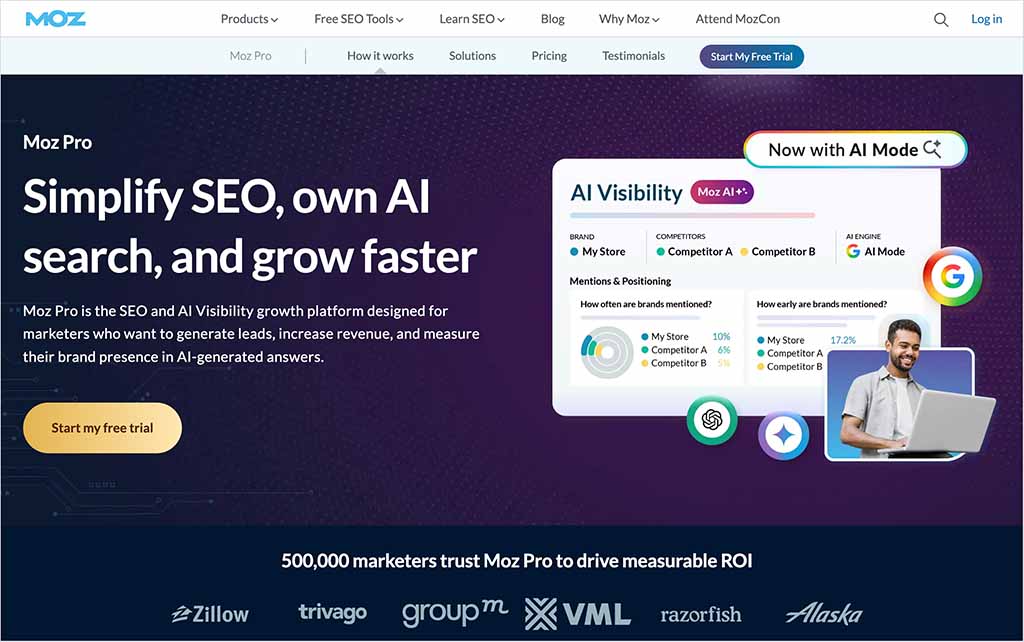
Moz has been around for a long time, and it remains a solid SEO platform that handles key tasks like rank tracking, site auditing, and local SEO very well. It also offers commendably cheap access to its API — this is available from just $20 per month.
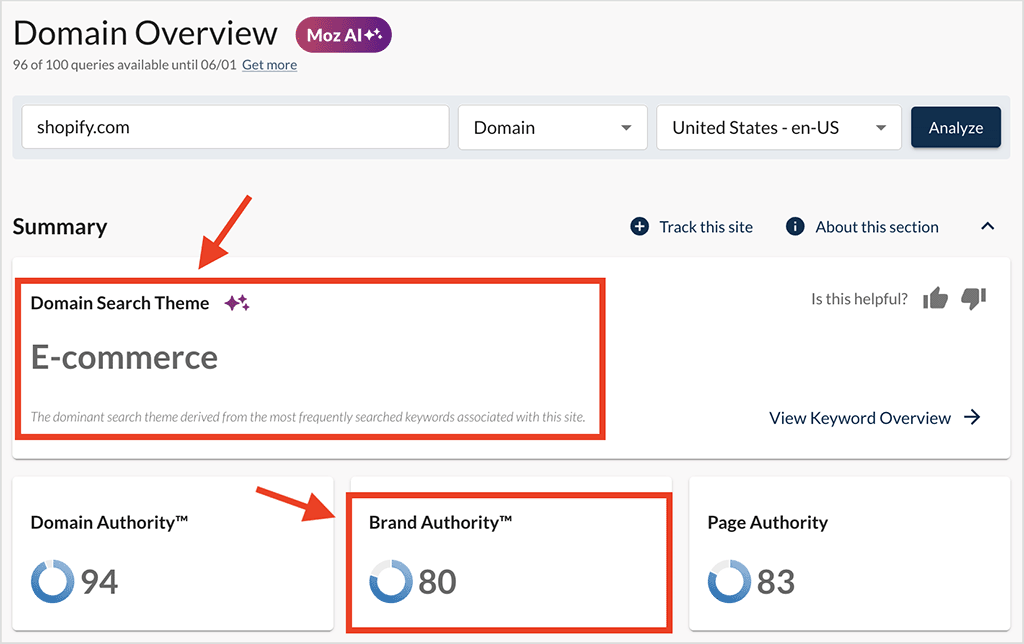
Now, one of Moz’s most distinctive features is its Brand Authority score. This gives you a rating from 1 to 100 that reflects how well-known a site or parent company is online. For ecommerce merchants, that’s useful because brand strength increasingly matters. These days, search engines and AI systems are more likely to favor trusted, well-known brands over ecommerce stores with little reputation or authority.
I also really like Moz’s ‘domain search theme’ summary, which identifies a site’s key topic (based on search behavior). This is useful for checking if your site’s topical focus is clear — Google increasingly rewards sites focused heavily on single niches in search results — and for assessing whether another domain is an appropriate fit for link building outreach.
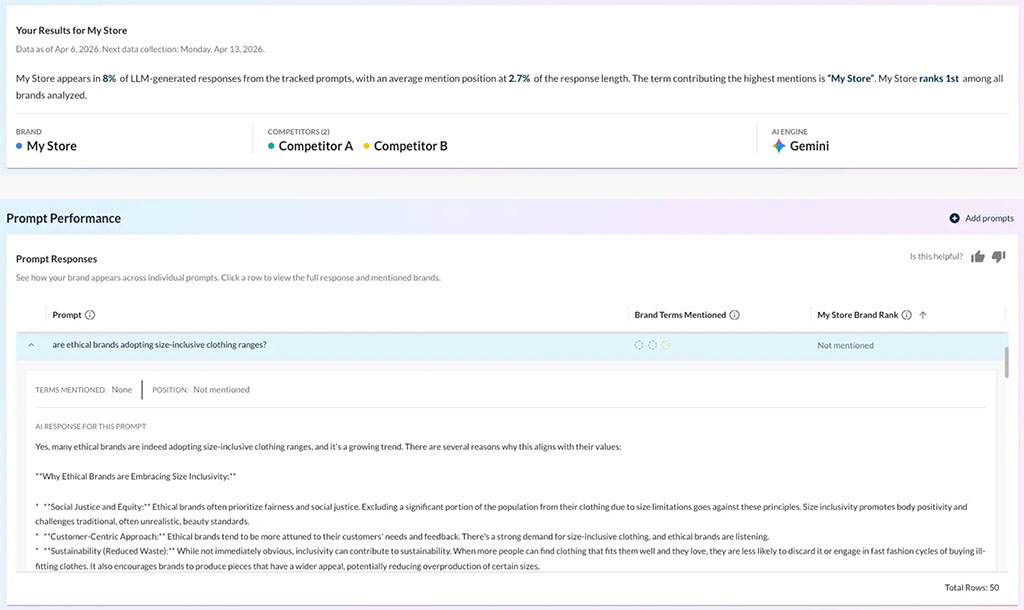
Moz’s AI features come in the form of its AI Research toolkit — this gives you access to prompt suggestions, AI content brief tools, and AI visibility tracking. These features let you monitor brand performance across key AI tools, and see how prominently your content appears in AI-generated answers.
The main drawback of Moz is the size of its keyword database. It contains just 1.25 billion keywords, far fewer than you’ll find in the equivalent databases provided by Semrush, Ahrefs and SE Ranking. On the plus side, it does have a very large backlink database, containing 44.8 trillion links.
Moz is ultimately a decent choice if you care about link data, site auditing, and brand authority tracking — and want SEO and AI visibility tracking features at a relatively affordable price.
Ubersuggest
Ubersuggest is the most affordable tool in this roundup by some distance. Its plans start at $29 per month, and lifetime purchase options are also available.
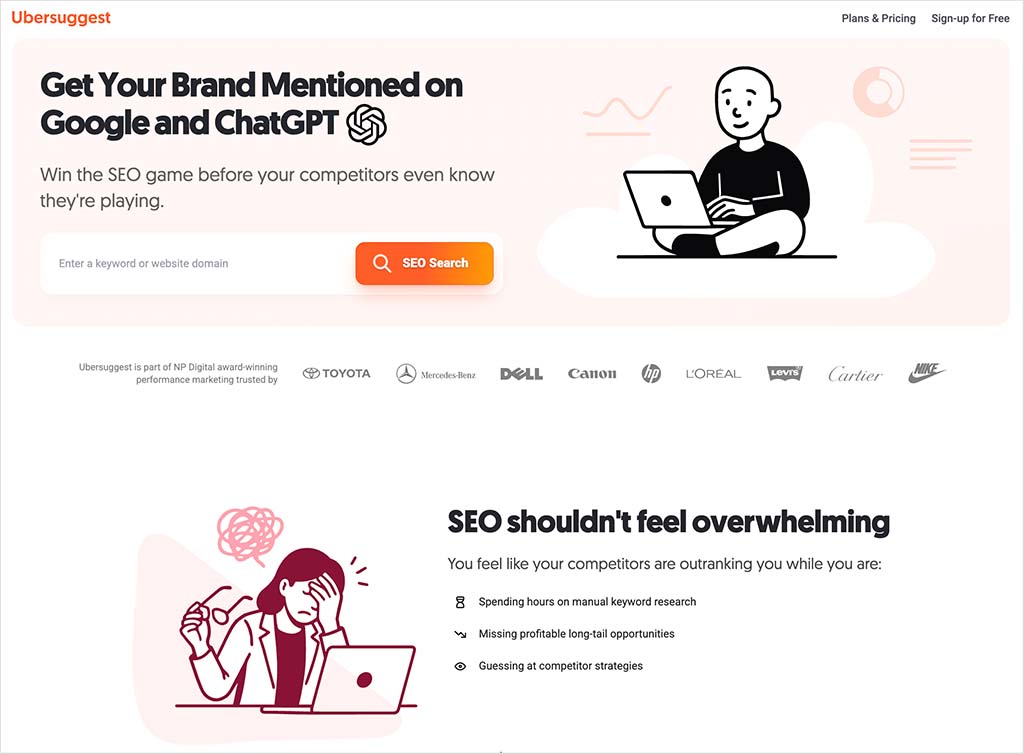
For solo ecommerce merchants in particular, this makes the product an attractive option. For less than $30 per month, Ubersuggest gives you access to keyword research, rank tracking, site auditing, backlink analysis, competitor research and content ideas — all presented through a clean, beginner-friendly interface.
Ubersuggest has also added some AI visibility functionality. It lets you monitor brand appearances in ChatGPT and Gemini, compare your visibility against competitors and identify relevant AI prompts for your industry.
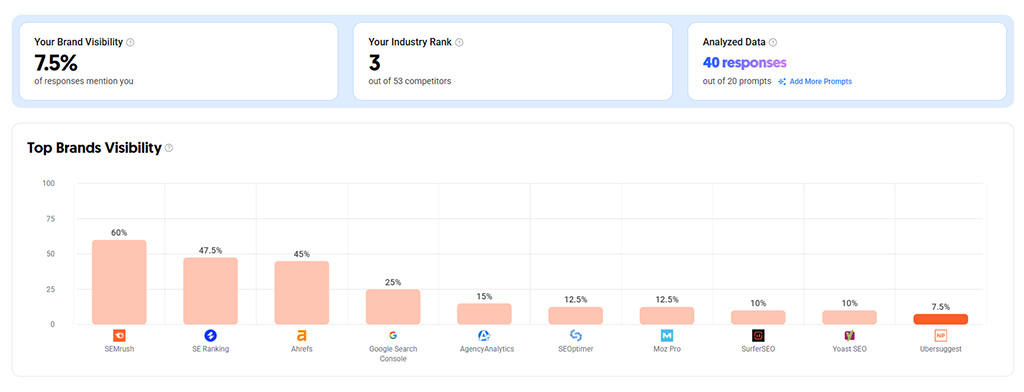
However, it has to be said that Ubersuggest’s AI features are much more basic than those provided by Semrush, Ahrefs, SE Ranking or Moz. Its datasets are smaller too.
So ultimately, Ubersuggest isn’t the right tool for conducting large ecommerce SEO campaigns or performing deep competitive research. But for budget-conscious merchants, it offers very good value.
User ratings and reviews
So far, you’ve heard my take on five of the leading SEO/AI visibility tracking tools. But what do users think? To help you get a sense of this, I’ve collated user ratings from G2 — a popular software user review site — for the five platforms under discussion — see my table below for details.
| Tool | User rating |
| Semrush | 4.4 / 5 |
| Ahrefs | 4.5 / 5 |
| SE Ranking | 4.7 / 5 |
| Moz Pro | 4.3 / 5 |
| Ubersuggest | 4.2 / 5 |
Verdict
For the strongest all-round mix of SEO, AI visibility, PPC data and competitor research, I’d go with Semrush.
For the biggest AI visibility dataset and very strong SEO data, Ahrefs is excellent — provided your budget can stretch to it.
For ecommerce merchants who want generous tracking limits and an extensive feature set, SE Ranking is a very solid choice — so long as you can make do with smaller keyword and link databases.
For brand authority tracking, link data and affordable API access, Moz is worth considering.
And for small stores on a tight budget, Ubersuggest is the obvious low-cost option.
And that’s it — I hope you’ve found this roundup useful! If you have any questions about any of these tools, do drop them in the comments. We read them all and will do our best to help.

Chris Singleton is the Founder and Director of Ecommercetrix.
Since graduating from Trinity College Dublin in 1999, Chris has advised many businesses on how to grow their operations via a strong online presence, and now he shares his experience and expertise through his articles on the Ecommercetrix website.
Chris started his career as a data analyst for Irish marketing company Precision Marketing Information; since then he has worked on digital projects for a wide range of well-known organizations including Cancer Research UK, Hackney Council, Data Ireland, and Prescription PR. He then went on to found the popular business apps review site Style Factory, followed by Ecommercetrix.
He is also the author of a book on SEO for beginners, Super Simple SEO.