

In this Ahrefs vs Profound comparison, we help you decide which of these leading AI visibility solutions works better for your ecommerce needs.
Our quick verdict on Ahrefs vs Profound
Ahrefs is the better all-round choice for most ecommerce businesses, because it doesn’t just show you how visible your brand is in AI systems — it also gives you the SEO tools needed to improve that visibility. Its larger AI prompt database, competitor research features and full SEO toolkit let you discover new opportunities to shape AI conversations — and act on them.
Profound does have some strong edges over Ahrefs too, though: it’s the stronger option if you need detailed prompt tracking over time, sentiment analysis, and AI shopping. It also provides data for a slightly wider range of AI tools.
But for merchants who need a toolset for both understanding AI visibility and improving it, Ahrefs is the more natural choice.
If you’re trying to improve your visibility in AI tools, there’s a good chance you’ve come across Ahrefs and Profound.
Both help you monitor AI prompts. Both let you see how often your brand appears in AI-generated answers. And both track AI visibility.
But after testing both platforms extensively, we think there’s one really important difference between them that ecommerce merchants need to understand.,
And it’s this: one of these tools is primarily designed to help you monitor AI visibility. The other is designed to help you improve it.
In this post, I’m going to discuss that distinction — and what it means for your online store.
First, I’ll walk you through the key reasons to use Ahrefs over Profound, and then I’ll highlight the reasons you might want to choose Profound instead.

Reasons to use Ahrefs
1. Ahrefs gives you access to a much larger AI prompt database.
Ahrefs’ AI analysis feature, Brand Radar, is built on a very large database of AI prompts and responses — it covers around 400 million monthly prompts.
This huge database lets you explore entire ecommerce categories, and see which brands AI systems mention most within them.
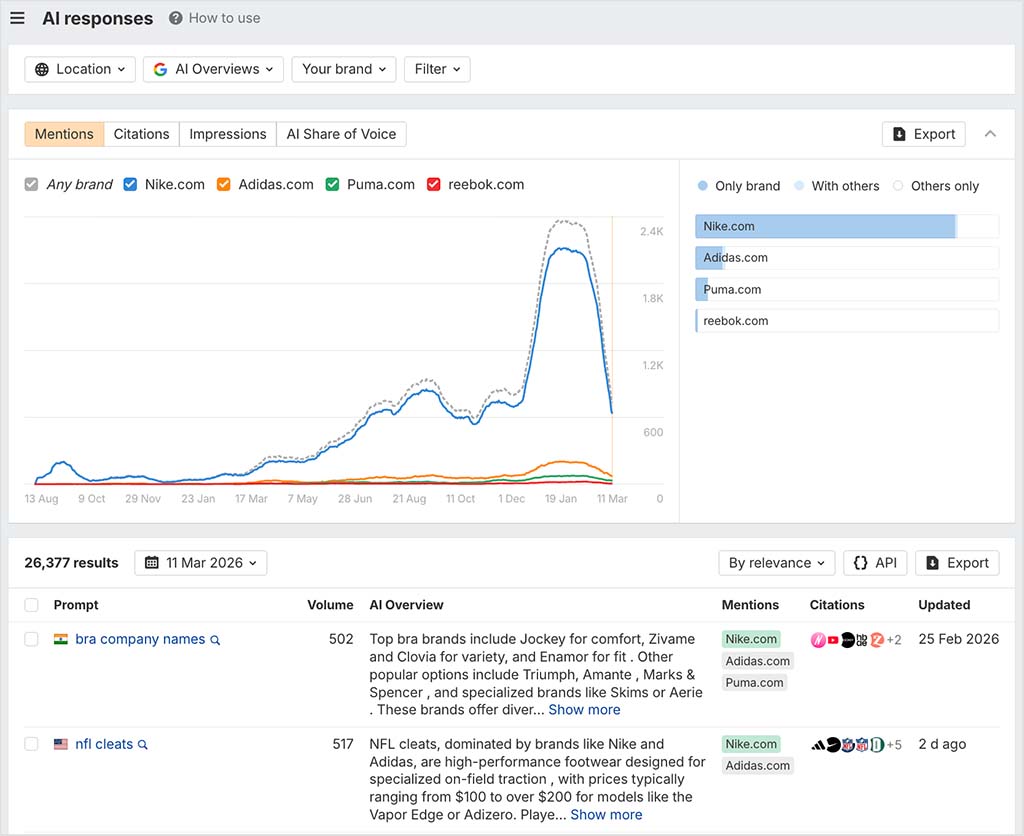
For example, you could examine categories like “best ecommerce platforms,” “best running shoes,” “top email marketing tools,” “best project management software” — and quickly identify which brands dominate AI-generated answers in those spaces.
Profound works differently. It’s much more focused on monitoring prompts that you choose to track, like:
“What’s a good Xbox alternative?”,
“Where can I buy cheap swimming togs?”
“What’s the best electric car?”
Now, that monitoring-focused approach definitely has advantages, and can be much more precise — but it relies on you knowing what you want to track.
2. Ahrefs is better for surfacing prompts people genuinely use
A lot of merchants assume AI visibility is about appearing for obvious buying-intent prompts like “best ecommerce platform,” “cheap holidays” or “best gym clothing brand.”
But in reality, AI systems often recommend products and brands inside much broader conversations.
For example, somebody might ask ChatGPT how to reduce knee pain while jogging — and the AI response might mention a particular brand of shoe insole.
Or somebody might ask how to increase team productivity — and get a recommendation to try apps like Monday or Trello.
Now, because Ahrefs has such a large dataset of prompts and responses, it’s great at surfacing these “non-obvious” prompts that lead to brand recommendations. And this matters because these are often the prompts businesses completely overlook when trying to improve their AI visibility.
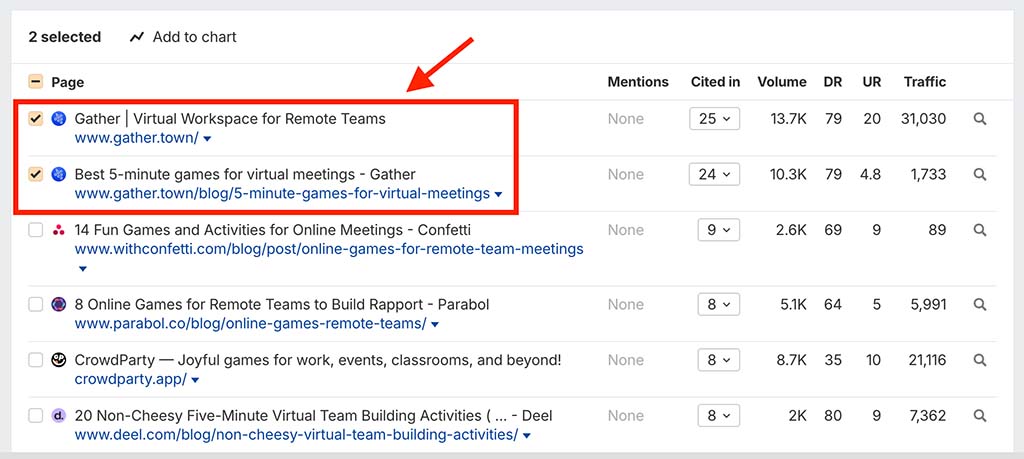
As I mentioned earlier, with Profound, you generally get data on prompts you already want to monitor. It’s not as good as Ahrefs at showing you the prompts that people actually use.

3. Ahrefs makes competitor analysis much easier
Ahrefs has a big advantage when it comes to competitor research.
Because its Brand Radar tool is built around a massive, indexed dataset, it lets you quickly compare how different brands appear in huge numbers of AI-generated answers.
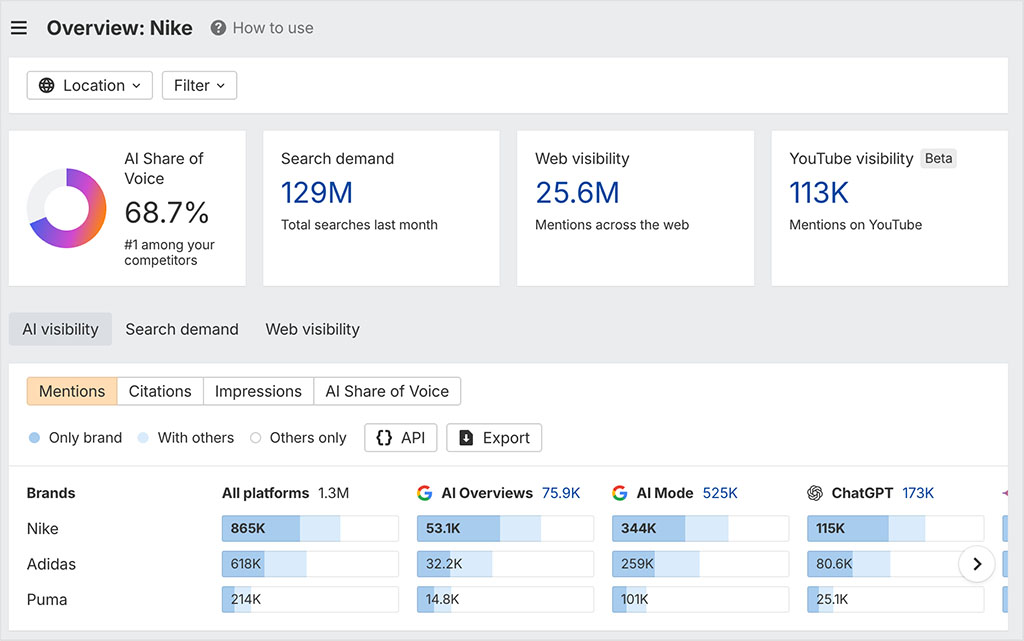
For ecommerce businesses, this can be incredibly useful. You can use Brand Radar to identify which of your competitors dominate AI recommendations, which product categories they appear in most often, and which topics AI systems associate most strongly with them. And you can draw important lessons about their content strategies from all this.
Now, Profound supports competitor tracking too. But again, because it relies on prompts you define, it’s less effective than Ahrefs here. The process involves more guesswork, more data entry, and more waiting for monitoring data to come in.
4. Ahrefs helps you identify which publishers influence AI answers in your ecommerce niche
Ahrefs shows you which publishers are being referenced the most by AI tools in your ecommerce niche. It makes it easy to see which blogs, review sites, and user forums are influencing answers about the type of products you sell.
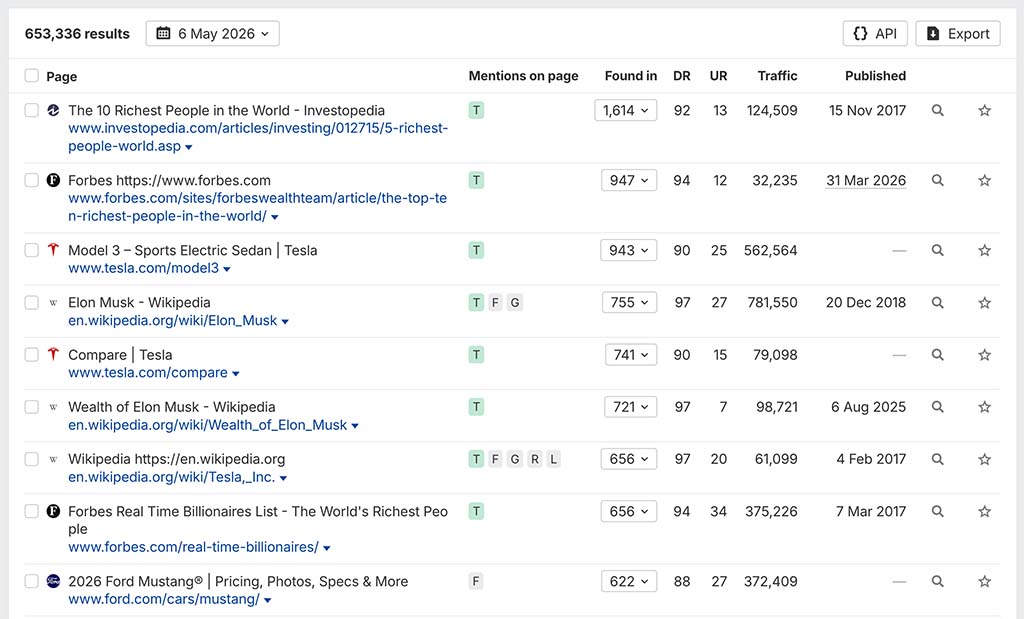
You can then use this information to shape outreach campaigns, PR activity, or content partnerships.
With Profound, although it tells you which publishers are referenced in answers to specific prompts, it doesn’t give you this “niche-level” understanding of who the most important players in your industry are.
5. Ahrefs gives you a complete SEO toolkit alongside AI visibility data
Getting your content to show up in AI tools is still highly dependent on traditional SEO techniques.
If your ecommerce website has strong backlinks, good technical SEO, helpful content and high topical authority, you’re far more likely to appear in AI-generated answers.
And this is where Ahrefs has a major advantage over Profound.
It gives you AI visibility tracking features; keyword research tools; backlink analysis; technical SEO audits; rank tracking; content analysis; and competitor SEO data. And all this functionality lets you go far beyond simply monitoring AI answers — it lets you influence them.
For example, if you discover that a competitor dominates AI answers for a product category, you can ask Ahrefs to show you which keywords they rank for, which backlinks support their pages, and which of their blog posts perform best in search. You can use this data to reverse-engineer successful content, and help your own pages and posts become more visible in both search engines and AI tools.
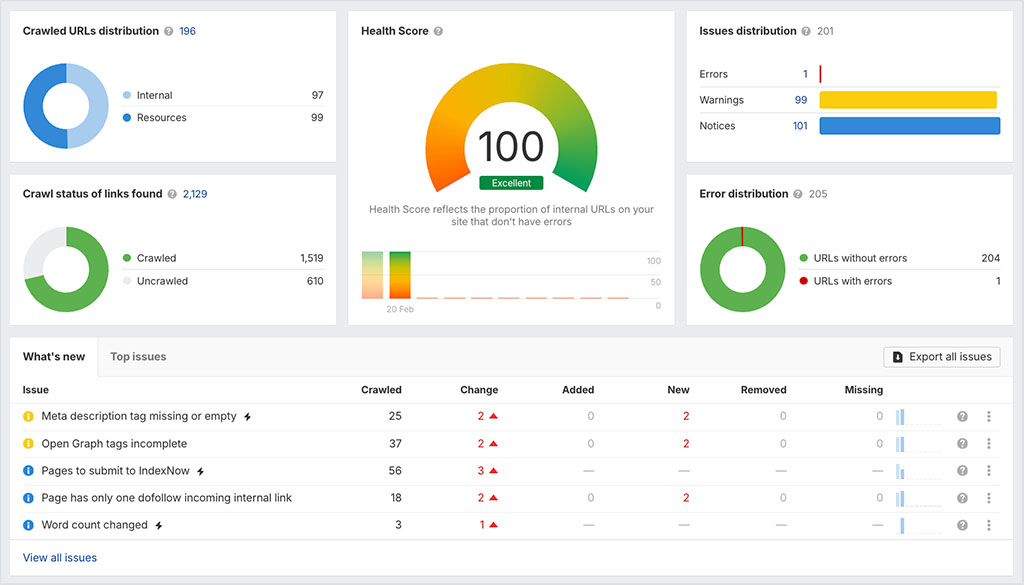
In short, Profound is good at showing you what’s happening inside AI systems.
But Ahrefs gives you a much bigger toolkit for actually influencing those outcomes.
Now, with all that said, Profound definitely has some important edges over Ahrefs. I’ll take you through these now.
Reasons to use Profound over Ahrefs
1. Profound is better for prompt monitoring over time
Profound is specifically designed around ongoing prompt tracking. And this is probably its biggest strength.
It lets you create prompt tracking campaigns focused on your brand, your competitors, particular products, and specific industries.
It then lets you monitor how the visibility of the prompts you’ve entered changes over time. You can track metrics like visibility share; citations; competitor rankings; and average positioning within AI answers.
Now, Ahrefs does support custom prompt tracking too. But instead of working with timelines and graphs that let you get a sense of ongoing performance, you’re dealing more with data ‘snapshots’. You can compare snapshots from different points in time against each other — but this makes getting data on your progress a much more manual affair.
2. Profound gives you AI prompt demand estimates
Profound gives you access to an interesting feature called “Prompt Volumes.”
This attempts to estimate how frequently different AI prompts are being used — similar to the way that SEO tools estimate Google search volumes.
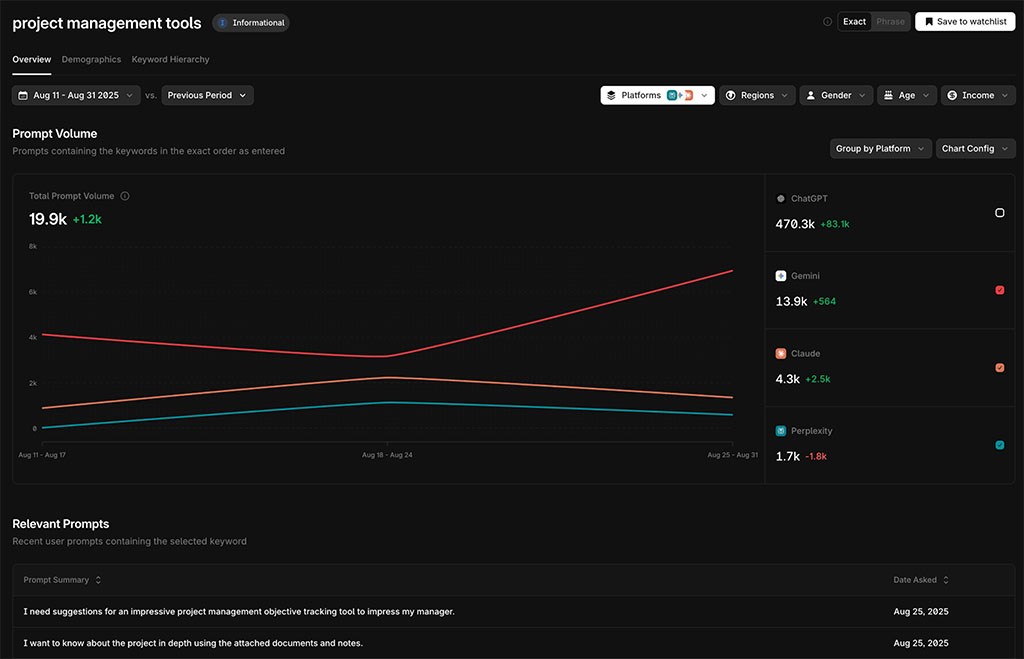
Now, because AI companies don’t publicly release detailed prompt-level usage data, these estimates can’t be treated as perfectly precise. There’s a bit of guesswork — albeit sophisticated guesswork — going on here.
But even so, these estimates can still give you a useful idea of which products and topics people are increasingly asking AI tools about — and help you get a sense of what content to produce next.
3. Profound analyzes brand sentiment
Unlike Ahrefs, Profound doesn’t just track whether brands appear in AI answers. It also analyzes how AI systems describe them.
So, for example, you could use Profound to find out if AI tools associate your ecommerce brand with things like affordability, product quality, innovation, customer service, or premium pricing.
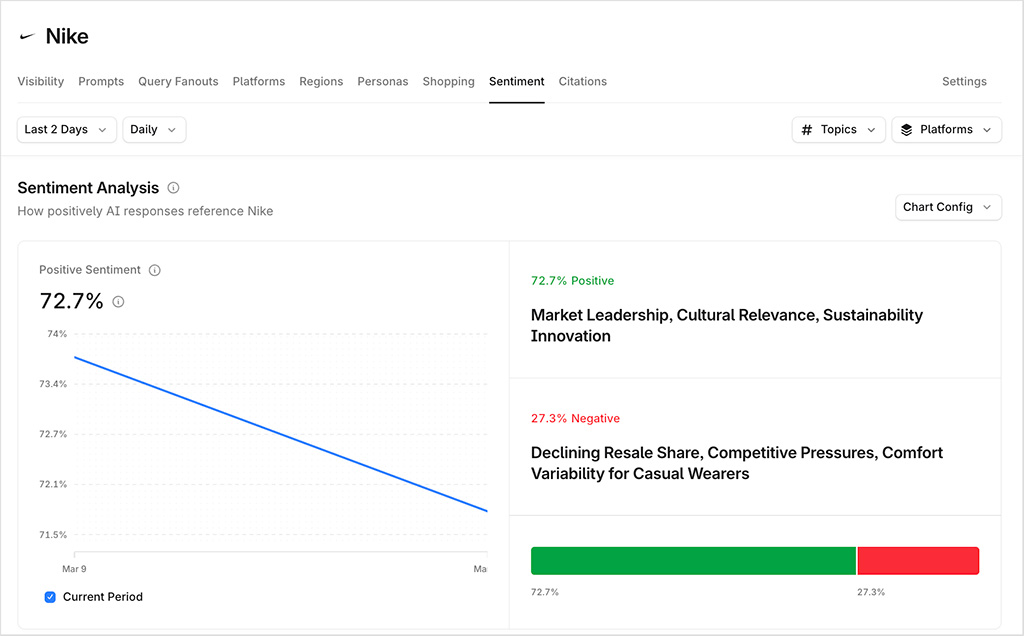
You can then use this data to change or improve your positioning, or to tweak your product range to suit how you want your brand to be perceived.
4. Profound gives you AI shopping analysis features
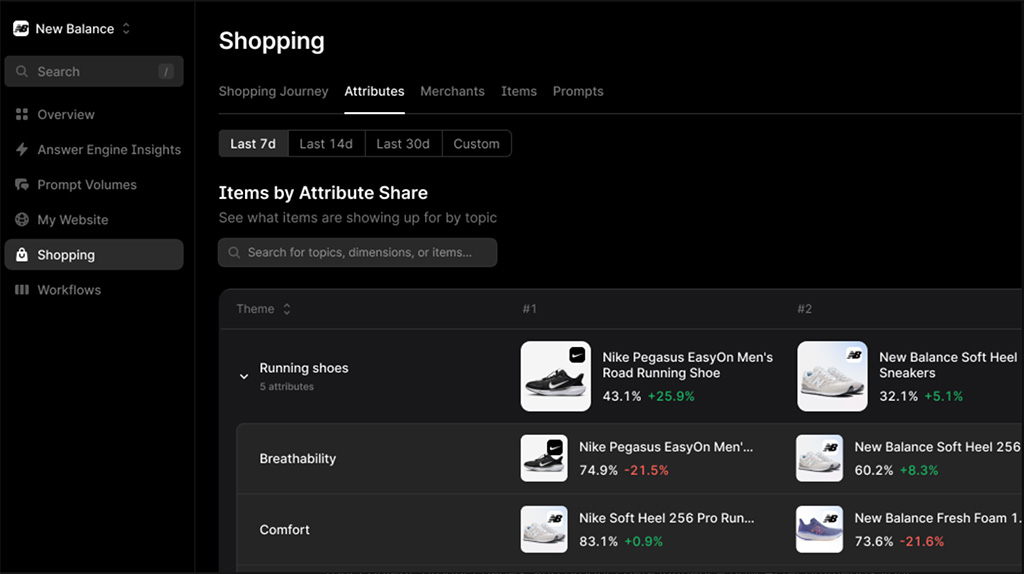
Profound gives you dedicated AI shopping analysis features — a toolset that will be of particular interest to ecommerce merchants. These features help you understand:
- which products appear in AI-generated buying recommendations
- which attributes AI systems emphasize
- how products are positioned inside AI shopping conversations.
So, if somebody asks “What are the best running shoes for marathon training?” or “What’s the best standing desk for small offices?”, Profound can show you which brands and product features AI systems typically prioritize in those answers.
Profound also provides “Agent Analytics” tools for Shopify that show you which product pages AI systems appear to visit during product research.
Currently, Ahrefs doesn’t really offer an equivalent feature set.
Related resources
5. Profound supports more AI platforms
Profound currently supports monitoring across a slightly wider range of AI systems than Ahrefs. It surfaces data from ChatGPT, Perplexity, Google AI Mode, Google AI Overviews, Gemini, Copilot, Meta AI, Grok, DeepSeek, and Claude.
Ahrefs covers most of the major platforms — but not Claude, Meta AI, or DeepSeek.
Verdict
If your main priority is detailed prompt monitoring and AI visibility reporting over time — especially for ecommerce product discovery — Profound is an excellent choice. Its sentiment analysis, shopping intelligence, and long-term monitoring tools are genuinely impressive.
But for most ecommerce businesses, I actually think Ahrefs is the better option.
And that’s because SEO still plays a huge role in AI visibility. AI systems continue to rely heavily on authoritative content, backlinks, trusted publishers, topical relevance, and strong technical SEO. And Ahrefs doesn’t just give you data on AI answers — it gives you the tools you need to make your online store and products show up in those answers.

FAQs about Ahrefs vs Profound
Is Ahrefs or Profound better for AI visibility tracking?
Ahrefs is the better choice for most ecommerce businesses that want to both monitor and improve their AI visibility. Its Brand Radar tool gives you access to a very large database of AI prompts and responses, while its wider SEO toolkit helps you act on the insights you find.
Profound is better suited to businesses that need detailed prompt monitoring over time, sentiment analysis and AI shopping intelligence.
What is the main difference between Ahrefs and Profound?
The main difference is that Ahrefs is stronger as an all-round SEO and AI visibility platform, while Profound is more focused on AI prompt monitoring and reporting.
Which tool is better for ecommerce businesses: Ahrefs or Profound?
For most ecommerce businesses, Ahrefs will be the more useful solution because it combines AI visibility data with the SEO tools needed to ensure AI visibility in the first place — keyword research features, backlink analysis, site auditing, rank tracking and competitor research.
However, Profound may be the better option for ecommerce brands that are specifically focused on AI shopping visibility, product recommendations and long-term prompt tracking.
Which tool is better for monitoring AI prompts over time?
Profound is better for monitoring AI prompts over time. It is built around ongoing prompt tracking campaigns and gives you clearer tools for monitoring how visibility, citations, rankings and positioning change.
Ahrefs can be used for custom prompt tracking too, but its approach is more snapshot-based, making long-term tracking a more manual affair.
Should I use Ahrefs and Profound together?
Using Ahrefs and Profound together can make sense if AI visibility is a major priority for your business.
Ahrefs can help you discover opportunities, analyze competitors, improve your SEO and identify influential publishers. Profound can then help you monitor specific prompts over time, track sentiment and analyze ecommerce-focused AI shopping results. For many smaller businesses though — and especially those working with small budgets — Ahrefs on its own will usually provide the better all-round toolkit.

Chris Singleton is the Founder and Director of Ecommercetrix.
Since graduating from Trinity College Dublin in 1999, Chris has advised many businesses on how to grow their operations via a strong online presence, and now he shares his experience and expertise through his articles on the Ecommercetrix website.
Chris started his career as a data analyst for Irish marketing company Precision Marketing Information; since then he has worked on digital projects for a wide range of well-known organizations including Cancer Research UK, Hackney Council, Data Ireland, and Prescription PR. He then went on to found the popular business apps review site Style Factory, followed by Ecommercetrix.
He is also the author of a book on SEO for beginners, Super Simple SEO.