


Shopify has announced the introduction of its new “Campaign Autopilot” feature — a new AI-powered marketing tool designed to help merchants create, manage and optimize advertising campaigns from within the Shopify admin.
The feature, which is currently available through an early access program, aims to reduce the complexity of digital marketing by automating ad campaign setup, budget allocation and optimization across multiple channels. The launch represents Shopify’s latest move to embed artificial intelligence more deeply into the tools merchants use to run their businesses.
Campaign Autopilot allows merchants to connect marketing channels, define spending limits and set performance goals before handing much of the day-to-day campaign management over to Shopify’s AI systems. According to Shopify, merchants can establish objectives such as target return on ad spend (ROAS), customer acquisition costs or profit margins, with the platform continuously adjusting campaigns in pursuit of those goals. The company says merchants remain in control and can review or modify campaign settings at any time.
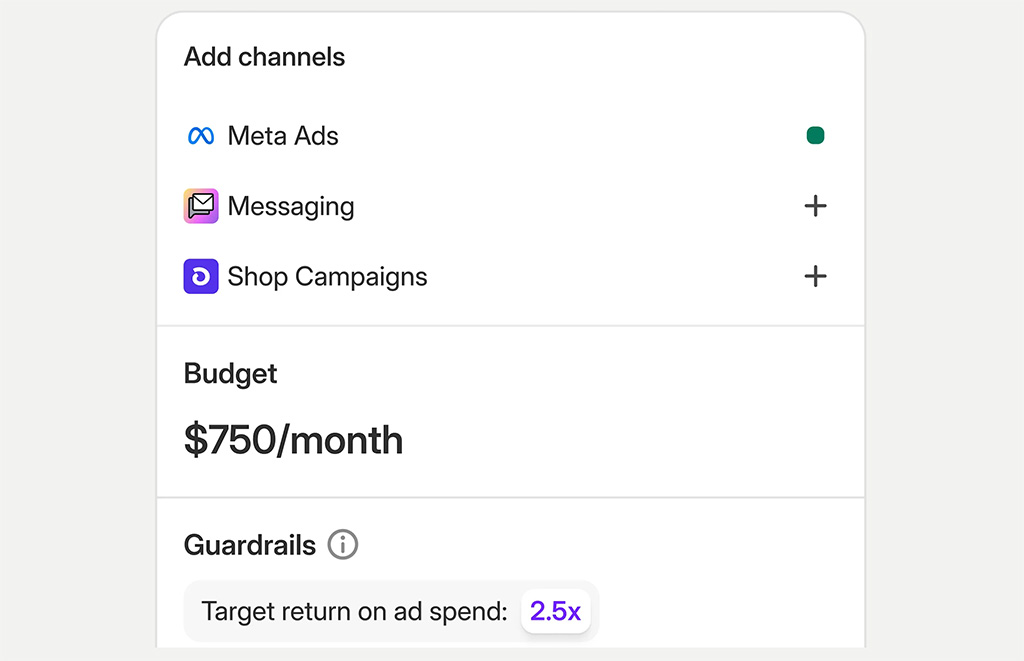
The new tool is also designed to work across multiple marketing channels. Shopify says Campaign Autopilot currently supports Meta Ads, Shop Campaigns and Messaging, with support for Microsoft Advertising, Snapchat and ChatGPT Ads planned for future releases. Shopify argues that bringing campaign management into a single interface could help merchants avoid switching between multiple advertising platforms and dashboards.
Campaign Autopilot is closely tied to Shopify’s broader AI strategy. The tool integrates with Sidekick, Shopify’s AI assistant, allowing merchants to ask questions about campaign performance, receive guidance and make adjustments using natural language prompts. Shopify says the system can help users connect marketing channels, set budgets, apply campaign guardrails and track results as campaigns evolve.
The launch comes at a time when ecommerce platforms are increasingly investing in AI-powered automation. Over the past two years, software vendors have introduced AI tools for content creation, customer service, product recommendations and search. Marketing has emerged as another major area of focus, particularly as merchants face rising advertising costs and increasing competition for customer attention.
For merchants, the potential benefits are clear. Automated campaign management could make digital advertising more accessible to smaller businesses that lack dedicated marketing teams or specialist expertise. It may also reduce the time required to launch and optimize campaigns, allowing merchants to focus on other aspects of running their stores.
However, there are potential trade-offs involved with this initiative.
Automated systems typically offer much less transparency than manually managed campaigns, and often give merchants less visibility into how budget decisions or optimization choices are being made. Some businesses may also be reluctant to hand over significant control of customer acquisition to AI systems (particularly when targeting niche audiences, or pursuing highly specific brand objectives).
As with other AI-powered tools, the effectiveness of Campaign Autopilot is likely to depend on the quality of underlying data — and the suitability of automation for a merchant’s particular business model.
Why this matters to ecommerce merchants
Digital advertising can be one of the most challenging aspects of running an online store, particularly for smaller businesses with limited time and expertise. Campaign Autopilot could lower the barrier to entry by automating many of the technical tasks involved in managing campaigns across multiple channels.
At the same time, merchants should view the tool as an aid rather than a replacement for marketing strategy. While AI may help optimize spending and campaign performance, factors like product quality, pricing, branding and customer experience will remain critical to long-term ecommerce success.
Get ecommerce news you can use
Sign up below and we’ll send you email digests of all the latest news and developments in the world of ecommerce, tips on how to grow an online business, and special offers.

Matt Walsh is the Head of Content at Ecommercetrix. He also creates video content for the site and its associated YouTube channel.
Having gained a degree in Literature and Philosophy from Trinity College Dublin and an MA in International Relations from Dublin City University, Matt worked in the marketing world for a decade before taking up an education role — teaching languages, literature and creative writing in London.
Matt is an Adobe Certified Associate in Photoshop and Illustrator, and also holds a certificate in digital marketing from DMI (Digital Marketing Institute), along with a postgraduate certificate in Design Thinking, Innovation, Entrepreneurship and Creative Thinking from Trinity College Dublin.