

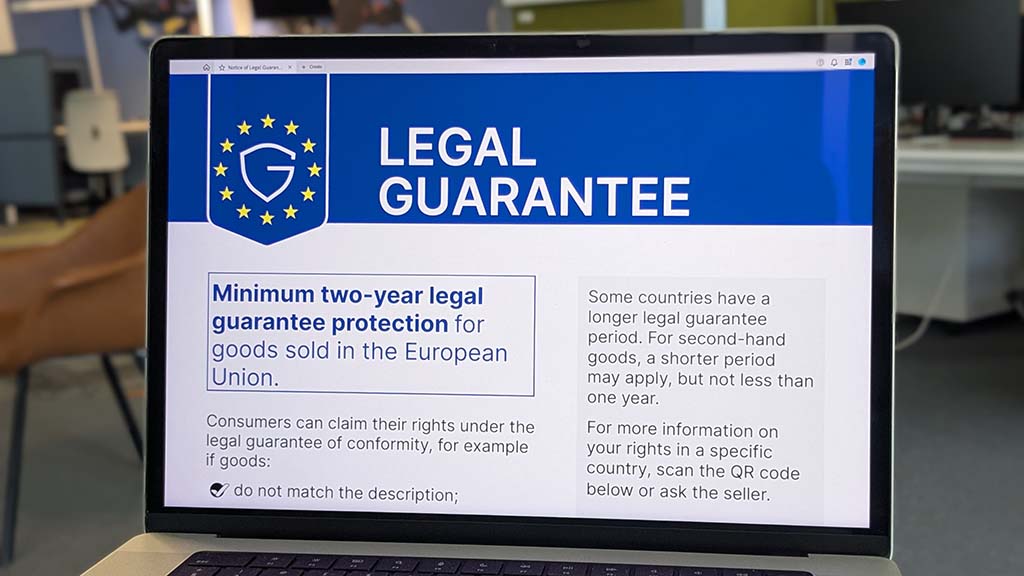
Ecommerce businesses selling physical goods to consumers in the European Union face new information requirements from September 27, 2026, including a mandatory notice explaining customers’ legal guarantee rights and a new label for certain manufacturer guarantees.
The changes form part of the EU’s Empowering Consumers for the Green Transition reforms, which are intended to make consumer rights clearer and help shoppers identify products backed by longer durability guarantees. The rules apply to businesses selling relevant goods to EU consumers both online and in physical stores.
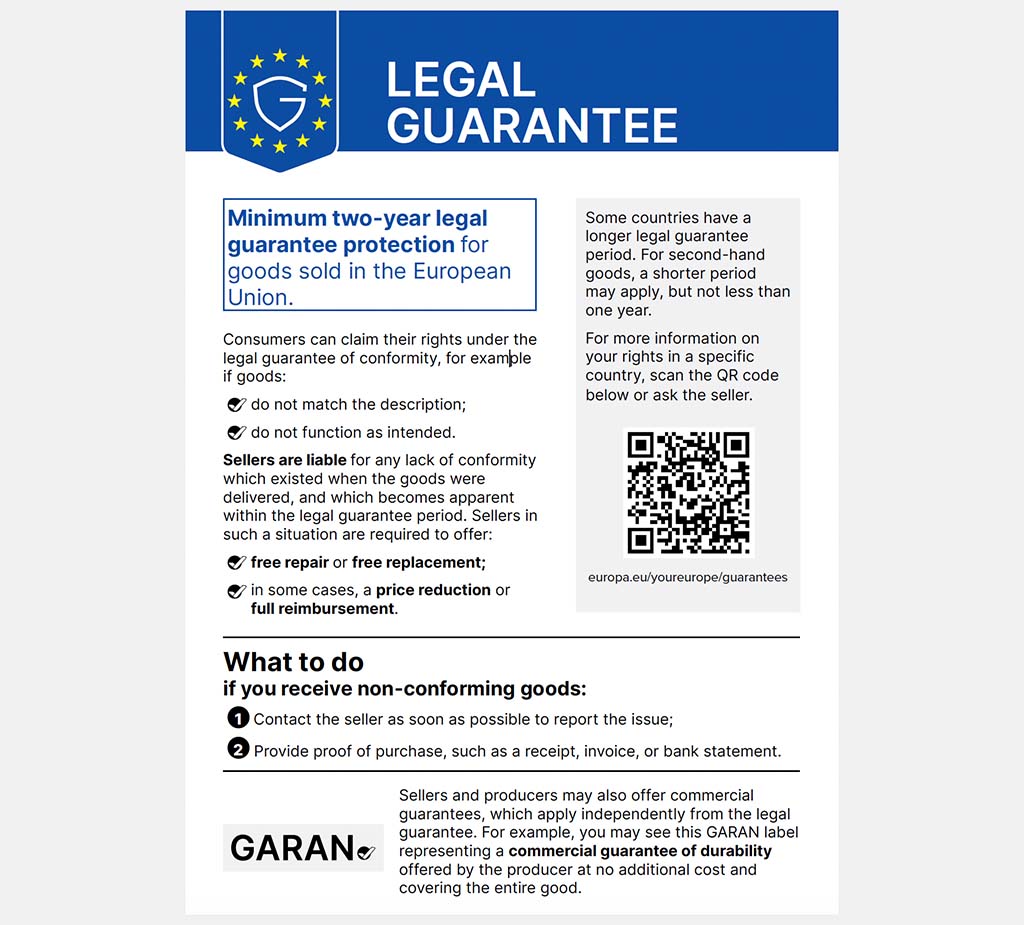
From September 27, sellers must display an official Legal Guarantee notice explaining that consumers buying goods in the EU receive at least two years of legal guarantee protection. If goods are faulty or don’t work as intended, customers may be entitled to a free repair or replacement and, in some circumstances, a price reduction or refund.
The notice doesn’t replace stronger rights available under national law. Two years is the EU-wide minimum: Ireland, for example, retains a six-year limitation period for raising certain problems, while the Netherlands links protection to how long a product can reasonably be expected to last.
What exactly do online stores have to display?
The EU provides specific instructions for displaying the new information.
On ecommerce sites, the Legal Guarantee notice must be displayed prominently and in color, using the prescribed EU design. The notice contains a QR code directing consumers to further information about their rights. For physical stores, printed notices cannot be smaller than A4, although they can be displayed in color or black and white.
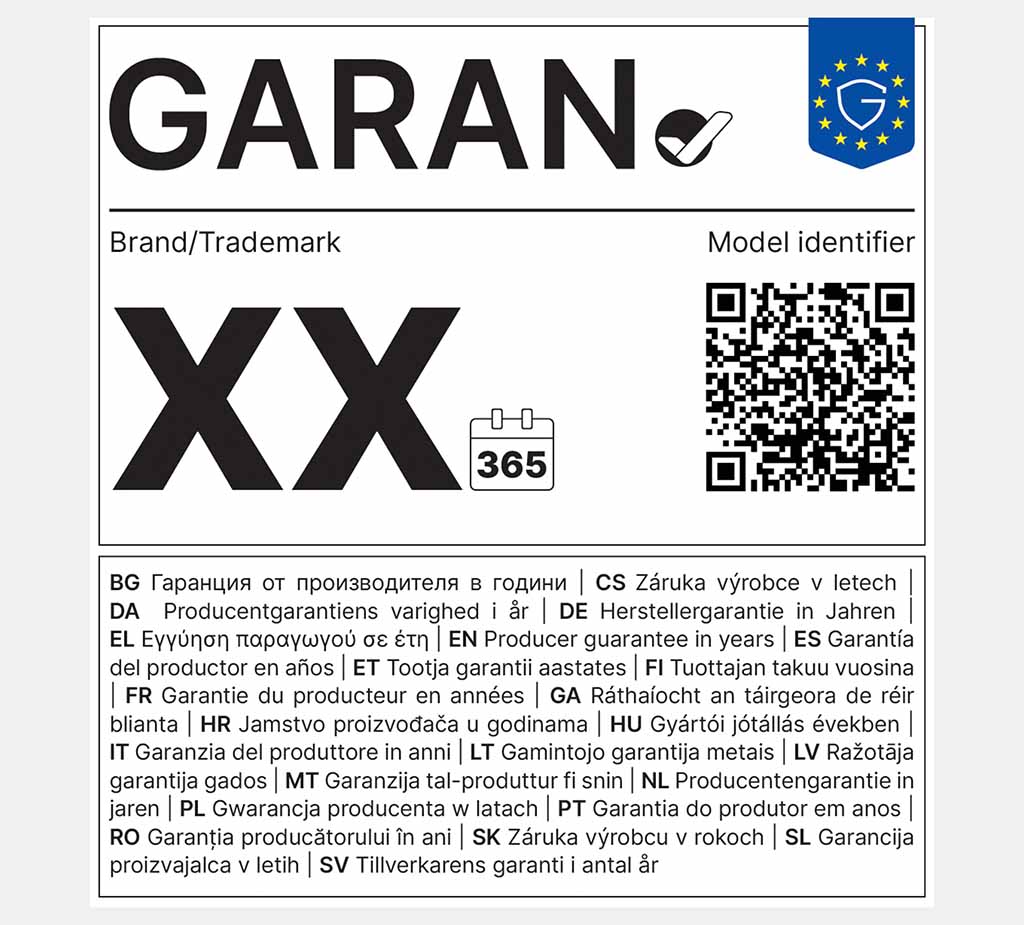
A separate GARAN label is required when a producer offers a commercial durability guarantee that is free, covers the entire product and lasts for more than two years. A guarantee covering only part of a product doesn’t qualify.
Online GARAN labels must also appear in color, but they can use a nested display: the complete label can be revealed following a first click, mouse rollover or equivalent touchscreen action. The label includes the guarantee duration, producer’s brand or trademark and product model ID. Printed versions cannot be smaller than 95 x 100 mm.
What about US and UK stores?
Being based outside the EU doesn’t necessarily remove these obligations. EU consumer rules can also apply to non-EU online traders that specifically target EU consumers.
Consequently, a US or UK ecommerce business actively selling goods to customers in countries such as Ireland, France or Germany should check how the new requirements apply to its EU sales. A US store selling only to US customers, by contrast, would not need to introduce the notices because of these EU rules.
What should ecommerce merchants do now?
Merchants should first establish which requirements apply to them. The Legal Guarantee notice applies broadly to relevant consumer goods sales, while the GARAN label is only required for products meeting its specific durability-guarantee conditions.
Some ecommerce platforms already have third-party tools to simplify implementation. Shopify, for example, has apps available for adding the EU Legal Guarantee notice and GARAN labels to stores. Merchants should still check that any app implements the official requirements correctly rather than assuming installation automatically ensures compliance.
Where no suitable app or built-in feature is available, merchants can implement the requirements manually. The EU provides official downloadable materials and high-resolution files that can be added to an ecommerce site, although some merchants may need developer assistance.
You can view the EU’s official Legal Guarantee and GARAN guidance and files here.
The guarantee changes are also part of wider reforms. The CCPC says businesses should review areas including environmental claims, sustainability labels, durability, repairability and information about software updates for products with digital elements.
Why this matters for ecommerce merchants
For merchants selling physical goods to EU consumers, September 27 is an important compliance deadline, with no transitional period.
In practical terms, merchants should check whether they need to add the Legal Guarantee notice, identify products requiring the GARAN label and ensure both are displayed correctly. Shopify apps may make this easier, while merchants on other platforms may need to implement the EU’s official materials manually.
The changes should make consumer rights clearer, but they also create additional compliance work — particularly for international stores and businesses with large product catalogs.
Get ecommerce news you can use
Sign up below and we’ll send you email digests of all the latest news and developments in the world of ecommerce, tips on how to grow an online business, and special offers.

Matt Walsh is the Head of Content at Ecommercetrix. He also creates video content for the site and its associated YouTube channel.
Having gained a degree in Literature and Philosophy from Trinity College Dublin and an MA in International Relations from Dublin City University, Matt worked in the marketing world for a decade before taking up an education role — teaching languages, literature and creative writing in London.
Matt is an Adobe Certified Associate in Photoshop and Illustrator, and also holds a certificate in digital marketing from DMI (Digital Marketing Institute), along with a postgraduate certificate in Design Thinking, Innovation, Entrepreneurship and Creative Thinking from Trinity College Dublin.