


Making a success of international ecommerce almost always means running a multilingual website — but for many ecommerce businesses, that’s where things start to get complicated. Translating product pages is one thing; handling multilingual SEO, URLs, dynamic content, and ongoing updates is another.
Weglot is a website translation tool designed to remove much of that complexity. It promises to turn a single-language website into a fully multilingual one in minutes, while also handling the technical SEO setup behind the scenes.
So, in this review, I’m going to walk you through all the pros and cons of Weglot, and help you work out if it’s the right solution for translating your online store.
Our quick verdict on Weglot
Weglot gives you an easy way to make an ecommerce site multilingual. Setup is quick, most SEO work is taken care of automatically, and the translations provided are very high in quality. The platform also works seamlessly with a host of popular ecommerce solutions.
Weglot’s main downsides are its high costs for merchants with large stores; its reliance on externally hosted translations; and the fact that to get the most out of it, you’ll need to manually review translated content. Ironically, it could do with support being provided in a few more languages too.
But overall, Weglot is an exellent, low-stress choice for merchants in search of a fast, reliable way to go multilingual.
Overall score: 4.6 / 5
Weglot: an overview
Weglot is a cloud-based website translation service. Rather than requiring you to manually create separate language versions of your site, it connects to your existing website and automatically detects, translates, and serves translated content to visitors.
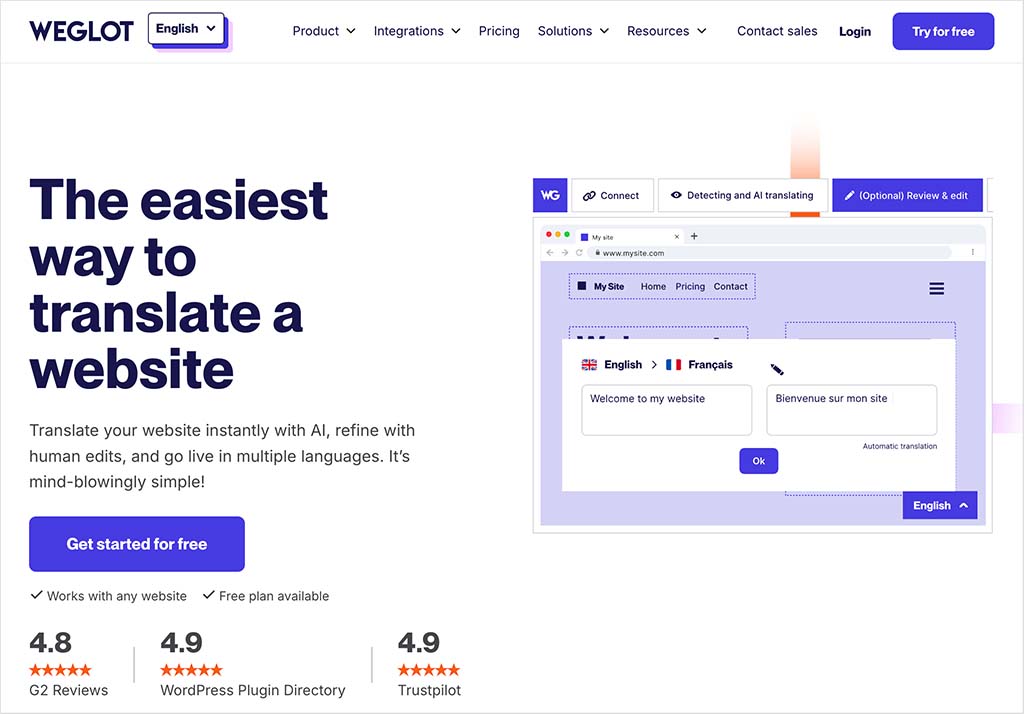
Once installed, Weglot:
- scans the visible text on your site;
- translates it automatically using machine translation;
- and displays the appropriate language version based on visitor location or language selection.
All your translations can be accessed and edited via an online dashboard in your Weglot account (rather than inside your CMS or ecommerce platform).
One of Weglot’s main selling points is that it works across a wide range of platforms. Whether you’re running an ecommerce store on Shopify, WooCommerce, Squarespace, Webflow, or a custom-built site, the setup process is broadly the same.
Key advantages of using Weglot to translate your store
1. You can set it up extremely quickly
Weglot gives you one of the quickest ways to make an ecommerce site multilingual: connecting a store to Weglot and publishing translated pages can take minutes rather than days. There’s no need to duplicate products, create language-specific themes, or manually translate content (although, for reasons I’ll come to shortly, manually reviewing your translations is a good idea).
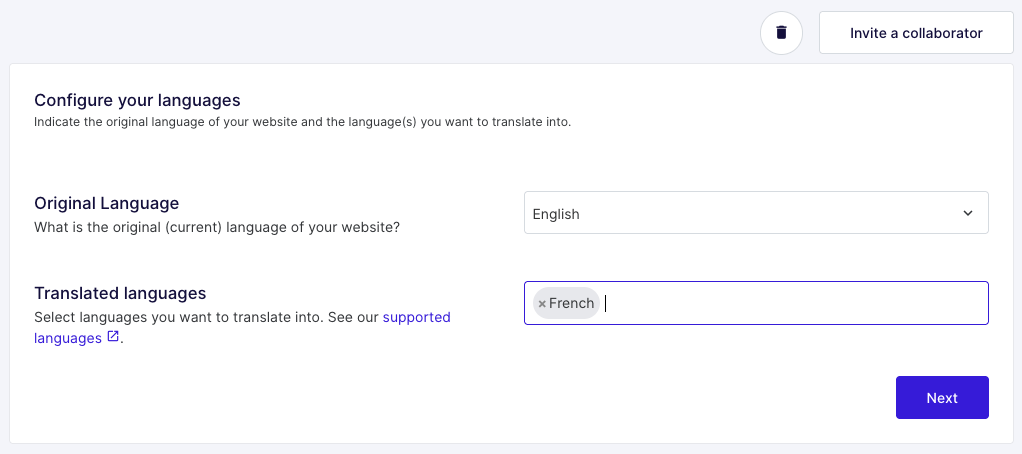
We tested Weglot on a Squarespace site and had a fully translated version of it in under a minute.
For merchants who want to test new international markets — or who don’t want to worry about a complex multilingual build — this quick setup represents a major advantage.
2. It makes multilingual SEO easy
Multilingual SEO is one of the biggest challenges for ecommerce sites, and this is where Weglot performs particularly well.
Weglot automatically adds correct hreflang annotations, and ensures translated pages can be indexed properly by search engines.
It automatically translates key SEO elements like:
- page titles,
- meta descriptions,
- image alt text.
All this helps prevent common multilingual SEO issues such as duplicate content, incorrect regional targeting, or translated pages failing to appear in search results.
💡 Tip: the below Weglot video review from our sister company, Style Factory, gives you a visual walkthrough of all of Weglot’s key pros and cons.

3. It doesn’t leave gaps in translations
Many translation tools struggle with ecommerce-specific elements such as:
- product filters,
- cart messages,
- checkout notices,
- pop-ups,
- and third-party widgets.
Weglot handles these much more reliably than many CMS-specific alternatives. And unlike some competing platforms, it doesn’t ignore elements like buttons, forms, JavaScript-generated content, and copy added by apps or plugins.
The result is a more complete translation of the customer journey — it’s not just product descriptions that get translated, but the entire shopping experience.
4. The quality of translations is good
Weglot uses high-quality, established machine translation engines to produce translated copy — these include engines from DeepL, Google, and Microsoft.
Translation quality is generally high, and Weglot states that around 80% of users publish translations without making manual edits.
But Weglot also provides tools to refine translations where needed. It lets you create glossary rules for consistent terminology (useful for product names or brand language) and applies AI-assisted learning that adapts your site copy to reflect any edits you make.
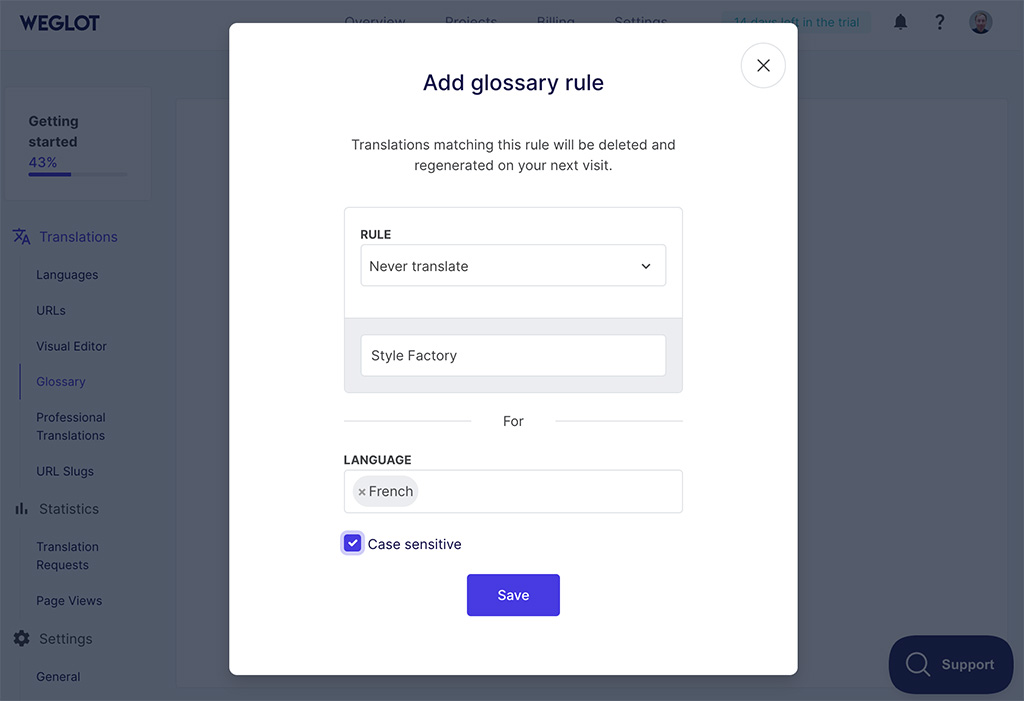
On higher-tier plans, tone-of-voice controls help you maintain a consistent brand style across languages — something that’s important for improving shopper trust and conversion rates.
5. It’s ‘platform-agnostic’
Unlike many translation tools that only work with a single platform, Weglot integrates with 40+ website builders and frameworks. These include popular store builders like Wix, Shopify and Squarespace.
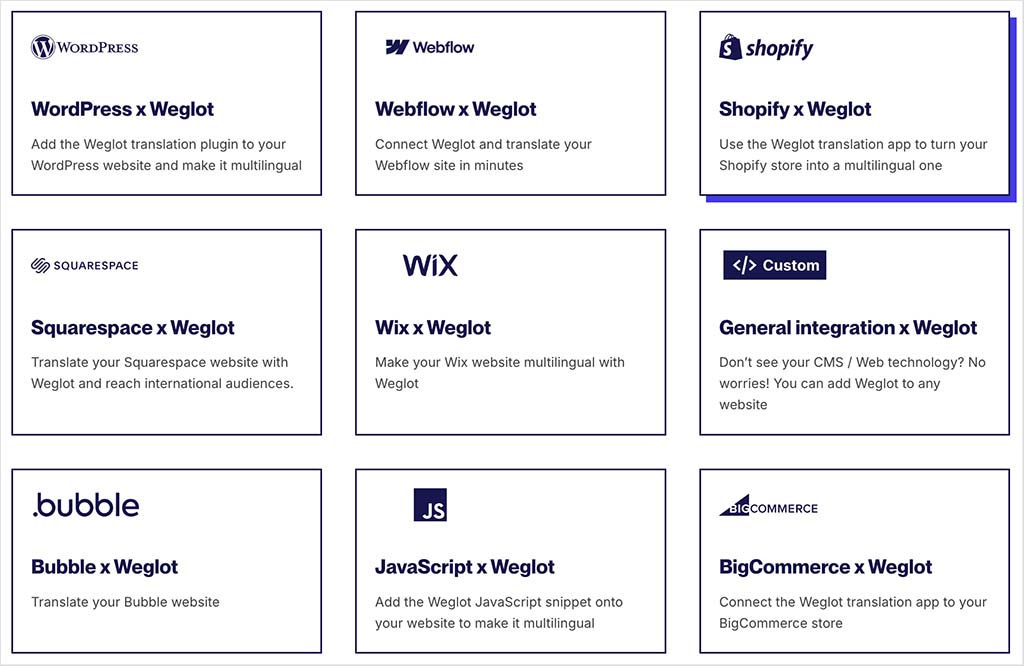
For ecommerce agencies, multi-store owners, or merchants running several storefronts across different platforms, this flexibility simplifies workflows — the same translation approach can be applied consistently across different sites and technologies.
6. It gives you a usable free plan
Weglot offers a free plan that allows you to translate your site into one more language (so long as its word count doesn’t exceed 2,000 words).
This won’t suit store owners managing a very large ecommerce catalog, but it’s useful for smaller projects, and gives you a good way to test translation quality before rolling Weglot out on a large website.
The main drawback of this free plan is that when using it, Weglot branding is displayed alongside your translations.
Disadvantages of using Weglot to translate your store
1. Costs can rise significantly as your store grows
Weglot pricing is based on the number of words on your site, and the number of languages used on it.
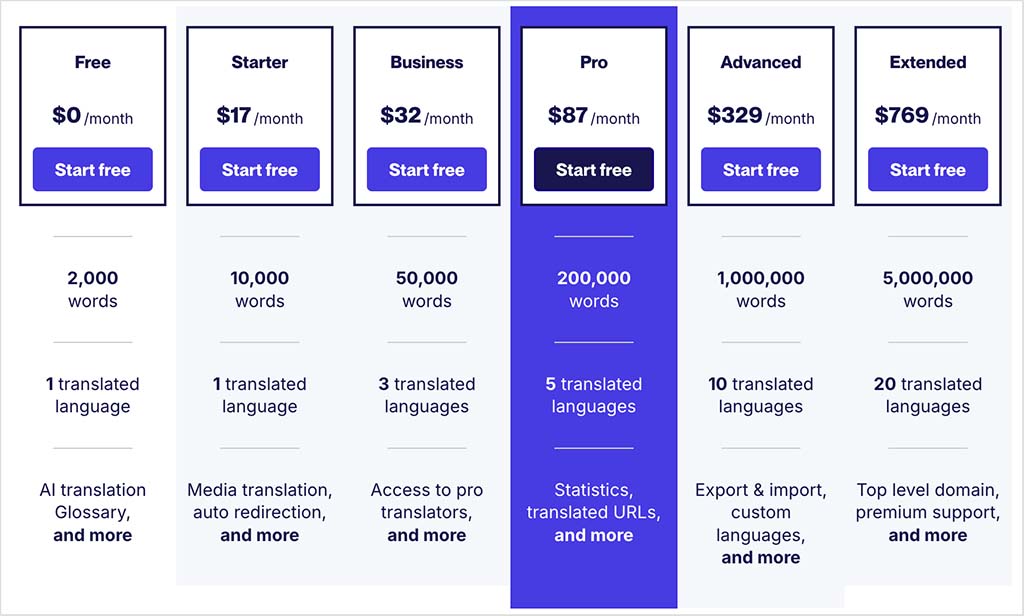
And for content-heavy ecommerce stores with large catalogs, costs can increase quickly. While this usage-based model is still cheaper than professional human translation, it can become more expensive than flat-fee alternatives over time.
For large stores, Weglot fees can become a significant ongoing operational cost, as the pricing table below highlights.
Weglot pricing plan
Monthly fee (USD)*
Free — 2,000 words, 1 language
$0
Starter — 10,000 words, 1 language
$17
Business — 50,000 words, 3 languages
$32
Pro — 200,000 words, 5 languages
$87
Advanced — 1m words, 10 languages
$329
Extended — 5m words, 20 languages
$769
2. You can’t always escape manual content reviews
Although translation quality is strong, Weglot uses machine translation by default.
And Google’s guidance around automated content means that, in an ideal world, important pages — such as category pages, legal content, or high-converting product pages — should be reviewed manually (and edited manually where necessary to preserve nuance or tone of voice). In certain contexts, failing to do this may negatively impact your store’s performance in search results.
This isn’t exactly Weglot’s fault — but it does reduce the tool’s “set it and forget it” appeal for merchants, especially those that rely extremely heavily on organic traffic.
📖 Related resource: How to do ecommerce SEO.
3. Translations are hosted on Weglot’s servers
Weglot is a fully hosted solution, meaning that all translations live on Weglot’s infrastructure rather than inside your ecommerce platform.
This approach is what makes Weglot so easy to deploy — but it also means:
- access to translations depends on an active subscription
- if your plan expires, translated pages stop appearing.
Self-hosted translation tools store translated copy in your own database, giving you long-term ownership of content.
4. URL slugs aren’t translated automatically
Weglot does not automatically translate URL slugs. If you want localized URLs (/about-us, /our-team etc.) — you’ll have to create them manually.
For small stores, this manual work is manageable. But for ecommerce stores with huge product catalogs, this can become very time-consuming.
5. Customer support is a bit limited
Weglot’s support team is generally responsive, but human support is only available in English and French (which, given thatt Weglot is in the translation business, I find really odd!). The documentation is available in a fairly limited number of languages too — just seven.
Phone support is also unavailable, which is disappointing — you can only contact the company via contact form or email.
Enterprise customers do receive enhanced support, including account management and access to solution engineers. But this comes at a price!
User reviews and ratings
So far, you’ve heard my take on Weglot. But what do other users make of it? To find out, and to give you a sense of broader user reaction to the tool, I collated data from a range of popular software review sites — you’ll find this below.
Review site
User rating (out of 5)
Trustpilot
4.8 (1,500+ reviews)
G2
4.7 (600+ reviews)
WordPress Plugin Directory
4.8 (1900+ reviews)
Shopify App Store
5.5 (800+ reviews)
Average
4.7 out of 5
Weglot — the verdict
Weglot is one of the fastest and least technically demanding ways to make an ecommerce website multilingual.
Its biggest strengths are:
- rapid setup
- strong multilingual SEO automation
- reliable translation of dynamic ecommerce content
- broad platform compatibility
The trade-offs mainly involve:
- potentially significant costs as your store grows in size
- reliance on a hosted service
- the potential need for manual translation review on key pages.
Overall, for ecommerce businesses that want to launch internationally quickly, test new markets, or avoid complex multilingual builds, Weglot is a strong and reliable option. It isn’t the cheapest translation solution available, but for many merchants, it will prove to be be the easiest, least stressful way to go multilingual.
Written by Chris Singleton based on research from Matt Walsh.

Chris Singleton is the Founder and Director of Ecommercetrix.
Since graduating from Trinity College Dublin in 1999, Chris has advised many businesses on how to grow their operations via a strong online presence, and now he shares his experience and expertise through his articles on the Ecommercetrix website.
Chris started his career as a data analyst for Irish marketing company Precision Marketing Information; since then he has worked on digital projects for a wide range of well-known organizations including Cancer Research UK, Hackney Council, Data Ireland, and Prescription PR. He then went on to found the popular business apps review site Style Factory, followed by Ecommercetrix.
He is also the author of a book on SEO for beginners, Super Simple SEO.