


Written by Chris Singleton based on research by Matt Walsh.
In this Omnisend review, I take a detailed look at one of the most popular tools for ecommerce merchants aiming to build integrated email and SMS marketing campaigns. Is it right for your business, or would you be better off with an alternative solution?
My quick verdict on Omnisend
Omnisend is one of the best ecommerce-focused marketing platforms you can opt for — a powerful, cost-effective tool that lets you create sophisticated multi-channel customer journeys. These can involve email, SMS, web push notifications and even WhatsApp messages.
Omnisend not without its drawbacks, however — its integrations library is smaller than some rivals, its testing and analytics features options are a bit basic, and its SMS costs can rise sharply at very high volumes.
But for most online retailers, Omnisend hits the sweet spot between power, ease-of-use and price, delivering the tools merchants need on in a single, competitively priced package.
Overall score: 4.5 / 5
What is Omnisend?
Omnisend is a marketing solution that was created specifically for ecommerce merchants. Founded in 2014 in Lithuania, it integrates tightly with platforms like Shopify, WooCommerce and BigCommerce, and it comes with features designed to cater for the realities of running an online store — like advanced customer segmentation, abandoned cart recovery, personalized product recommendations and lifecycle marketing.
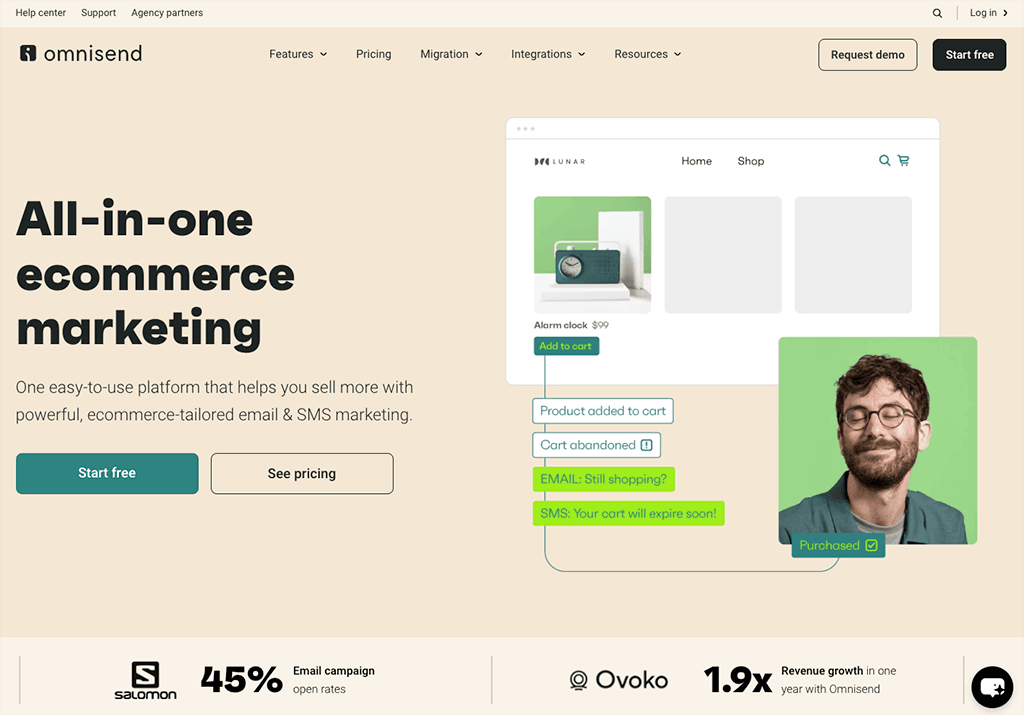
Over time, it has expanded beyond email and SMS to facilitate unlimited push notifications, data capture form design (including gamified options) and AI‑powered segmentation.
Omnisend’s goal is simple: to remove friction between your store and your marketing, so you can connect with audiences quickly and drive repeat revenue.
But does it actually meet that goal? Well, I’ll walk you through its pros and cons and help you find out.
The key pros of Omnisend
1. Its free plan is genuinely useful
Omnisend’s free plan lets you send up to 500 emails per month to 250 subscribers. That’s less generous than Mailchimp’s or AWeber’s free allowances, but unlike its rivals, Omnisend gives you access to all core features on its free plan — automations, segmentation, SMS integration and even live chat support.
This makes Omnisend’s free plan ideal for new store owners who want to experiment with advanced features without committing significant budget from the start.
2. Its email editor is designed specifically for ecommerce applications, and speeds up campaign building
Omnisend’s drag‑and‑drop editor is purpose‑built for online stores. Its standout Product Picker lets you pull products (titles, images, prices and links) directly from your catalog — no copying and pasting needed!

Dynamic blocks make Omnisend even more powerful; an abandoned‑cart email can display the exact items your store visitors left unpurchased automatically, and product recommendation blocks can populate your e-newsletters with best‑sellers or new arrivals in real time.
3. Its signup form toolkit is excellent and includes effective gamification
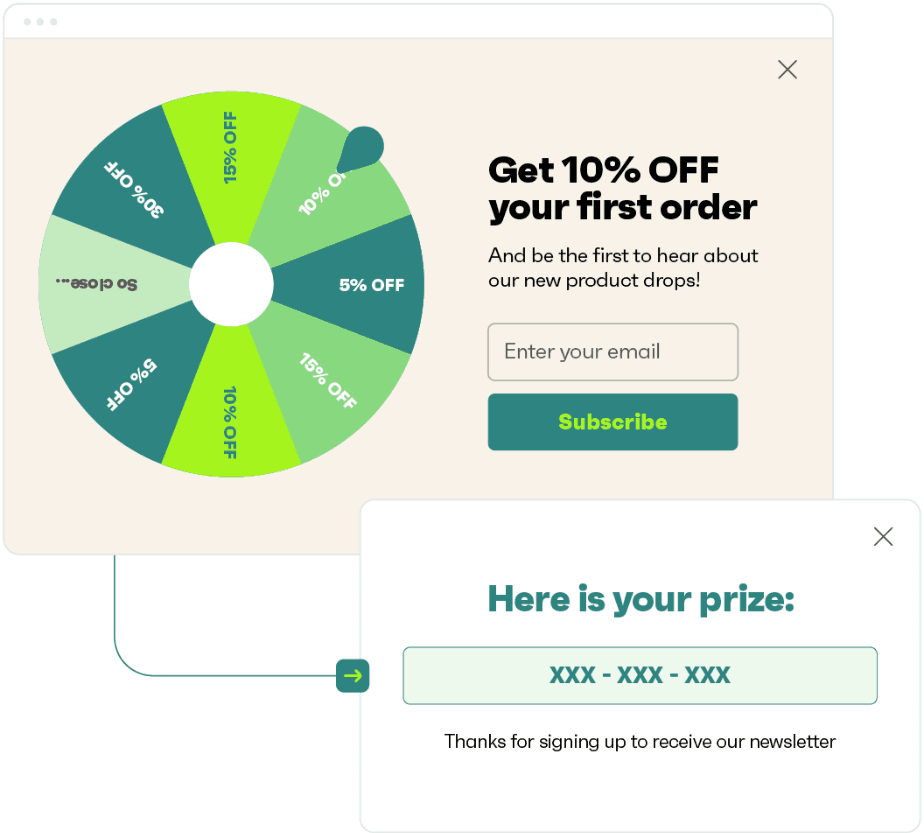
Omnisend gives you over 100 form templates to play with — popups, flyouts, embedded forms and landing pages — plus options like teasers, countdown timers, mobile‑only versions and multi‑step flows.
The platform’s headline data capture feature is gamification, which comes in the form of Omnisend’s “Wheel of Fortune” form (where visitors spin a wheel to win a prize). This typically converts far better than static popups, giving you a smart way to grow lists during peak retail moments.
4. Its SMS marketing is first‑class and integrates seamlessly with email
One of Omnisend’s biggest strengths is how it integrates SMS neatly alongside email and automation. It lets you send one-off promotional texts, build automated SMS flows triggered by customer behaviour, or combine SMS and email in the same journey.
A typical example of this in action would be following up an abandoned cart email with a reminder text, or sending a flash sale alert by SMS at the same time a newsletter goes out. With coverage in 209 countries, the feature also provides genuine global reach.
Omnisend lets you keep SMS costs simple too. The Standard plan includes $1 of free SMS credit for testing, while the Pro plan bundles in monthly credits equal to your subscription price (i.e., a $59 plan includes $59 worth of SMS each month). Extra credits can be purchased separately, and the platform includes built-in opt-in and consent management tools to ensure compliance.
Compared to rivals, Omnisend’s SMS offering is hard to beat. Mailchimp and ActiveCampaign treat SMS as an add-on, GetResponse includes it but in a limited way, and Klaviyo doesn’t bundle credits as you scale.
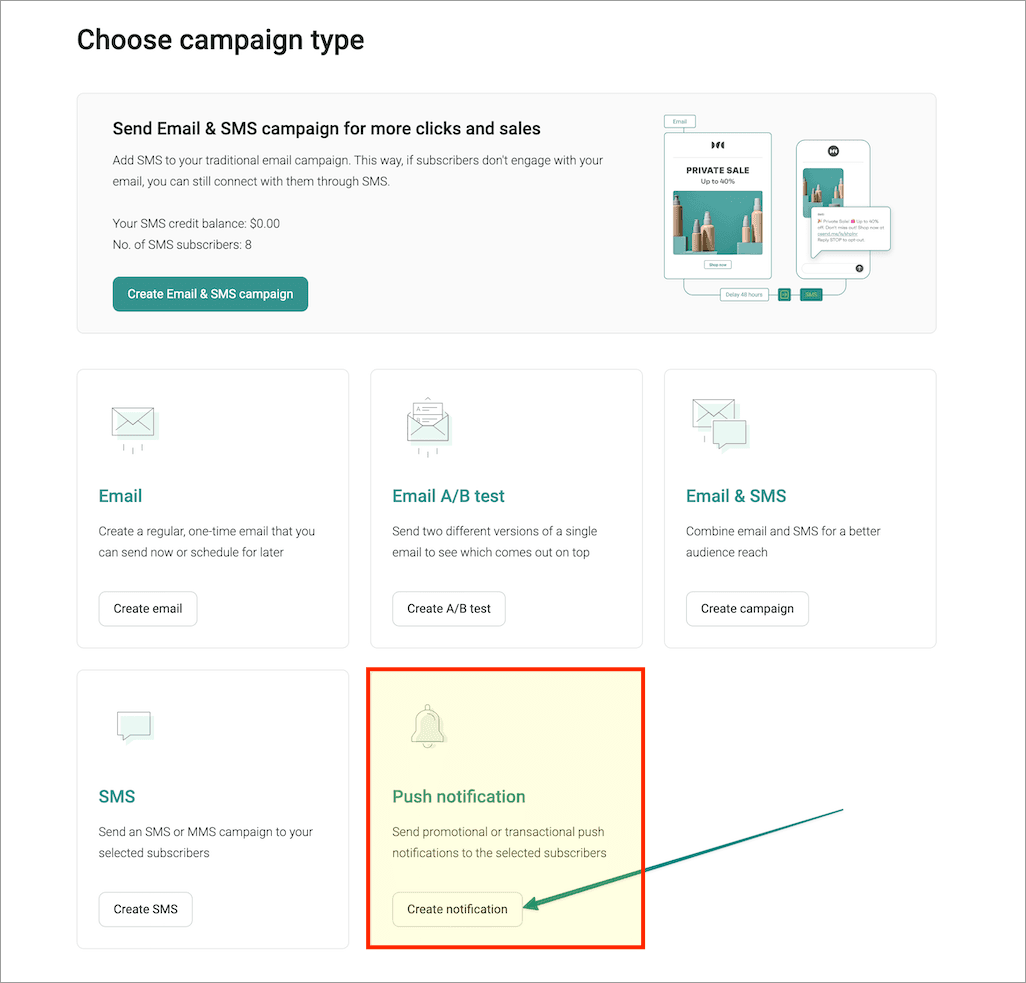
5. It provides unlimited web push notifications on all its paid plans
Web push notifications are short, clickable messages that appear in a customer’s browser — even when they’re not on your site.
And helpfully, Omnisend lets you send an unlimited number of these on every paid plan, which few competitors match. They’re great for announcing flash sales, price‑drop alerts and restock announcements.
6. Its pricing is competitive and scales predictably as your lists grow
Omnisend’s Standard plan starts at $16 per month for 500 contacts. That’s roughly in line with AWeber and ActiveCampaign’s entry level plan fees ($15/mo), and cheaper than GetResponse’s ($19) or Klaviyo’s (the latter’s plans range in price from $30–$45).
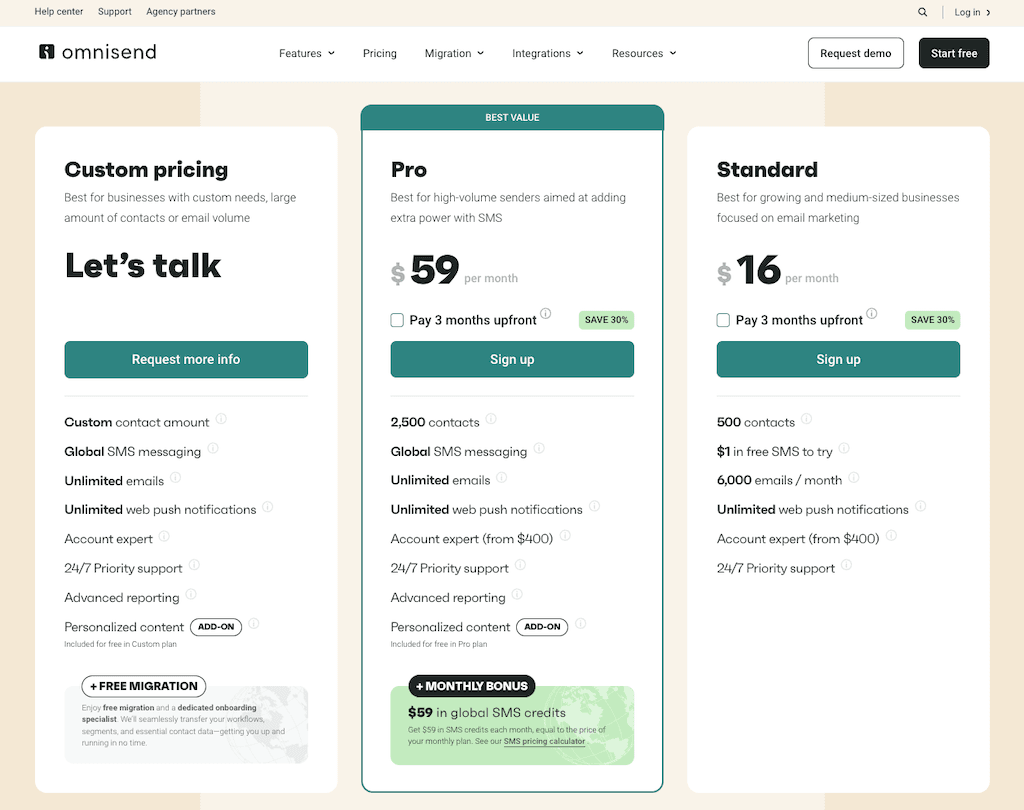
The nice thing here is that even at this entry level price point, you get access to all the good stuff. Advanced automations, ecommerce-focused templates, unlimited web push notifications and built-in SMS marketing (with pay-as-you-go pricing) come as standard on Omnisend’s entry-level plan.
If you pay upfront for Omnisend, you’ll also get 30% off your first three months — bringing the Standard plan down to $11.20/mo and the Pro plan to $41.30/mo during that period.
And Omnisend’s value becomes more pronounced as you scale. With 5,000 contacts, the Standard plan costs $81 per month. To work with the same list size with ActiveCampaign Plus you’ll need to pay around $145/mo, while Klaviyo charges $100–$115/mo to use a list this size. And to work with 100,000 contacts, Omnisend charges $988 — that’s $300 less than Klaviyo.
Plan
Monthly pricing (USD)*
Free (250 contacts)
$0
Standard (500 contacts)
$16
Pro (2,500 contacts)
$59
* Pricing increases with list size.
7. Its marketing automation is excellent and purpose‑built for online stores
Automation is one of Omnisend’s real strong points. It gives you access to 27 prebuilt workflows, all geared firmly towards ecommerce.
These automations cover both the basics — welcome series, abandoned cart recovery, order confirmations and shipping updates — and more advanced options (replenishment reminders, birthday messages, customer reactivation and cross-sell campaigns).
The edges that Omnisend has over its competitors here involve ease of use and a focus on ecommerce. For example, Klaviyo and ActiveCampaign both offer powerful automation, but unlike Omnisend, most of their workflows have to be built manually. Mailchimp also provides prebuilt customer journeys, but they’re fairly generic in nature (i.e., not really tailored to the needs of online store owners).
8. Its lifcycle marketing features make targeting the right customers straightforward
Segmentation is all about sending the right message to the right audience — and Omnisend gives you excellent tools to do this. It lets you create unlimited segments on every plan, apply as many conditions as you like when defining them, and build them around shopping behaviour, engagement or contact data.
(This flexibility goes beyond what many rivals offer — Mailchimp, for example, restricts advanced segmentation to its most expensive tiers.)
In practice, this means you can get very precise with your targeting. You can, for example, ask Omnisend to build a segment of “customers in their 30s who opened the last campaign and added an item to their cart,” or filter contacts by anniversaries, locations and purchase history. And if you don’t want to start segmentation from scratch, Omnisend lets you make use of a set of prebuilt segments to cover common ecommerce scenarios.
Where Omnisend really shines, though, is in its approach to lifecycle marketing. Its ‘Customer Lifecycle Stages’ feature automatically categorizes contacts as recent, loyal, high-potential or at-risk customers — and suggests campaign strategies for each.
For example, Omnisend might suggest sending a thank-you and loyalty invite to a new customer; VIP perks to a regular shopper, and a discount code to a lapsed customer.
9. Its customer support is fast, available 24/7 and well‑reviewed by users
Omnisend support is available via live chat and email around the clock on all Omnisend plans — even the free one. First‑reply times reported at under 4 minutes.
For larger stores, an optional (paid) dedicated account expert service provides onboarding, migration assistance and one‑to‑one guidance.
The platform is well-regarded for the quality of its support, and has won Stevie awards in the past for it too.
10. Its user feedback is consistently strong across app stores and review sites
On the Shopify App Store, Omnisend scores 4.8/5 from thousands of reviews; WooCommerce users rate it even higher, and independent sites like G2 and GetApp also show excellent user ratings.
Merchants frequently praise its ease of use, tight Shopify integration and the revenue impact of abandoned‑cart and post‑purchase flows.
Review site
User rating (out of 5)
GetApp
4.7 (833 reviews)
G2
4.6 (948 reviews)
TrustRadius
3.9 (36 reviews)
Average
4.4
11. Its AI features actually do something useful
Omnisend now comes with a range of AI features that aim to save merchants time and improve campaign results. These include tools for generating subject lines, pre-headers and even full pieces of copy — all aimed at making it quicker and easier to craft messages that people actually open.
But this offering goes beyond text generation: Omnisend uses AI automatically segment audiences, highlight high-value customers and predict churn. Of these, the churn predictor is arguably the most powerful: it identifies customers at risk of leaving so that you can re-engage them with timely discounts, loyalty reminders or targeted offers. This gives you a simple but effective way to protect repeat revenue.
While rivals like Mailchimp and GetResponse also provide AI writing assistants, Omnisend’s AI tools feel much more more ecommerce-specific. The emphasis isn’t just on producing copy — it’s on helping store owners increase customer lifetime value and make smarter use of their customer data.
Now let’s take a look at some of the key downsides of using Omnisend.

The key cons of Omnisend
1. Its email template library is smaller than those offered by key rivals
Omnisend provides around 200 email templates in its library. This is less than what some competitors offer — for context, AWeber gives you over 600 designs to work with, ActiveCampaign around 250, and GetResponse 245.
As you might expect, the main focus of Omnisend’s templates is product promotion: they’re well suited to applications like highlighting best sellers, showcasing new inventory or running seasonal sales.
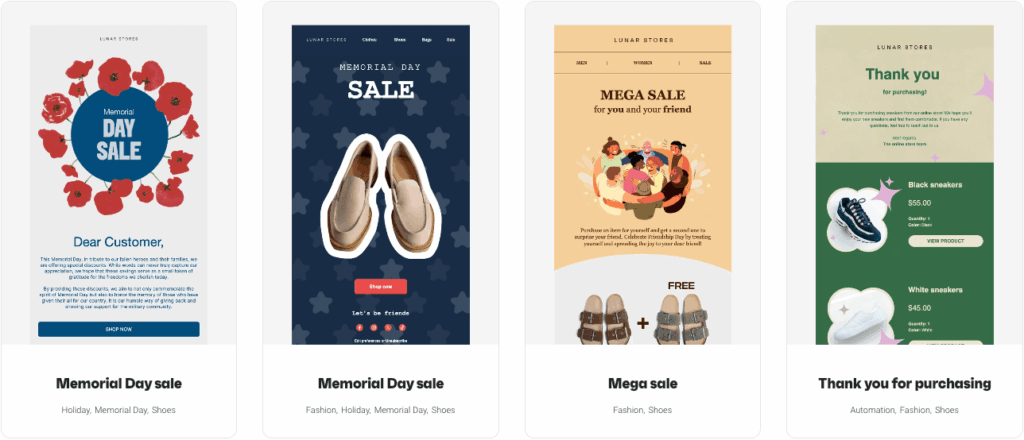
But if your priority is content-heavy newsletters, event promotions or donor campaigns, Omnisend’s relatively narrow range of templates can feel restrictive.
In those scenarios, platforms with broader and more editorial template libraries — like Mailchimp or GetResponse — may be a better fit. These give you more flexibility when the goal isn’t just selling products but also communicating ideas or promoting causes and events.
2. SMS pricing is expensive for high-volume senders
Omnisend deserves credit for including SMS on all its plans and for offering bonus credits on the Pro plan. That perk is generous and makes it stand out from many rivals (which often make SMS an afterthought or lock it behind higher pricing tiers).
However, once you use up your SMS credits, you can expect your Omnisend costs to climb quickly.
In the U.S., Omnisend charges about $0.015 per SMS and $0.045 per MMS; by contrast, Klaviyo charges bulk senders $0.0085 per SMS and $0.00255 per MMS. This means that sending one million SMS through Omnisend costs roughly $15,000, compared to about $8,500 with Klaviyo — a $6,500 difference.
For a lot of merchants, Omnisend’s Pro plan credits will be sufficient, but businesses that lean heavily on SMS should note that Klaviyo may work out significantly cheaper.
3. It provides fewer apps and integrations than its rivals
Omnisend’s apps and integrations are very ecommerce-focused.
There are around 160 native integrations available from Omnisend’s app market, allowing you to connect Omnisend to all the big ecommerce platforms — including Shopify, WooCommerce, BigCommerce and Wix.
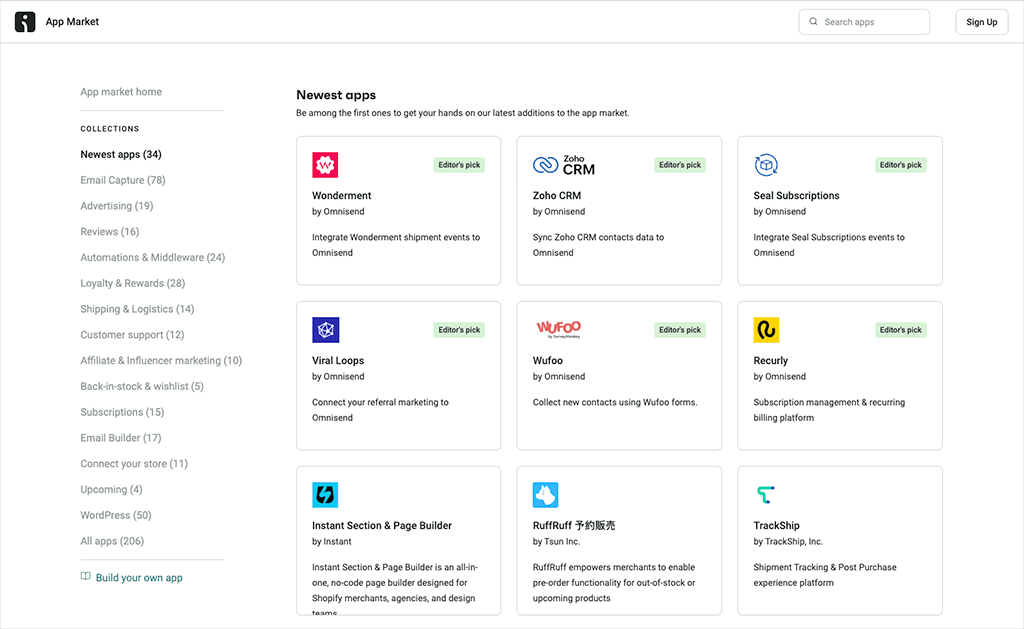
Add-ons for loyalty (Smile.io, LoyaltyLion), reviews (Judge.me, Yotpo), shipping (ShipStation, AfterShip), advertising (Google Ads) and subscriptions (Recharge, Loop) are also available.
But if you’re looking for apps and integrations outside of retail, Omnisend might not be the best choice. For deep integrations with CRMs, membership platforms or broader business tools, you’ll usually find that Mailchimp or Klaviyo provide a much wider range of options..
4. It lacks more general marketing features found in competing tools
As I’ve discussed throughout this review, Omnisend is firmly built around ecommerce — all its features are designed to help convert visitors into customers, or reactivate lapsed ones.
But the downside of this tight focus on selling is that the platform lacks some of the extras you’ll find in broader, all-in-one marketing suites.
For example, GetResponse includes webinar hosting to support lead generation, while Mailchimp and HubSpot lean further into content-driven marketing with tools for publishing newsletters, posting to social media or even building full websites. Omnisend doesn’t aim to cover these areas, which makes it less appealing if your aims extend beyond product promotion.
5. Its analytics and testing features are comparatively limited
When comes to analytics and testing, Omnisend gives you the essentials — including revenue reporting, A/B testing, automation performance and click maps.
But if you’re looking for features like true multivariate testing, inbox placement previews or deep CLV modelling, you’ll likely be disappointed by the platform. Data‑driven teams will probably prefer Klaviyo or enterprise tools here.
6. Omnisend’s deliverability performance is solid — but typically a notch below market leaders
Deliverability — the percentage of emails that actually land in inboxes — is a key consideration when picking an email marketing tool. Omnisend performs respectably here, but independent studies usually place it a touch behind competing platforms like Mailchimp, Klaviyo and ActiveCampaign.
That doesn’t mean your campaigns won’t get through: for most online store owners, Omnisend’s rates are more than adequate, and you can still expect your messages to reach customers reliably. The gap is really only an issue if you’re chasing absolutely best-in-class performance.
7. Dedicated IPs are only available from Omnisend if you meet its eligibility criteria
By default, Omnisend — like most platforms — sends campaigns through shared IP addresses. This usually works fine, as the shared pool is actively maintained to keep deliverability strong. For high-volume senders, though, a dedicated IP can be useful because it separates your reputation from other clients (and, if set up and used correctly, can improve deliverability rates).
Now, Omnisend does offer dedicated IPs, but only to accounts that meet its criteria around volume and practices. These IPs are free once approved, but you can’t simply request a dedicated one as an add-on.
Some competing platforms take more flexible approaches here: ActiveCampaign sells them, Mailchimp includes them on higher tiers and GetResponse makes them available to enterprise users.
Omnisend review verdict
Omnisend is one of the most ecommerce‑friendly marketing platforms available. Its product pickers, gamified signup forms, ecommerce automations and bundled push notifications make it a superb choice for online retailers that want results without complexity.
It’s not perfect — its apps library is smaller than those of some rivals, advanced testing functionality is limited and SMS costs can climb considerably if you’re a high-volume sender.
But for a majority of online store owners, Omnisend strikes an excellent balance between power, ease of use and price. It’s designed around ecommerce needs, is priced competitively and delivers the tools most merchants actually use to drive revenue in a single, easy-to-use package.
Pros and cons summary
☑️ Highly functional free plan
❌ Limited range of email templates available
☑️ Great for ecommerce applications
❌ No multivariate testing features
☑️ Good range of data capture options
❌ SMS can get expensive for high-volume senders
☑️ Competitive pricing
❌ Limited range of apps and integrations available
☑️ SMS and email features integrate really well together
❌ Deliverability could be a bit higher
☑️ Great customer support
❌ Dedicated IPs only available at Omnisend’s discretion
Omnisend alternatives
- Klaviyo — closest rival, with particularly strong predictive analytics and segmentation, but usually pricier at scale.
- Mailchimp — huge integration library and provides multivariate testing features, but less ecommerce‑specific than Omnisend.
- GetResponse — an all‑in‑one suite with webinars, funnels and a site builder for content‑led marketing.
- ActiveCampaign — powerful automation features plus a built‑in CRM, making it a better fit for B2B and longer sales cycles.
- AWeber — simpler, beginner‑friendly tool that includes phone support.

Chris Singleton is the Founder and Director of Ecommercetrix.
Since graduating from Trinity College Dublin in 1999, Chris has advised many businesses on how to grow their operations via a strong online presence, and now he shares his experience and expertise through his articles on the Ecommercetrix website.
Chris started his career as a data analyst for Irish marketing company Precision Marketing Information; since then he has worked on digital projects for a wide range of well-known organizations including Cancer Research UK, Hackney Council, Data Ireland, and Prescription PR. He then went on to found the popular business apps review site Style Factory, followed by Ecommercetrix.
He is also the author of a book on SEO for beginners, Super Simple SEO.