

In this Ahrefs review, I take an in-depth look at one of the most popular SEO and brand visibility monitoring tools available. Is it right for your ecommerce SEO project, or should you consider an alternative?
My quick verdict on Ahrefs
Ahrefs is one of the most comprehensive and data-driven SEO tools available. It excels at keyword research, backlink analysis, competitor research, and technical SEO auditing, and provides a level of depth and accuracy that makes it a favorite among experienced SEO professionals and agencies.
Its biggest strengths lie in the quality of its keyword data, its backlink analysis tools, and the way it lets you track the SEO performance of an unlimited number of verified domains. On mid-tier plans and above, Ahrefs also offers very generous reporting limits, making it possible to carry out large volumes of research without constantly hitting usage caps.
However, Ahrefs is not cheap, offers no free trial, and places some significant restrictions on its lower-tier plans. Many features — including daily rank tracking, brand visibility monitoring, report generation and AI content creation tools — require expensive add-ons, which can quickly push costs uncomfortably high for small businesses and solopreneurs.
Overall score: 4/5
An introduction to Ahrefs
Ahrefs has been a major player in the SEO industry for well over a decade. Founded in 2010, the platform has grown into one of the most widely used SEO tools in the world, with millions of users and customers that include large global brands, agencies, independent publishers and of course, ecommerce merchants.
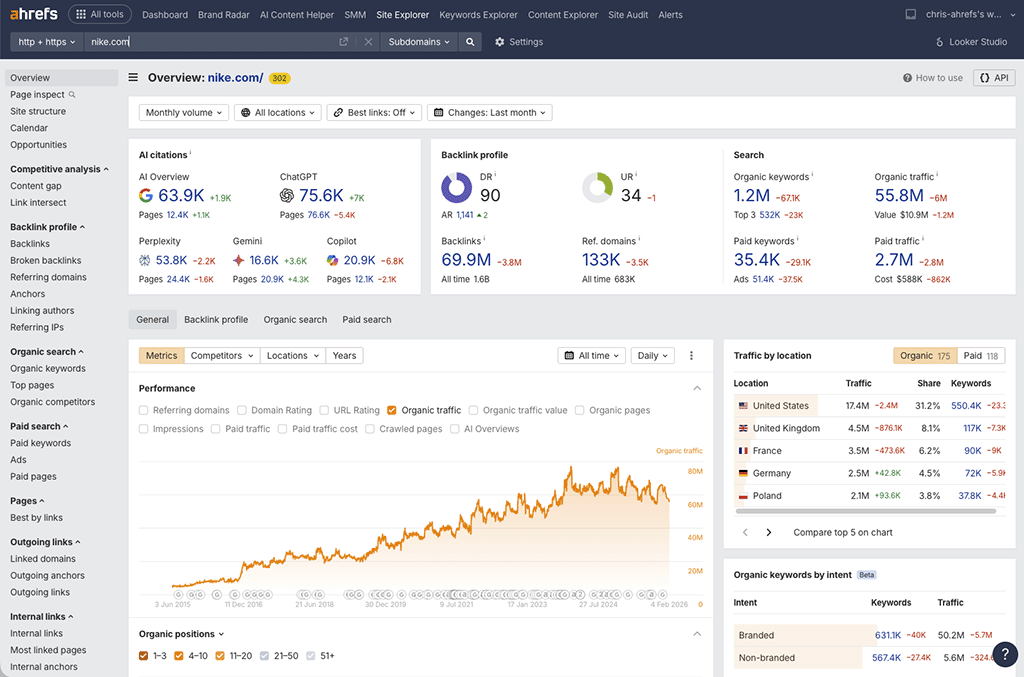
At its core, Ahrefs is designed to help users improve their websites and stores’ visibility in search engines by providing detailed data and tools for:
- understanding what people are searching for
- creating content that has the potential to rank
- identifying link-building opportunities
- improving the technical SEO health of websites
In this review, I’ll take a detailed look at what Ahrefs does well, where it falls short, and who it’s best suited to.
Let’s start with the pros of using Ahrefs.
The key pros of using Ahrefs
1. It lets you track the SEO performance of an unlimited number of websites
One of Ahrefs’ most attractive features is its domain verification system.
If you verify ownership or control of a domain (via Google Search Console, DNS records, or an HTML file), that domain does not count toward your project limit. This means you can technically track the SEO performance of an unlimited number of websites without paying for additional projects.
For agencies managing multiple sites, or ecommerce merchants running multiple stores, this represents one of the best-value aspects of Ahrefs’ pricing model, and helps offset its relatively high subscription costs.
2. It gives you access to excellent keyword research tools
Ahrefs’ Keyword Explorer is one of the strongest keyword research tools on the market.
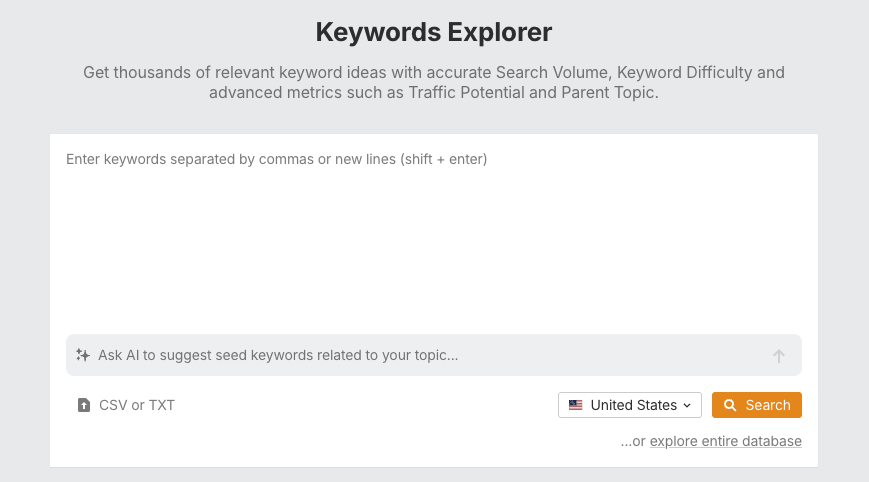
It provides a comprehensive set of metrics that allow you to assess whether a keyword is worth targeting. These include:
- monthly search volumes
- keyword difficulty scores
- SERP overviews showing who already ranks for your target keywords
- click-through data (how many searches actually result in clicks)
- cost-per-click estimates
- historical trend data
- per-country keyword statistics
A particularly strong feature of Ahrefs is its ability to show click data alongside search volume. In an environment where many Google searches now result in zero clicks, this helps you avoid targeting keywords that look attractive on paper but deliver little real traffic.
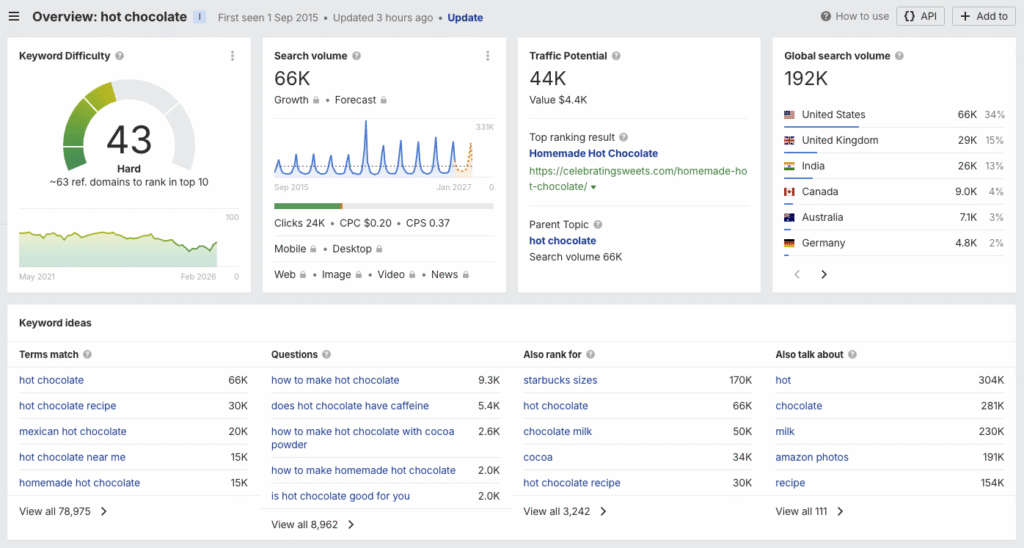
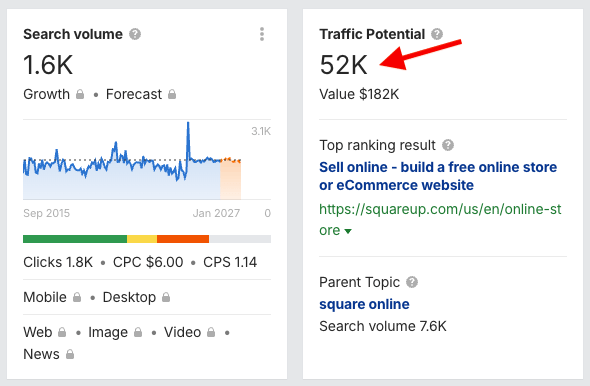
One of my favorite Ahrefs metrics is its Traffic Potential data. This is an estimate of how much total organic traffic a page could receive if it ranked number one for a topic (taking related keyword variations into account). Having access to this data makes it much easier to prioritize keywords that can drive meaningful traffic.
In my screenshot below, you can see the Traffic Potential metric in action. While the “online store builder” phrase only attracts 1,600 searches per month, the “true” search volume, when all variations of the keyword are accounted for, could be as high as 52,000 queries.
Ahrefs’ keyword suggestion data is extensive too. The platform provides multiple ways to generate keyword ideas, based on:
- matching terms (keywords that include your seed phrase)
- related terms (conceptually related keywords)
- search suggestions (Google autocomplete data)
- global terms (keywords drawn from all languages and locations)
Keyword suggestions can be filtered using a wide range of criteria, including keyword difficulty, search volume, traffic potential, search intent, and the authority of domains currently ranking for them.
The ability to filter keywords by search intent — informational, commercial, transactional, branded, and local — is particularly useful, allowing you to focus on keywords that align closely with your business goals.
This is particularly important for ecommerce merchants, because the ‘commercial’ and ‘transactional’ search intent filters really let you zone in on the keywords that are most likely to generate sales on your online store.
3. It gives you access to industry-leading backlink analysis tools
Backlink analysis is one of Ahrefs’ core strengths and a key reason many SEO professionals choose the platform.
Using the platform’s Site Explorer tool, you can analyse any domain or URL to see:
- which websites link to it
- the anchor text used in those links
- how many referring domains it has
- how its backlink profile has changed over time
- the relative strength of links (using its Domain Ratings and URL Ratings)
Ahrefs is particularly strong when it comes to broken link analysis. It makes it very easy to identify broken inbound backlinks pointing to competitors’ sites, and using the tool to spot broken outbound links on your own site is straightforward too. This is invaluable for broken link building strategies, and for maintaining good technical SEO.
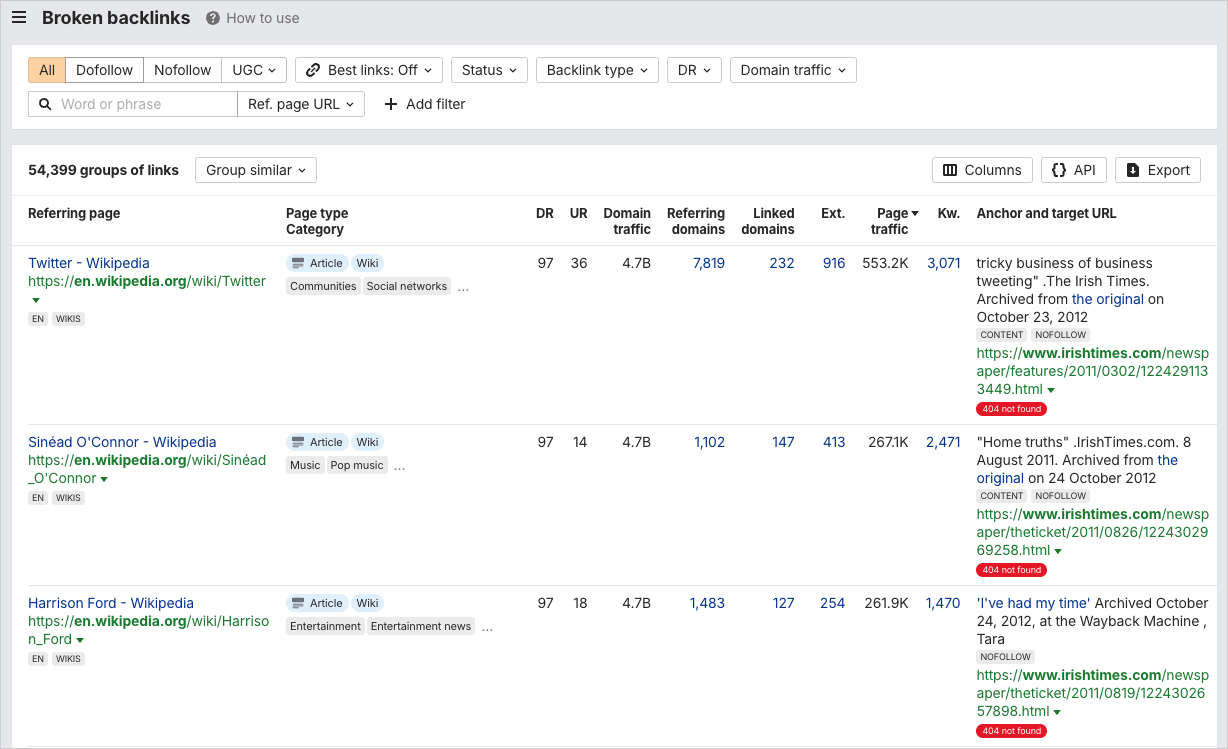
(Broken link building involves finding a broken link — one that no longer leads to a live web page — recreating the content that the link previously pointed to, then asking site owners who used to link to the dead content to link to your new page instead.)
Compared to competing tools, even its key rival Semrush, the process of finding broken links in Ahrefs is commendably straightforward and well implemented.

4. It gives you access to sophisticated brand tracking tools
Research published by Moz and other SEO analysts suggests that well-known brands are increasingly being rewarded with stronger visibility in search results. This has caused frustration among independent publishers, but the underlying implication is clear: Google appears to be using brand recognition as a proxy for trust, giving preferential treatment to content from established brands over lesser-known ones in many search contexts.
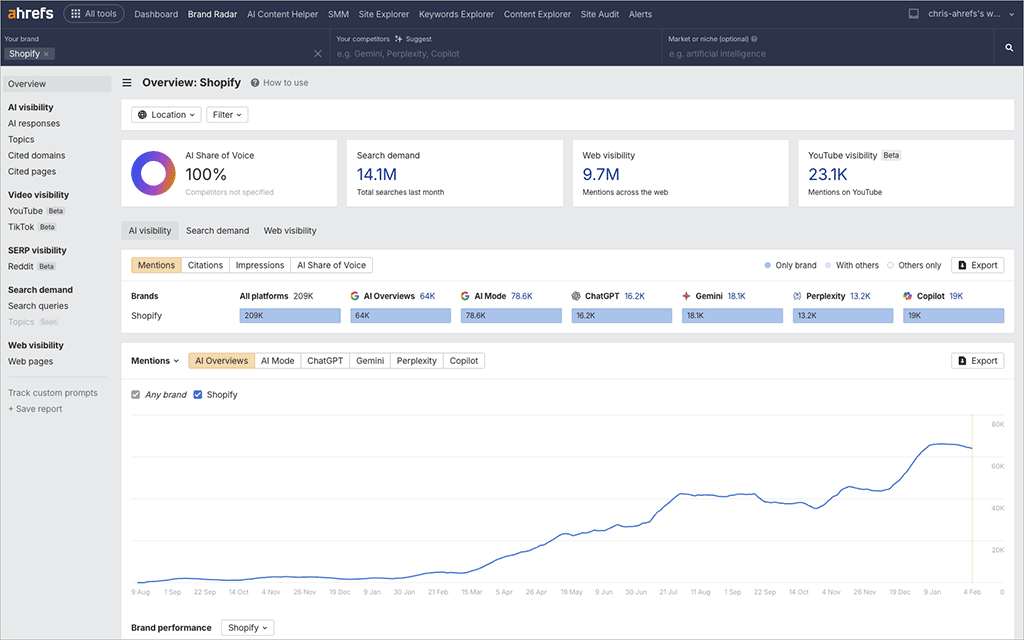
As a result, SEO platforms are placing greater emphasis on brand visibility analysis tools — and Ahrefs has followed suit with its recently introduced Brand Radar tool. This allows you to enter a brand name and track where it is being mentioned across a range of sources, including AI platforms, websites, forums, and social media channels. It also lets you track prompts used in LLMs relating to topics of your choosing (although this feature is in beta for now).
Despite the understandable focus on AI tools in Ahrefs’ Brand Radar tool, for me one of the most useful aspects of the feature is its surfacing of YouTube visibility data. As search engines increasingly blend into conversational and AI-driven interfaces, YouTube is playing a growing role in content discovery. YouTube still functions in many ways like a search engine; operates as a powerful recommendation system in its own right; and is being surfaced more prominently by Google within both AI Overviews and traditional search results.
All this makes getting a clear sense of YouTube visibility increasingly important — and it’s great that Ahrefs lets you do that.
5. It helps you create content
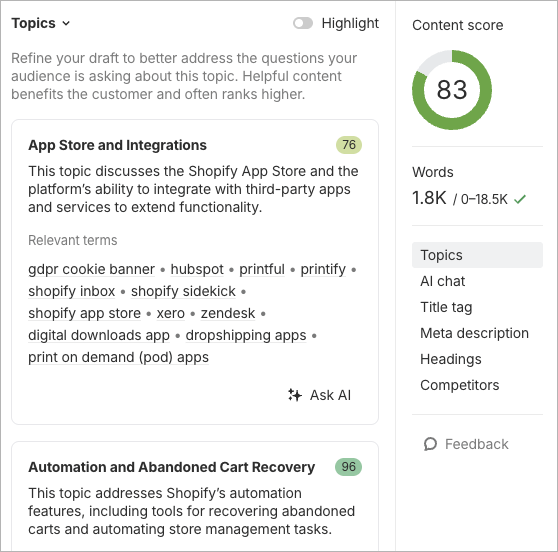
Ahrefs is no longer simply a tool that provides you with data — its new AI-powered ‘Content Grader‘ and ‘Content Helper‘ add-ons actively help you create SEO-friendly content.
The Content Grader is designed to evaluate existing content from an SEO perspective. You enter a URL and a target keyword into the tool, and Ahrefs assesses how comprehensive the content is, compares it against competing pages, and suggests specific improvements.
In practice, the most useful aspect of this tool is the quality of its recommendations — during my tests of the feature, it showed me meaningful content gaps and areas where competing websites were covering topics more thoroughly.
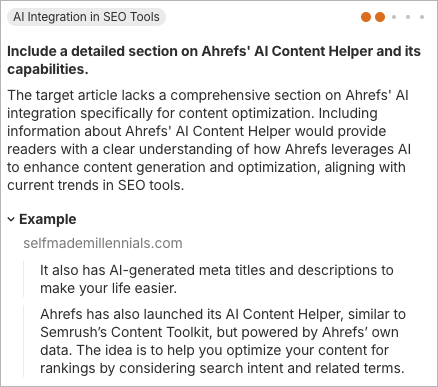
The Content Helper takes a more proactive approach to proceedings. Rather than auditing existing pages, it guides you while you write, surfacing topics and keywords you should cover in real time. It also gives you access to a chatbot that can help with structure, ideas, and drafts.
6. It gives you robust site auditing features
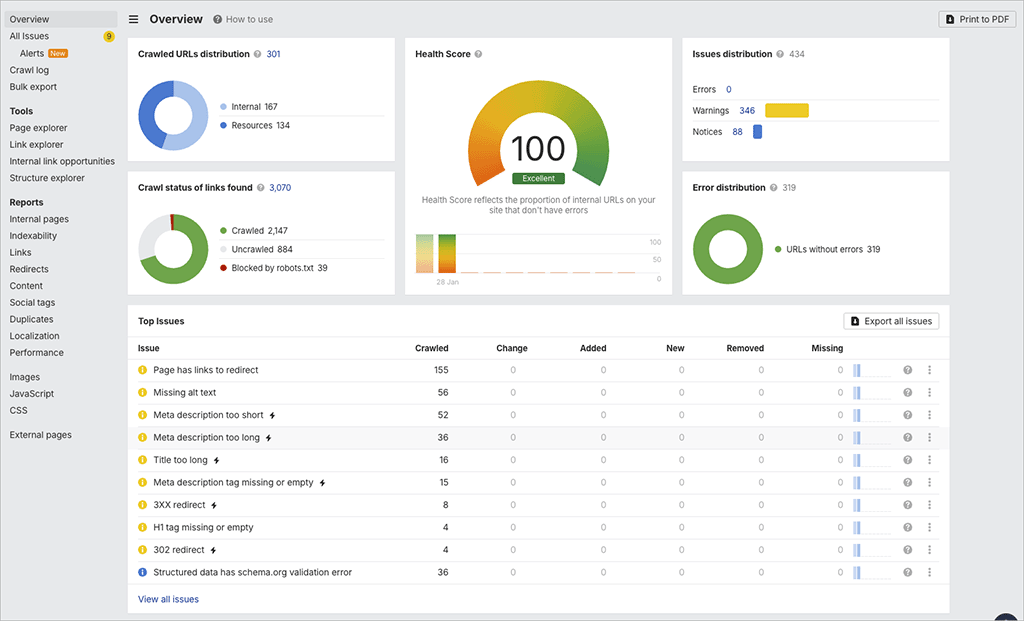
Ahrefs includes a comprehensive Site Audit tool that crawls websites and flags technical SEO issues that could be affecting search performance.
These include broken links, duplicate content, missing alt text, crawl errors, missing headers, security issues and more. The reports provided by the tool are clear, actionable, and suitable for use across a wide range of platforms and content management systems.
It also provides useful features for evaluating Core Web Vitals (a set of targets regarding website speed and stability that Google encourages site owners to meet). The platform provides both real-world field data (from Chrome users) and lab data, giving users a more complete picture of site performance than tools that rely solely on lab metrics.
7. It’s relatively easy to use
Despite the depth and volume of data it provides, Ahrefs is relatively easy to use. Its interface follows a familiar structure, with a clear navigation bar at the top of the screen, and logically grouped sub-menus on the left. This setup makes it easy to locate key features.
Ahrefs’ reports are generally well laid out, with important metrics surfaced prominently and the option to drill down into more detailed data when needed. Clear labeling, consistent terminology, and increasingly strong use of visual elements — charts, trend graphs, icons and score gauges — help make complex SEO data more digestible, even for users who are new to the whole area.
So, while there is still a learning curve, it is less steep than might be expected given the power and intricacies of the platform. Most users can start pulling useful insights quickly, and the interface does a good job of balancing depth with accessibility.
So, those are my key reasons for using Ahrefs. If you’d like to try it out yourself, you can do so here. But what about its drawbacks?
Let’s take a look at those now.
Key cons of using Ahrefs
1. Its entry-level plan is quite restrictive
Given its $129 per month price tag, Ahrefs’ entry-level plan is quite restrictive. While it provides access to basic keyword research and backlink data, several features that many users would consider core to modern SEO workflows are either limited or unavailable.
Exclusions include search intent data, broken link building tools, keyword clustering, SERP updates, and AI-powered features; historical data is restricted to just six months too. These limitations make it difficult to run a complete SEO campaign without upgrading.
Competing solutions tend to restrict usage limits rather than core functionality at similar price points, making Ahrefs’ entry-level offering feel comparatively poor value.
Ahrefs pricing plan
Monthly fee (USD)*
Lite
$129
Standard
$249
Advanced
$449
Enterprise
$1,499
2. The add-ons are very expensive
Ahrefs’ modular, add-on–based pricing model can significantly increase the total cost of ownership for many users. Several important features require separate monthly payments on top of an Ahrefs subscription.
For example, access to Ahrefs’ Content Helper and Content Grader tools requires purchase of a $99 per month Content Kit add-on. Custom report creation — a basic requirement for agencies and consultants — costs an additional $99 per month via the Report Builder add-on.
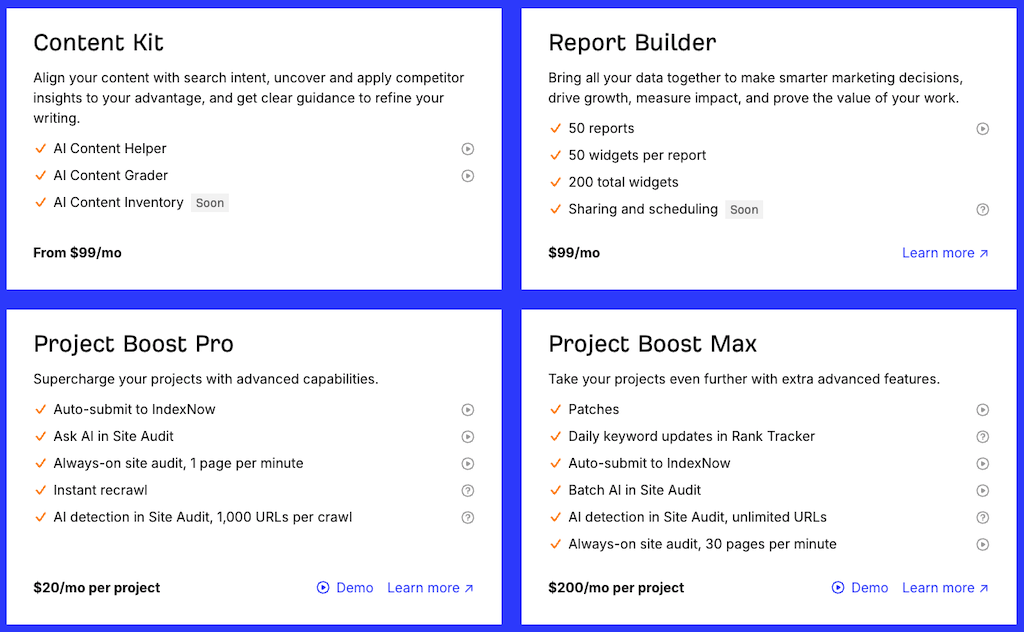
Rank tracking is very costly if daily updates are required, because you can only access these with a $200 per-project per-month Boost Max add-on.
All these costs can escalate quickly, particularly for agencies or businesses managing multiple websites. A user running several projects and relying on daily rank tracking, content optimization, and client reporting could easily double — or even triple — their monthly spend compared to the headline plan price.
Competing SEO platforms often bundle features like daily rank tracking, AI-driven content insights, and report building into their standard plans. Ahrefs’ add-on approach makes overall pricing harder to predict, and can leave users paying premium rates for functionality that feels fundamental rather than optional.
3. It doesn’t give you outreach tools
Ahrefs excels at surfacing backlink opportunities but offers little support for managing link building outreach.
There are no built-in CRM tools, no email integration, and no way to track outreach progress within the platform. Users typically need to rely on spreadsheets or third-party tools to manage link-building campaigns.
This approach works, but it adds friction — particularly for agencies or teams managing outreach at scale.
4. There’s no free trial
Unusually for a SaaS product with an ongoing financial commitment, Ahrefs offers no free trial.
While a limited free product (Webmaster Tools) is available, this only provides partial access to Site Explorer and Site Audit features and does not allow users to properly test keyword research, backlink analysis, or rank tracking.
Given the platform’s high monthly cost, this lack of a trial makes committing to Ahrefs a bit riskier than it needs to be.
5. There’s no phone support
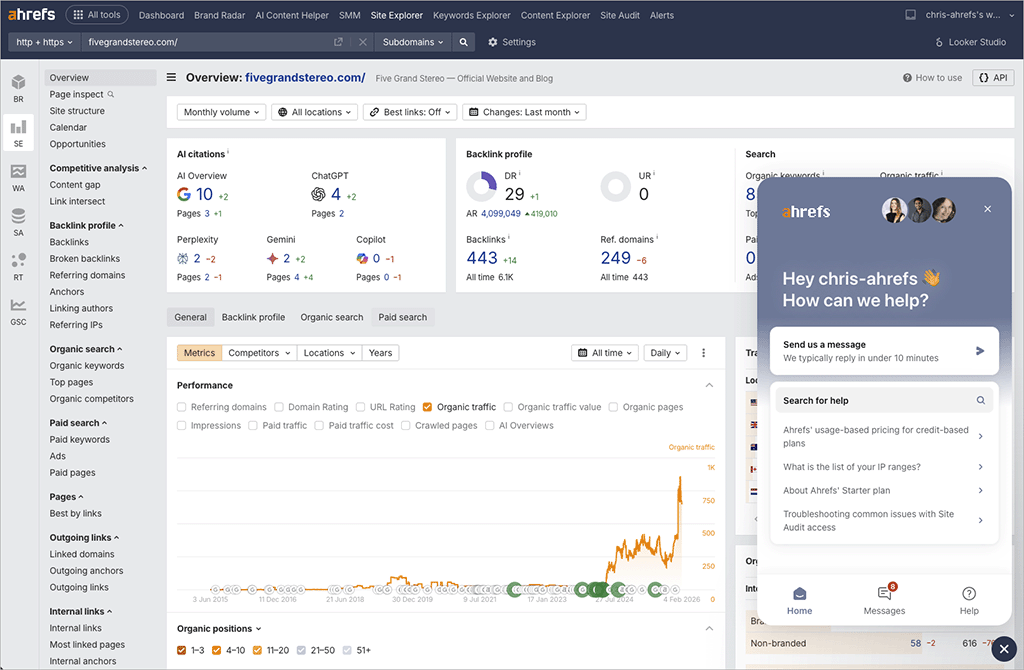
Ahrefs provides customer support via live chat and email, but it does not offer phone support on any of its plans. For a platform as complex and expensive as Ahrefs, this may be a drawback for some users — particularly those new to SEO or teams dealing with time-sensitive technical issues.
User reviews of Ahrefs
So far in this review, you’ve heard my take on Ahrefs. But what does its user base make of it? To find out, I collated some user rating data from popular review sites. You can view this in the table below.
Review site
User rating (out of 5)
Capterra
4.7 (578 reviews)
G2
4.5 (667 reviews)
TrustRadius
4.5 (389 reviews)
Average rating
4.6
Overall, Ahrefs came out with an average user rating of 4.6 — indicating a high level of user satisfaction with the platform.
Overall verdict
Ahrefs is a powerful, data-rich SEO platform that excels at what it was originally designed to do: provide deep insight into search performance, backlinks, keywords, and technical SEO. And, with the addition of its new AI-powered tools, it’s an increasingly good solution for monitoring brand visibility and creating SEO-friendly content.
Its keyword research tools are among the best available, its backlink analysis features are particularly strong, and the way it lets you work with an unlimited number of domains makes it an excellent choice for agencies and multi-site operators. On mid-tier plans and above, its generous reporting limits allow for extensive research.
However, Ahrefs is not without its drawbacks. The lack of a free trial, its restrictive entry-level plan, and its expensive add-ons make it a difficult sell for beginners and smaller businesses. Smaller operators who need daily rank tracking, AI content tools, or outreach management may find it difficult to justify the financial outlay associated with all these features.
Overall, Ahrefs is an absolutely excellent SEO platform, and an increasingly good AI visibility tracking tool — the downside is that this excellence is expensive.

Ahrefs pros and cons summary
Pros and cons of Ahrefs
☑️ Lets you track an unlimited number of verified domains
❌ Entry-level plan is very restrictive
☑️ Provides excellent keyword research tools
❌ Add-ons are extremely expensive (Brand Radar, Content Kit etc.)
☑️ Offers industry-leading backlink analysis features
❌ There’s no built-in outreach tools
☑️ Provides good brand visibility monitoring tools via its Brand Radar feature
❌ Daily rank tracking features not provided by default
☑️ Gives you good content assessment and creation features
❌ There’s no phone support
☑️ Its site auditing features are excellent
❌ There’s no free trial
Alternatives to Ahrefs
There are several alternatives to Ahrefs on the market, with the most obvious one being Semrush, which is broadly comparable in terms of pricing and feature set. Semrush is less generous when it comes to project and (some) data limits, but arguably more generous when it comes to bundled features. You can read our Semrush review here.
Other key alternatives worth considering include Moz and SE Ranking.
📖 Related resource: Ecommerce SEO guide

Chris Singleton is the Founder and Director of Ecommercetrix.
Since graduating from Trinity College Dublin in 1999, Chris has advised many businesses on how to grow their operations via a strong online presence, and now he shares his experience and expertise through his articles on the Ecommercetrix website.
Chris started his career as a data analyst for Irish marketing company Precision Marketing Information; since then he has worked on digital projects for a wide range of well-known organizations including Cancer Research UK, Hackney Council, Data Ireland, and Prescription PR. He then went on to found the popular business apps review site Style Factory, followed by Ecommercetrix.
He is also the author of a book on SEO for beginners, Super Simple SEO.