

Please note: this article contains affiliate links. If you buy through these, we may receive a commission at no extra cost to you. Using our links supports our work.
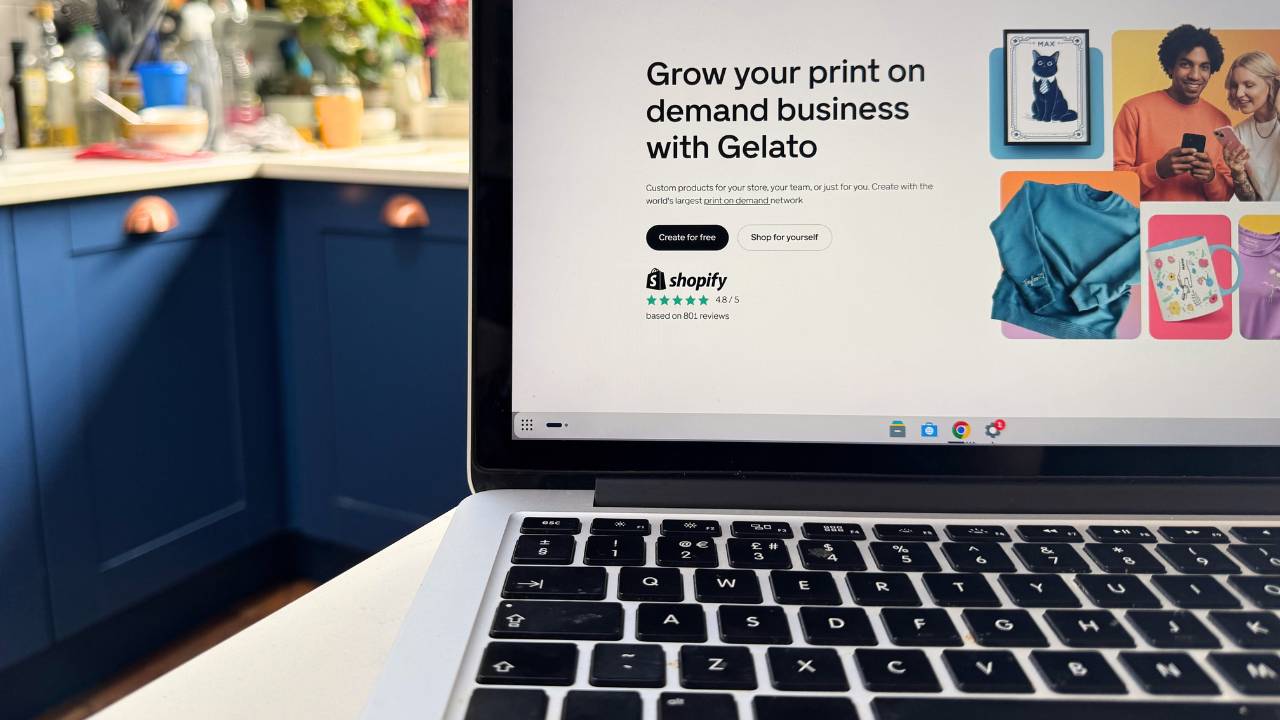
In this Gelato review, I walk you through the key pros and cons of the platform. I’ll explain where it beats rivals like Printful and Printify, and where it falls short — and help you work out whether it’s the right print-on-demand solution for your ecommerce business.
My quick verdict on Gelato
Gelato is one of the strongest print-on-demand platforms I’ve used. It’s an easy-to-use tool, its products are priced competitively, and its emphasis on sustainability is to be welcomed. Its biggest selling point is its local production network, which reduces shipping distances, speeds up delivery and makes selling to customers in different countries simpler.
It’s not the best choice if you need the biggest possible product catalog, lots of native ecommerce integrations, full control over print providers or advanced embroidery options. But for Shopify and Etsy sellers in particular — and anyone looking for a polished, scalable and sustainability-focused POD solution — Gelato is a very solid option.
Overall score: 4.4 / 5
I’ll start my full review with a quick overview of the platform.

Gelato: an overview
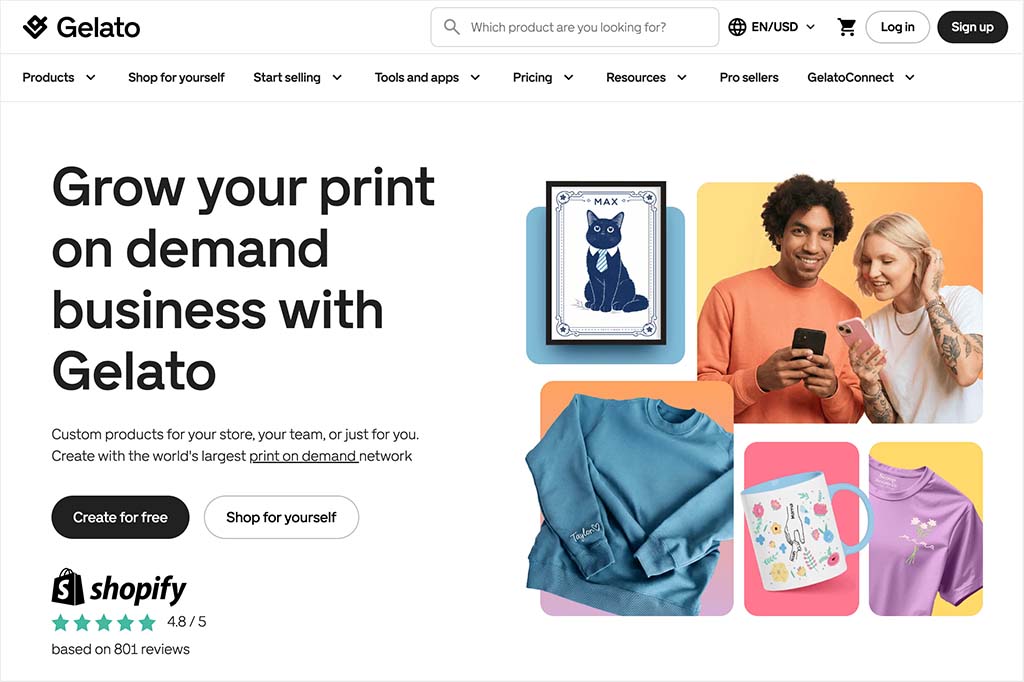
As with other POD solutions, Gelato lets you sell customized products online without needing to manufacture or ship anything yourself. You upload your designs, add them to products, and connect Gelato to your online store or marketplace. When someone places an order, Gelato handles all the printing, packing and delivery on your behalf.
But what makes Gelato a bit different from many competing print-on-demand platforms is its focus on sustainability — via local production.
Instead of printing products in just a few central locations and shipping them around the world, Gelato aims to produce orders as close to the end customer as possible. It does this by working with 140 production partners across over 30 countries. This can lead to more environmentally friendly shipping — and faster, cheaper delivery too.
In what follows, I’m going to highlight all the key pros and cons of Gelato’s approach. Let’s start with the positive stuff.
Advantages of using Gelato
1. It’s very easy to use
Of all the print-on-demand platforms we’ve tested, Gelato is one of the easiest to use. Its interface is clean, the product designer is intuitive, and the platform lets you work with all the key file formats most sellers are likely to use when uploading designs — including JPG, PNG, SVG, HEIC and PDF.

Now, one thing that makes Gelato especially easy to use is that you don’t have to choose your own print suppliers.
With some rival platforms (Printify being the key example), you often have to compare different providers, prices, shipping rates and production locations before publishing a product.
Gelato handles all of this for you, and this is a big time-saver.
2. It’s great for selling personalized products
Gelato’s built-in Personalization Studio, available to Shopify and Etsy users, lets you sell products that customers can customize themselves — for example, by adding their own text or photos.
This is a really useful feature if you want to sell things like personalized wall art, gifts, cards, mugs or apparel.
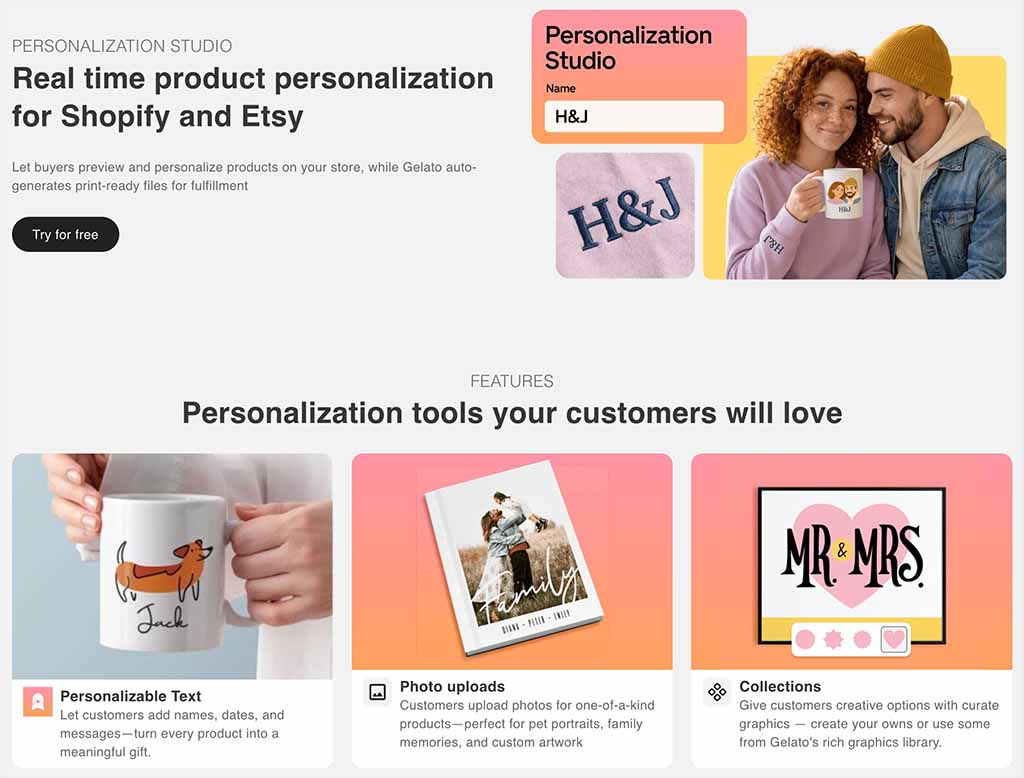
And importantly, Gelato makes setting this up fairly simple. You can choose which parts of a design can be customized, allow shoppers to edit text or upload images, and set rules to control what customers can see or change.
This gives you a good balance between flexibility and simplicity — and avoids the need to rely on complicated third-party personalization tools.
3. It places a big emphasis on sustainability
Print on demand is already a more efficient model than traditional retail in one important respect: products are only made after they’ve been ordered.
But Gelato goes further by trying to produce items as close to the customer as possible. According to Gelato, 88% of its orders are fulfilled in the same country as the customer, and 99% are fulfilled within the same region.

This can reduce shipping distances, shorten delivery times and make international selling less complicated.
For merchants who want to run a more environmentally conscious ecommerce business, this local-production model is one of Gelato’s most compelling features.
4. The print quality is good
For this review, we placed several sample orders with Gelato, including t-shirts, a framed print, and a phone case. Delivery was prompt and product quality was good overall — we were particularly happy with the framed print, which looked really vibrant and professionally finished.

The only issue we encountered was with the phone case: although the print quality on the product was good, it contained white stripes at the top and bottom that weren’t shown in our design preview. I contacted Gelato about this — they responded quickly and sent out a replacement.
5. Its products are competitively priced
Another thing I really like about Gelato is that its local fulfillment approach doesn’t seem to come with a big pricing premium.
In our pricing tests, Gelato came very close to key competitors Printful and Printify on cost — and where some products were concerned, it was actually the cheapest option.
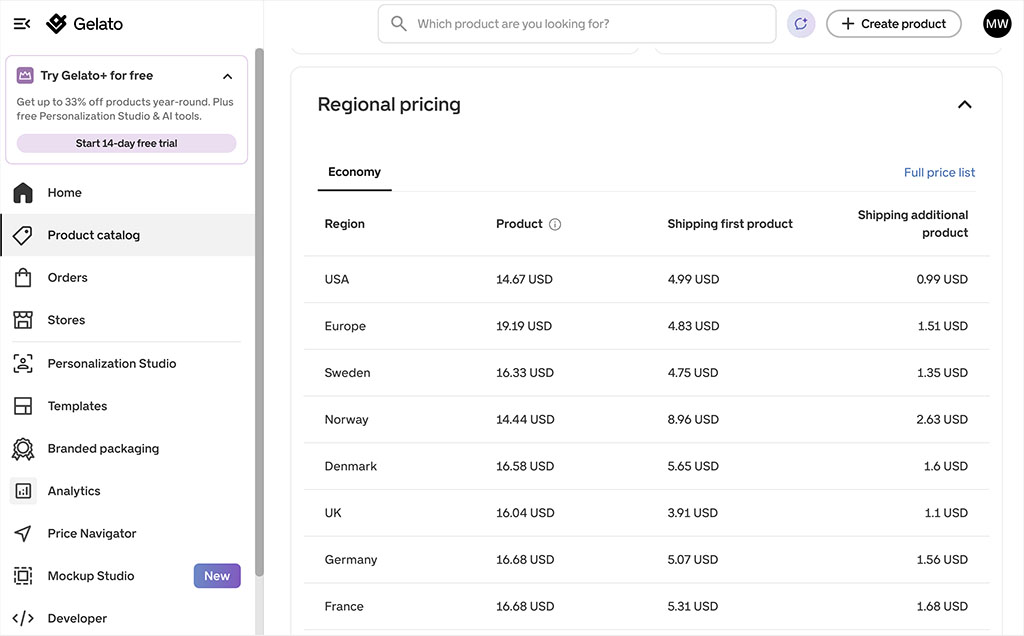
For example, in our comparisons of popular products like t-shirts, hoodies, sweatshirts, beanies and posters, Gelato was the lowest-cost option in three of the nine tests, and came a close second in several others.
So if you’re worried that choosing a more localized or sustainability-focused print-on-demand platform will mean paying noticeably more, don’t be. Gelato gives you a strong mix of competitive pricing, local fulfillment and delivery efficiency.
6. It makes understanding costs and margins easy
Gelato’s product catalog gives you detailed pricing and shipping data, and users who subscribe to a paid plan get access to a really useful Price Navigator tool. The latter lets you explore product costs, shipping fees and estimated margins across different countries and currencies.
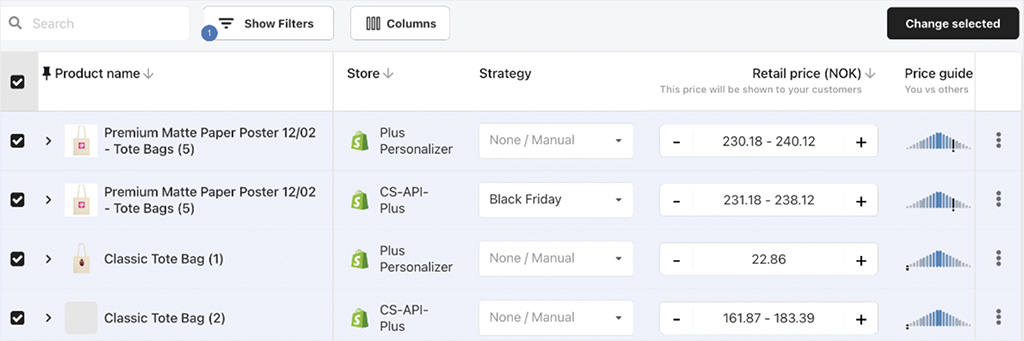
This is particularly useful if you’re selling internationally, because profit margins can vary quite a lot from one market to another.
7. It can be used entirely for free
Gelato gives you a free plan — this means that you can use the platform to create products, connect to major ecommerce platforms and sell without paying a monthly subscription fee.
That said, there are paid plans available too. The main paid plan, Gelato+, costs $29 per month — or $19.99 per month when paid for annually — and adds features like product discounts, Personalization Studio, branded labels and packaging inserts, premium mockups and extra design tools.
You can try these features out via a 14-day free trial of Gelato+.
So, those are the main positives. But there are a few downsides to be aware of too.
Disadvantages of using Gelato
1. Its product catalog is on the smaller side
Gelato’s product range covers around 400 items. This will be enough for many merchants, especially those focused on mainstream categories like t-shirts, hoodies, posters, mugs and wall art.
But Printful offers more than 500 products, and Printify offers over 1,300. So if you want access to the widest possible range of print-on-demand items — including more niche products like blankets, stickers, magnets, mousepads, umbrellas or pins — you may find more flexibility elsewhere.
2. It offers fewer built-in ecommerce integrations than some competitors
Gelato lets you sell POD items via the most important ecommerce platforms — Shopify, Etsy, WooCommerce, Wix, Squarespace, BigCommerce, TikTok Shop and Amazon. That’s probably enough for a lot of merchants.
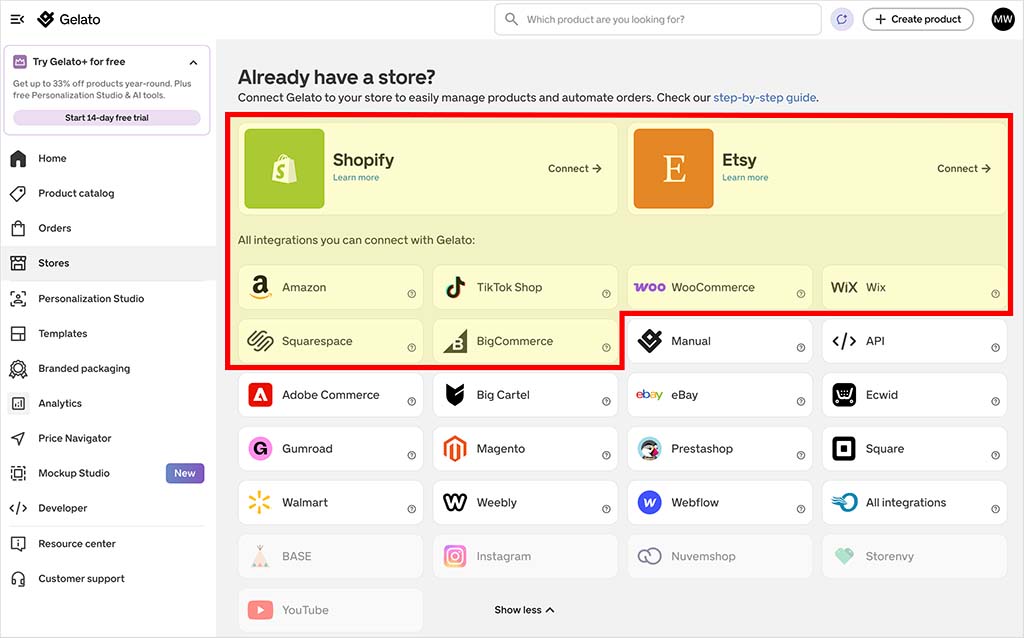
But other platforms — like Printful and Printify — offer a more extensive set of native integrations. And although Gelato can connect to more platforms through the third-party tool Order Desk, that adds extra cost.
3. It doesn’t let you build a standalone store
Unlike some competing solutions, you can’t build a standalone online store with Gelato — you’ll always need to connect it to an ecommerce platform or marketplace. By contrast, Printful and Printify both offer simple hosted storefront creators that let beginners sell POD products without setting up a full ecommerce website.
Now, to be fair, the kind of storefronts that Printify and Printful let you build are very basic, but they can be useful for validating product ideas. It would be good to see Gelato add something similar.
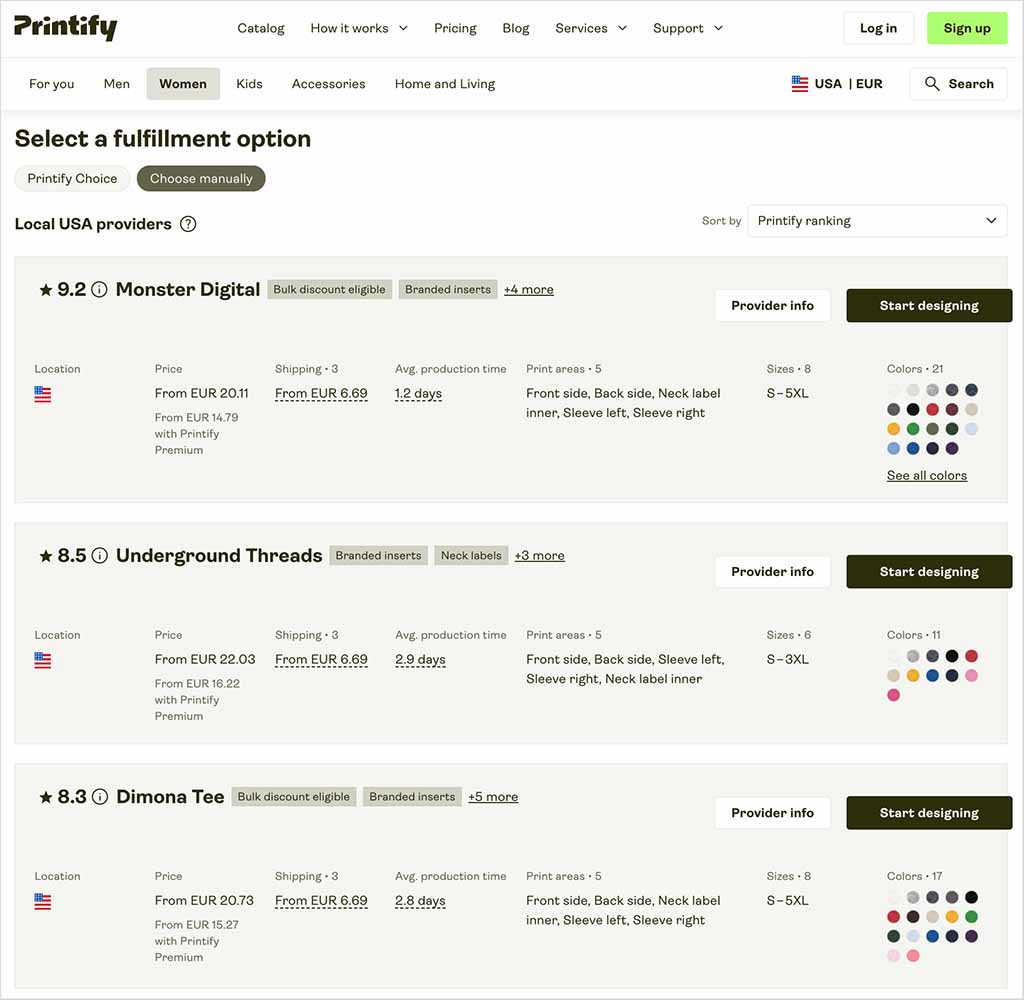
4. You don’t get control over which print providers are used
Another possible downside is that Gelato gives you less control over fulfillment partners than a platform like Printify.
Gelato automatically routes orders to production partners, which keeps things simple. And for me, not having to choose suppliers is, in general, a positive thing — as I discussed above, it’s a big time saver. But experienced sellers who want to choose a specific supplier for every product may find this approach restrictive.
5. It’s not great for placing sample orders
Gelato offers a generous first-order discount (30%, if you order within 48 hours of creating your account). And this can be useful if you want to get your hands on a lot of sample products at once.
(That said, when I tried to access this offer, it didn’t seem to cater to the combination of products I wanted to order — t-shirts, flasks, and wall art.)
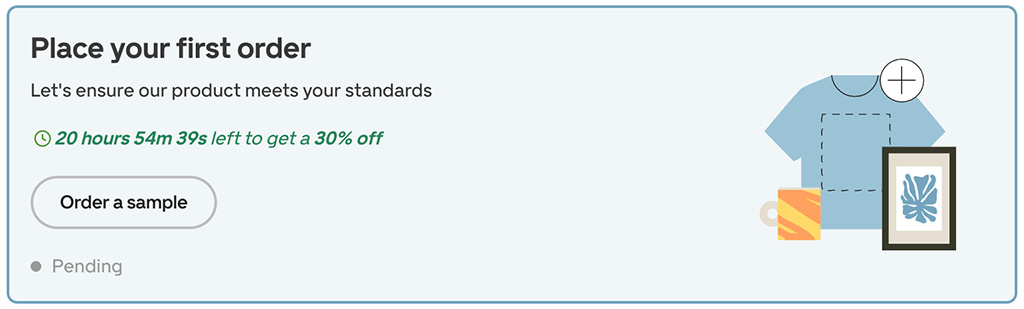
But unlike competing POD tools, Gelato doesn’t provide merchants with a way to order samples on an ongoing basis (Printful, for example, lets you place one sample order containing up to three items each month).
So if you regularly launch new designs, test new product categories or want to check print quality on an ongoing basis, you may find this frustrating.
6. Its embroidery features are a bit basic
Gelato’s embroidery features are solid, and they’ll work well for simple logos, text-based designs and minimalist artwork. But they limit you to a maximum of six thread colors, chosen from a predefined palette.
So, if embroidery is going to be a major part of your product range — and especially if you want to sell detailed, colorful or gradient-based designs — some rival print-on-demand services will give you more creative flexibility.
User reviews
So far, you’ve heard my take on Gelato. But what does its user base make of it? To find this out, I collated review data from some popular software review sites. You can view this in the table below.
| Review platform | Rating | Number of reviews |
| Trustpilot | 4.4/5 | 3,136 |
| G2 | 4.5/5 | 11 |
| Shopify App Store | 4.8/5 | 827 |
| Wix App Market | 2.3/5 | 15 |
| WooCommerce Marketplace | 3.3/5 | 12 |
As you can see, Shopify users were happiest with the platfor; Wix and WooCommerce ones less so (although it has to be said that reaction from these users was based on a much smaller selection of review).
So, what’s the verdict?
Overall, Gelato is one of the most polished print-on-demand platforms we’ve tested. It’s easy to use, great for creating personalized products, excellent for international fulfillment and unusually transparent when it comes to pricing, margins and sustainability.
All that said, Gelato won’t be the right choice for everyone. If you want access to the biggest possible product catalog, the widest range of integrations, total control over print providers or advanced embroidery options, platforms like Printful or Printify may suit you better.
But for Shopify and Etsy sellers in particular — and for anyone who wants a simple, scalable print-on-demand platform boasting fantastic local fulfillment — Gelato is an excellent option.
I’ll finish off with a quick summary of the key pros and cons of Gelato.
Gelato: Pros and cons summary
☑️ Competitive product pricing
❌ Relatively small product catalog
☑️ It’s easy to use
❌ Provides fewer ecommerce integrations than rivals
☑️ It’s great for product personalization
❌ Doesn’t give you access to a built-in store builder
☑️ Commendable approach to sustainability
❌ Doesn’t give you control over fulfillment partners
☑️ Excellent local fulfillment options
❌ Sample order process isn’t ideal.
☑️ Gives you good data on costs and margins
❌ Embroidery features could be better
FAQs about Gelato POD
What is Gelato?
Gelato is a print-on-demand platform that lets you create and sell customized products online without having to manufacture, store or ship anything yourself. You upload your designs, add them to products and sell your items by connecting Gelato to an ecommerce platform or marketplace. When a customer places an order, Gelato handles the printing, packing and delivery for you.
Is Gelato good for beginners?
Yes — Gelato is a strong option for beginners. Its interface is clean, its product designer is easy to use, and you don’t have to manually choose print suppliers for every product. This makes it simpler to get products live quickly than with some competing print-on-demand platforms.
What makes Gelato different from other print-on-demand platforms?
Gelato’s main point of difference is its focus on local production. Instead of printing products in just a few central locations, Gelato tries to produce orders as close to the customer as possible, using a network of production partners across more than 30 countries. This can help reduce shipping distances, speed up delivery, and make international selling easier.
What are the main disadvantages of using Gelato?
The main drawbacks of Gelato are its smaller product catalog, its relatively limited range of built-in ecommerce integrations, and the fact that you don’t get full control over which print providers are used. It also doesn’t include a standalone store builder, and its embroidery features are a bit basic compared with those of some rival platforms.
Who is Gelato best for?
Gelato is best for Shopify and Etsy sellers who want an easy-to-use, scalable print-on-demand platform with strong personalization features, competitive pricingm, and good international fulfillment options. It’s less suitable for merchants who need the widest possible product range, lots of ecommerce integrations, or control over which fulfillment partners to use.
Related resources
You may also find our Printify vs Shopify comparison of interest.

Chris Singleton is the Founder and Director of Ecommercetrix.
Since graduating from Trinity College Dublin in 1999, Chris has advised many businesses on how to grow their operations via a strong online presence, and now he shares his experience and expertise through his articles on the Ecommercetrix website.
Chris started his career as a data analyst for Irish marketing company Precision Marketing Information; since then he has worked on digital projects for a wide range of well-known organizations including Cancer Research UK, Hackney Council, Data Ireland, and Prescription PR. He then went on to found the popular business apps review site Style Factory, followed by Ecommercetrix.
He is also the author of a book on SEO for beginners, Super Simple SEO.
Thanks to Matt Walsh for all his research for this article.